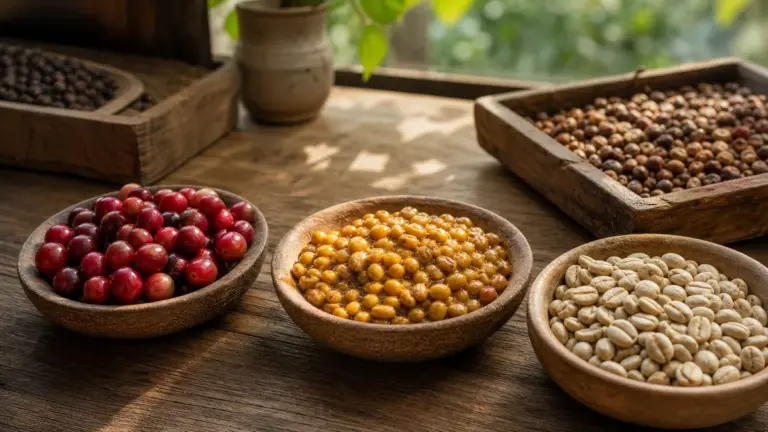
The washed coffee process removes the cherry’s skin, pulp and sticky mucilage before the coffee is dried inside its parchment covering. Traditionally, producers use pulping, fermentation and washing to achieve this, often producing coffees with clearly defined flavours and noticeable acidity.
In short
- Pulping removes the skin and most flesh, but leaves sticky mucilage around the parchment-covered seed.
- “Dry fermentation” means fermentation without added water, not drying the coffee.
- Around 12 to 48 hours is a useful fermentation guide, not a fixed recipe: temperature and the condition of the coffee matter.
- Washed parchment is commonly dried to approximately 10% to 12% moisture before storage and subsequent hulling.
- Water demand depends on the equipment and handling system; wastewater still needs treatment even when water use is reduced.
Traditional Washing Methods
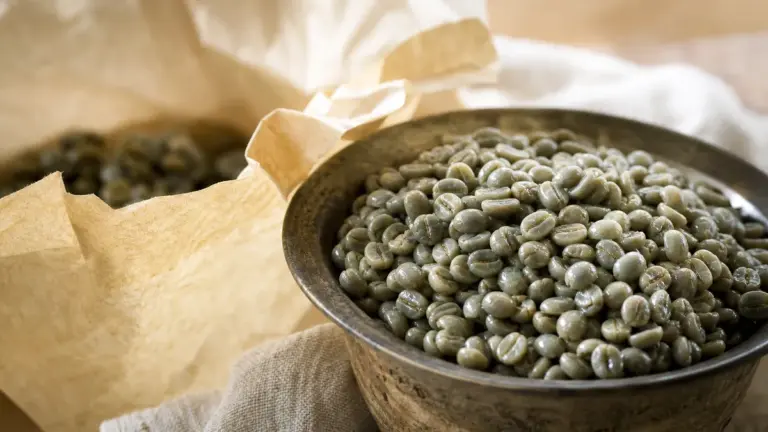
Washed processing separates the removal of fruit from the drying of the seed. The coffee bean is that seed; parchment is the thin, protective covering that remains around it during drying.
The distinguishing feature is what reaches the drying surface: parchment coffee with its mucilage removed. By contrast, the natural process dries the whole cherry, while the honey process retains mucilage during drying.
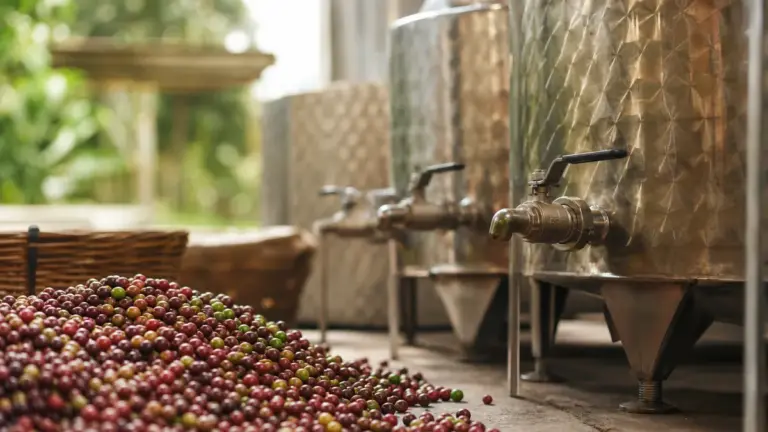
Traditional washing stations use pulpers, fermentation tanks, washing channels and drying areas. Smaller operations may wash coffee in tanks rather than channels. The equipment differs, but the underlying sequence remains recognisable.
The washed process, step by step
- Receive and sort the cherries. Remove leaves, twigs and visibly unsuitable fruit, and keep identifiable batches separate.
- Float and classify where appropriate. Water-based separation helps remove floating material and separate cherries by density, alongside visual sorting.
- Pulp the fruit. A pulper separates the skin and flesh from the parchment-covered seeds.
- Loosen the mucilage. Traditionally, fermentation makes the sticky coating easier to remove. Mechanical removal is another route.
- Wash and grade. Clean water and agitation remove loosened mucilage; channels can also separate parchment by density.
- Dry the parchment. Remove surface water promptly, then continue controlled drying to the required moisture level.
- Condition and store. Hold the dried coffee in suitable conditions before hulling removes the parchment.
This is a process map, not a universal operating recipe. A washing station must adjust its handling to the fruit, equipment and weather rather than follow a timetable regardless of conditions. The processing methods hub places this sequence alongside the other main approaches.
Pulp Removal
Pulping and washing do different jobs. Pulping removes the cherry’s skin and most of its flesh; washing removes the mucilage left around the parchment. Confusing them makes it difficult to understand why fermentation comes between the two.
A pulper squeezes cherries between moving and fixed surfaces. Correct adjustment separates the fruit without unnecessarily damaging the parchment or the seed beneath it. Screening can then remove unpulped cherries and loose pieces of flesh.
For conventional washed production, prompt handling after harvest helps prevent uncontrolled deterioration before pulping. Deliberately holding cherries for an experimental fermentation is a separate, managed intervention, not a reason to leave an ordinary batch unattended.
Poorly adjusted or dirty equipment can undermine everything that follows. Torn parchment exposes the seed, while retained fruit residues provide material for unwanted microbial activity. Washing later cannot simply reverse damage already caused.
Fermentation
Fermentation makes mucilage easier to wash away and can also change the coffee’s eventual sensory character. It is not merely a cleaning pause, although mucilage removal is its traditional practical purpose.
Mucilage contains sugars and pectic substances, the materials associated with its sticky structure. Enzymes and microorganisms contribute to its breakdown. In a controlled experimental study, researchers found that enzymes already present in the coffee contributed early in wet fermentation, with yeasts becoming important subsequently. That finding describes the tested conditions, rather than proving that every washing station has identical microbial behaviour.
Dry fermentation and underwater fermentation
Both methods start with wet, freshly pulped coffee. The difference is whether the producer adds water to cover it.
| Method | What happens | What needs attention |
|---|---|---|
| Dry fermentation | Pulped coffee rests without added water | Temperature changes and uneven conditions within the mass |
| Underwater fermentation | Clean water covers the pulped coffee | Water quality, temperature and progress towards mucilage removal |
“Dry” here does not mean the coffee has been dried, nor does it mean natural processing. It describes the fermentation environment.
Neither method is automatically superior. TechnoServe’s operational guidance identifies different risks: warm conditions can accelerate dry fermentation, while cool conditions can slow submerged fermentation considerably. Producers need to monitor the coffee itself, not just the air around the tank.
How long does fermentation take?
Approximately 12 to 48 hours is an orientation, not an instruction. The International Trade Centre gives a broad range of 10 to 48 hours and explicitly allows shorter or longer periods. Temperature, mucilage characteristics, microbial populations and water conditions help explain the variation.
The practical endpoint is whether the mucilage can be washed away effectively. A washed sample loses its slippery coating and feels rougher or gritty. Producers can combine this physical check with records of elapsed time, temperature and pH, a measure of acidity.
A particular pH reading is not a universal finishing signal. Anacafé recommends recording when coffee first reaches the functional washing point, especially if fermentation is intentionally continued beyond it. That distinction separates the time needed for cleaning from additional time chosen to influence flavour.
Washing Channels
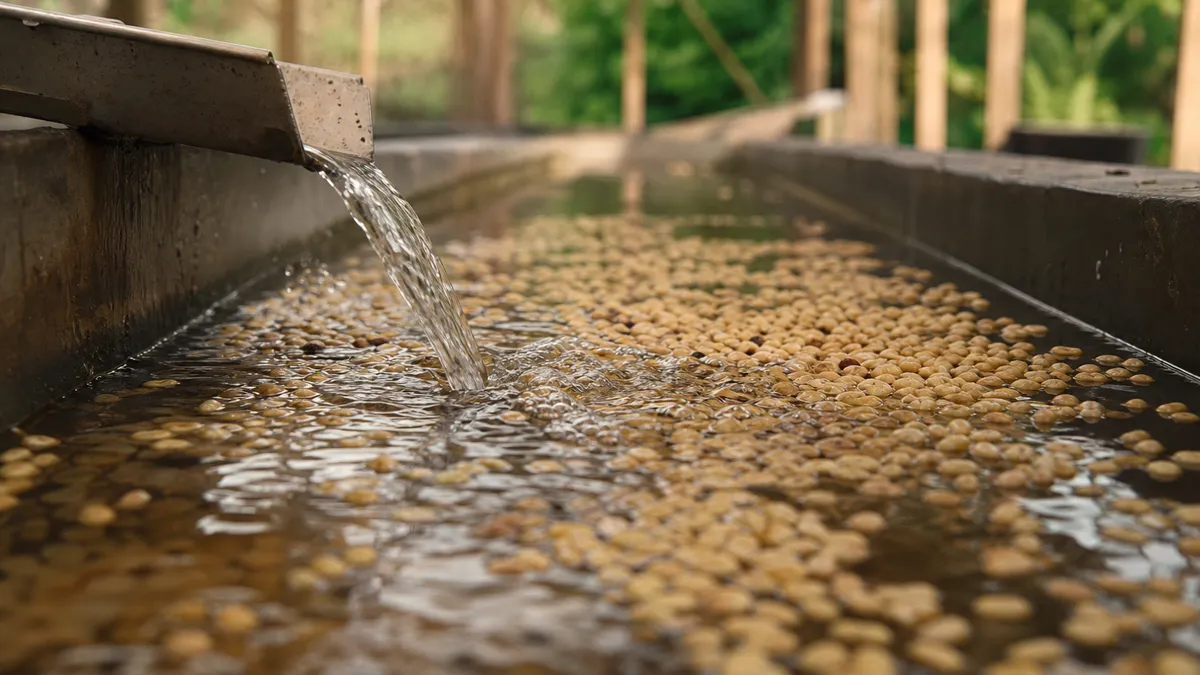
Once fermentation has sufficiently loosened the mucilage, washing removes it through clean water, movement and friction. In a traditional channel, workers move parchment coffee against the flowing water using paddles or suitable rakes.
The channel can perform another job at the same time: density separation. Denser parchment settles differently from lighter material, and barriers allow fractions to be collected separately. This supports grading, but does not replace tasting the finished coffee.
Not every washed coffee passes through a long channel. Washing can take place inside a tank or with mechanical equipment. The useful question is whether the mucilage was removed effectively without damaging or contaminating the coffee, not whether the station matches a particular photograph.
Some producers add a clean-water soak after washing. This is distinct from underwater mucilage fermentation, even though both involve submerged parchment. Ask which stage a producer means when a processing description mentions “soaking”.
Drying and Resting in Parchment
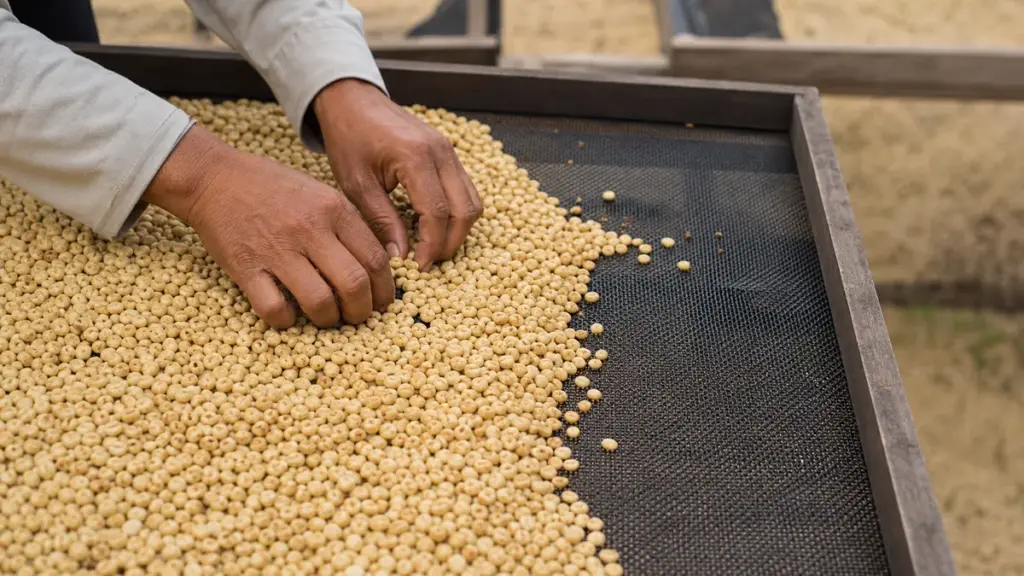
Washing leaves very wet coffee that must be dried carefully. Producers use raised mesh beds, patios, mechanical dryers or combinations of these.
Initial surface drying should begin promptly. Thereafter, turning and controlled exposure help the batch dry evenly, with protection against rain and rewetting. Drying is not simply a race: insufficient drying compromises storage, while poorly controlled heat or uneven drying can damage quality.
A common target is 10% to 12% moisture on a wet basis, meaning water as a percentage of the sample’s total mass. Cenicafé gives this range for dried parchment, while the International Trade Centre’s processing overview specifies 11% to 12%. These are overlapping recommendations, not evidence that a single reading suits every specification.
After drying, coffee can be conditioned to make moisture more even, then stored in parchment before hulling. Cenicafé recommends a resting period under specified cool, clean and dry conditions, but its recommendation should not be turned into a universal duration for every origin.
Good resting conditions matter more than a romantic idea of “ageing”. Coffee must be protected from moisture uptake and contamination throughout storage.
What Does Washed Coffee Taste Like?
Washed coffee is often described as having clarity: flavours and aromas are relatively easy to distinguish rather than merging into a heavy fermented impression. Acidity can seem particularly clear. Here, acidity means a sensory quality such as refreshing fruit-like brightness, not a measurement of how the drink affects digestion.
These are tendencies, not a guaranteed flavour recipe. The Ethiopian Coffee and Tea Authority describes clarity and prominent acidity in its washed coffees, but the process label alone cannot tell you exactly how a particular bag will taste.
Nor is washed coffee untouched by fermentation. A controlled wet-processing experiment published in 2019 found that changing fermentation duration affected chemical composition and sensory attributes, including fruitiness and acidity.
For buying, use “washed” as one piece of information. Read the tasting description and ask for processing details when they matter to you. “Clean” is useful sensory shorthand, not proof that washed coffee is inherently better than every natural or honey coffee.
Experimental Washed Techniques
Experimental washed processing changes particular stages while still removing mucilage before final parchment drying. The useful details are the actual interventions, not simply the word “experimental”.
Extended fermentation and controlled conditions
Producers may extend fermentation, manage temperature more closely or ferment cherries before pulping. Anacafé discusses these approaches while emphasising hygiene, monitoring and documentation.
A longer fermentation is not automatically an improvement. It changes the opportunity for microbial and chemical activity, but also requires control to avoid undesirable results. Ask whether the stated duration covers whole-cherry holding, post-pulping fermentation or several stages combined.
Starter cultures
A starter culture is a deliberately introduced microbial population, rather than reliance entirely on the organisms already present.
Experimental research has investigated yeasts as potential starters for wet coffee fermentation, assessing characteristics such as survival, enzyme activity and production of aroma-related compounds. This supports their potential as processing tools, not a promise that adding a yeast will reliably create a named flavour.
Mechanical and enzyme-assisted removal
Mechanical demucilagers remove mucilage through controlled friction and water. Enzyme-assisted methods offer another way to help break it down. These approaches can shorten or replace traditional mucilage fermentation.
Processing terminology varies between organisations, particularly around mechanically cleaned coffees. Ask how the mucilage was removed and what remained during drying. The complete processing guide provides the broader framework without treating every fermentation label as a separate processing family.
Water Use and Wastewater
Water can be used for receiving and transporting cherries, fermentation, washing, grading and cleaning. Consequently, “washed” does not specify a fixed water requirement.
Cenicafé’s research describes substantial variation between conventional washing arrangements and more controlled equipment. Mechanical washing and handling systems can reduce demand, but comparisons must use the same basis: litres per kilogram of cherry, dry parchment and green coffee are not interchangeable measurements.
Lower water use does not remove the need to manage wastewater. Washing water contains organic material from the fruit and mucilage. Cenicafé identifies its high organic load and the need for treatment.
For an importer or roaster, useful questions include:
- Which processing stages are included in the reported water measurement?
- What coffee product and weight form the denominator?
- How are pulp and mucilage collected?
- What happens to wastewater before discharge or reuse?
A credible environmental description explains the system and its boundaries. “Eco-washed” alone does not.
FAQ
Is fully washed different from washed?
“Fully washed” commonly describes the traditional pulping, fermentation and washing sequence, but terminology is not completely uniform. Some organisations distinguish mechanically demucilaged coffee from fully washed coffee. If precision matters, ask whether fermentation loosened the mucilage, a machine removed it, or the producer combined both approaches.
Can robusta coffee be washed?
Yes, robusta can undergo washed processing. Kenya’s Coffee Directorate describes a full-wash route for robusta involving pulping, mucilage fermentation, thorough washing and parchment drying. Washed processing is therefore not a definition of arabica, even when a particular guide focuses mainly on arabica production.
Does washed mean the coffee needs rinsing before brewing?
No, “washed” describes processing at origin before drying, hulling and roasting. It is not an instruction to rinse roasted beans or ground coffee. When choosing coffee, read it as information about how the fruit was removed, alongside the producer’s other processing and tasting details.
Where to go next
Read Coffee Processing: The Complete Guide for the wider sequence from harvested fruit to green coffee. Follow with Natural Process and Honey Process to understand what changes when whole fruit or mucilage remains during drying, the clearest contrast with the washed process.
Sources
-
International Trade Centre, The Coffee Guide, fourth edition, 2021, processing overview.
https://www.intracen.org/media/5718 -
TechnoServe, Coffee Wet Mill Processing Guide, undated, hosted in its March 2022 upload directory.
https://www.technoserve.org/wp-content/uploads/2022/03/TechnoServe-Wet-Mill-Processing-Guide.pdf -
FAO, Post-harvest Handling and Processing of Coffee in African Countries, undated online edition, “Introduction” and “Annex 5: Coffee Post Harvest Handling and Processing in Kenya”.
https://www.fao.org/4/x6939e/x6939e01.htm
https://www.fao.org/4/x6939e/X6939e11.htm -
Ethiopian Coffee and Tea Authority, Ethiopia: Taste of Origins, undated booklet, “Wet Processing”.
https://ethiocta.gov.et/wp-content/uploads/2022/09/ECTA-new-Coffee-Booklet-.pdf -
Cenicafé, Puerta Quintero and Echeverry Molina, Fermentación controlada del café: Tecnología para agregar valor a la calidad, Avances Técnicos 454, April 2015.
https://www.cenicafe.org/es/publications/avt0454.pdf -
Anacafé, Guía de buenas prácticas para la innovación en procesos poscosecha, 2023.
https://www.anacafe.org/uploads/file/56ff869769ce4f718eea55b33c8424e6/Guia-innovacio%CC%81n-procesos-poscosecha.pdf -
Elhalis, Cox and Zhao, “Yeasts are essential for mucilage degradation of coffee beans during wet fermentation”, Yeast, 2023.
https://pubmed.ncbi.nlm.nih.gov/37464909/ -
Frontiers in Microbiology, “Influence of Various Processing Parameters on the Microbial Community Dynamics, Metabolomic Profiles, and Cup Quality During Wet Coffee Processing”, 2019.
https://www.frontiersin.org/journals/microbiology/articles/10.3389/fmicb.2019.02621/full -
Elhalis and colleagues, “Microbiological and biochemical performances of six yeast species as potential starter cultures for wet fermentation of coffee beans”, LWT, 2021, published online in 2020.
https://www.sciencedirect.com/science/article/abs/pii/S0023643820314183 -
Cenicafé, ECOMILL: Tecnología de bajo impacto ambiental para el lavado del café, Avances Técnicos 432, 2013; repository record dated 2014.
https://biblioteca.cenicafe.org/handle/10778/500 -
Agriculture and Food Authority, Coffee Directorate, Kenya, coffee manual, undated retrieved edition, section 6.2, “Robusta Coffee Processing”.
https://www.afa.go.ke/download/3210/
Research combined retrieved processing manuals, national coffee research guidance and primary experimental studies, distinguishing operating recommendations from findings under specific experimental conditions.
Last checked: November 2026