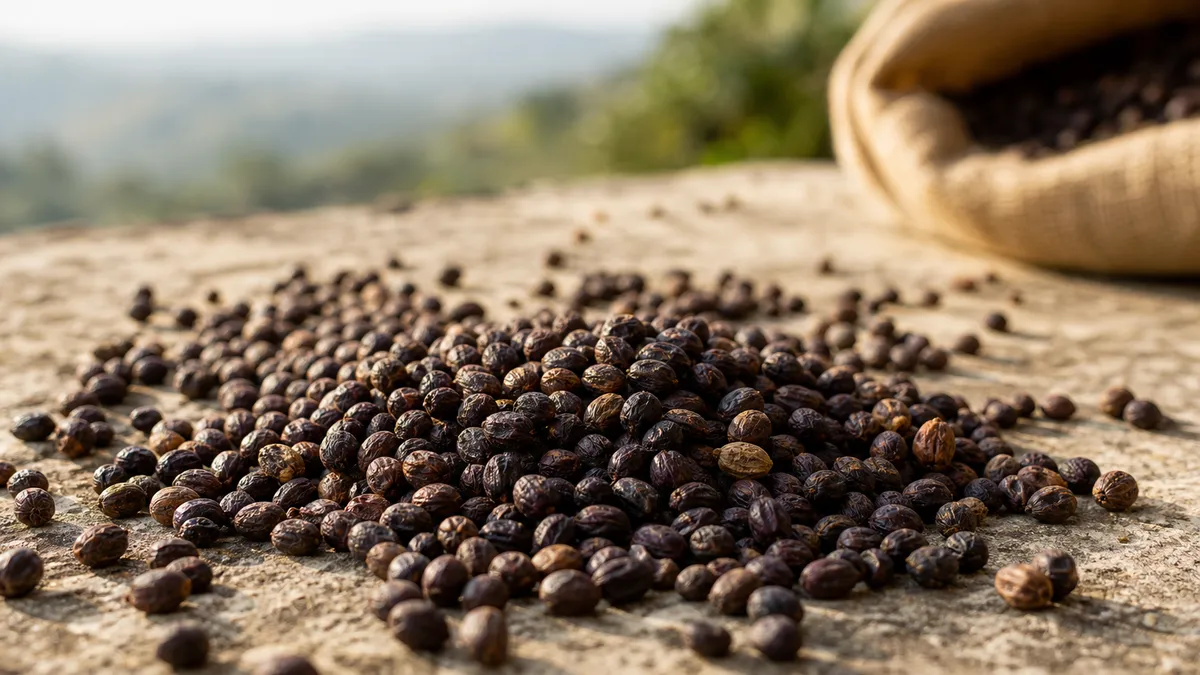
Coffee is grown in the Middle East, particularly in Yemen’s terraced highlands and the mountains of south-western Saudi Arabia. Yemen is central to the history of commercial coffee and the trade through Mocha, but arabica’s botanical origins lie in Africa, not the Arabian Peninsula.
In short
- Yemen is not the Middle East’s only coffee producer: Saudi Arabia also has established coffee-growing traditions.
- Mocha, also written Mokha or al-Makha, is a Yemeni Red Sea port whose name became associated with traded coffee.
- Natural processing means drying the whole coffee cherry before removing its dried outer layers.
- Yemenia describes a genetic group within arabica, not a separate coffee species or a name for every Yemeni coffee.
- For buying, prioritise a named growing location, processing details and a clear supply chain over romantic origin claims.
Guides in Middle East
Start here if you are new
Begin with beans and origins if you want to understand how species, growing conditions and processing fit together. Then read Yemen for the country-level detail, including its growing areas and the names you may encounter on coffee bags.
This regional page keeps the wider picture in view: the connection across the Red Sea, Yemen’s trading role, neighbouring coffee cultivation and the distinction between where coffee grows and how people prepare it.
Where coffee grows in the Middle East
For coffee growing, the relevant geography is the mountainous south-west of the Arabian Peninsula, rather than a broad sweep of desert. Yemen’s western highlands support established coffee farming, while Saudi Arabia also grows coffee in Jazan, Asir and Al-Baha.
That corrects a common oversimplification: Yemen is not the Middle East’s only coffee-producing country. UNESCO documents Saudi Khawlani cultivation, and field research has sampled coffee populations across those three Saudi growing regions.
The distinction matters when reading a label. A country can be associated with coffee through farming, roasting, trading or hospitality, but these are different things. A Saudi-grown coffee is an agricultural origin; coffee prepared in a Saudi or Gulf style is a description of preparation and service.
| Country | Coffee-growing context | What to look for |
|---|---|---|
| Yemen | Established arabica cultivation on mountain terraces and in valleys | A named district, village, producer or producer group, with processing information |
| Saudi Arabia | Established mountain cultivation, including Khawlani traditions in the south-west | Confirmation that the beans were grown in Saudi Arabia, rather than simply roasted or prepared there |
This is a guide to documented established production, not a claim that no experimental planting exists elsewhere. Likewise, a famous coffee-drinking culture should not automatically be treated as a coffee-growing origin.
Regional origin fact panel
The region does not have one altitude band, harvest calendar or cup profile. The examples below are deliberately identified rather than presented as universal limits.
| Feature | Regional guide |
|---|---|
| Species | Arabica, Coffea arabica, is the principal coffee discussed here |
| Altitude example | A documented Sa’dah producer group in Yemen supplied coffee grown at 1,400 to 2,500 metres above sea level |
| Main varieties and names | Yemeni local names include Udaini, Tufahi, Dawairi and Jaadi; genetic studies distinguish groups including Typica/Bourbon and New-Yemen |
| Main processing tradition | Natural, or dry processing: drying the fruit before hulling |
| Harvest example | The cited Sa’dah lot was harvested from October 2020 to February 2021; this is a historical lot record, not a regional calendar |
| Cup-profile examples | Chocolate and wine-like fruit appear in descriptions of Yemeni coffee; individual UK roaster descriptions also include stone fruit, red grape, caramel, nuts and sweet spice |
The altitude and harvest example comes from Royal Coffee’s published lot documentation. Variety information comes from genetic research; flavour descriptions are reported tasting observations, not guarantees for every harvest.
From African forests to Yemen and Mocha
Arabica’s African origins and Yemen’s commercial importance belong to the same story, but they should not be confused. Kew identifies southern Ethiopia and South Sudan as arabica’s native range. Yemen became a major centre of cultivation and subsequent dispersal.
There is uncertainty over the earliest chronology. World Coffee Research places the movement of seeds from south-western Ethiopia to commercial cultivation in Yemen in the middle of the fifteenth century. CIRAD’s historical account places the beginning of Yemeni production in the first half of the sixteenth century.
These institutional summaries do not agree on a precise starting date. This guide therefore follows the broader, well-supported account: coffee crossed from Africa to Yemen, where cultivation and trade became established before Yemeni planting material spread much further.
Why Mocha mattered
Mocha was an export port, not the mountain farm where all “Mocha coffee” grew. Its location on the Red Sea connected inland production with wider trading networks, and the port’s name became attached to the coffee moving through it.
Ottoman networks helped carry Yemeni coffee into Egypt, Syria, Iraq and Turkey. The British Museum documents trading posts at al-Mokha, Jeddah, Suez, Cairo, Aleppo and Basra, showing that coffee travelled through connected markets rather than along one simple route.
Keep three places separate when reading this history: the plant’s African homeland, the Yemeni highlands where it was cultivated, and the ports through which it was traded. Calling Yemen coffee’s historic trading cradle does not make it arabica’s native habitat.
A short historical timeline
- Fifteenth to early sixteenth centuries: institutional accounts place the establishment of Yemeni coffee cultivation within this period, although their dates differ.
- 1516 to 1517: Ottoman conquests expanded control over major eastern Mediterranean, Red Sea and pilgrimage routes.
- Seventeenth century: Mocha flourished as a major coffee-exporting port.
- Eighteenth century: Yemeni-derived planting material became foundational to expanding arabica cultivation elsewhere.
Terraced farms: coffee shaped by mountains
Yemeni coffee farming is closely associated with terraces cut into steep highlands. FAO describes production concentrated in the western highlands, where coffee remains part of farming knowledge passed between generations.
Terraces provide usable growing surfaces on slopes. In Saudi Khawlani cultivation, UNESCO specifically describes them as conserving soil and water, making their practical purpose as important as their striking appearance.
Nevertheless, terraces do not remove the difficulty of farming in dry country. FAO identifies water scarcity, changing climate, ageing trees and restricted access to inputs among the pressures on Yemen’s coffee sector. Traditional methods should not be mistaken for an absence of technical challenges.
Water arrangements also differ between farms. Rainfall, stored water and irrigation can all matter, so “grown in an arid country” does not mean that a coffee tree needs no water.
For detailed comparisons between Haraz, Bani Matar, Haimah and Yafi, use the Yemen guide. At regional level, the useful lesson is to ask for the actual growing location rather than assuming that one highland description covers the whole country.
Natural processing and the place of qishr
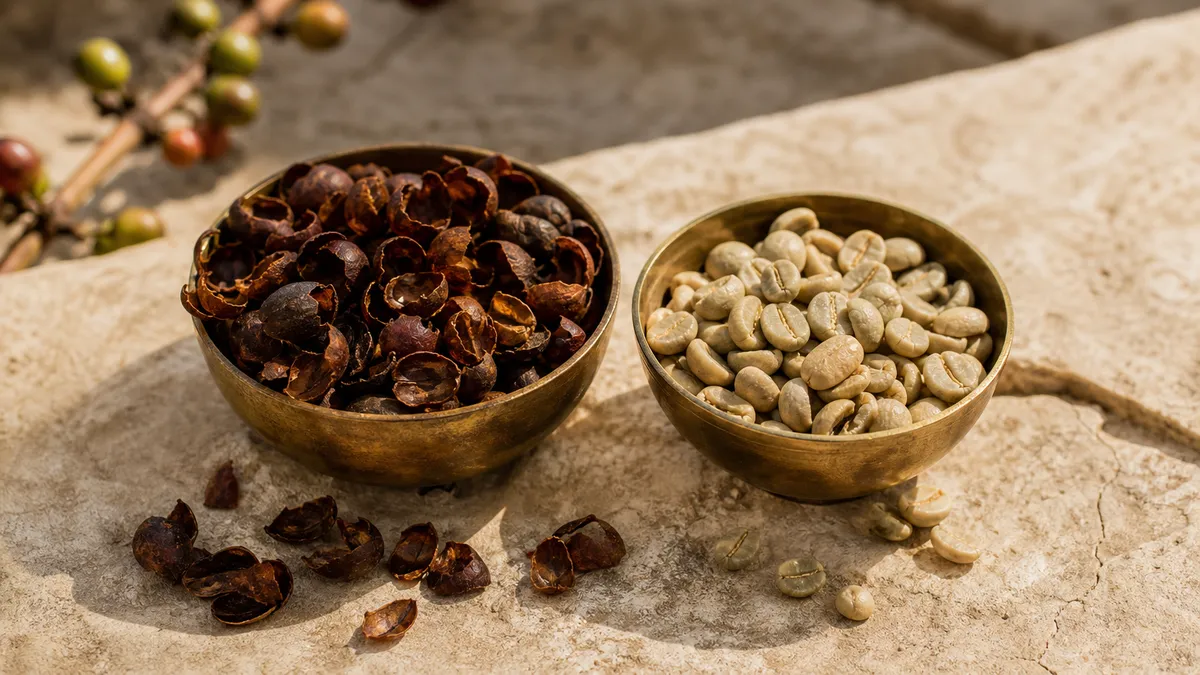
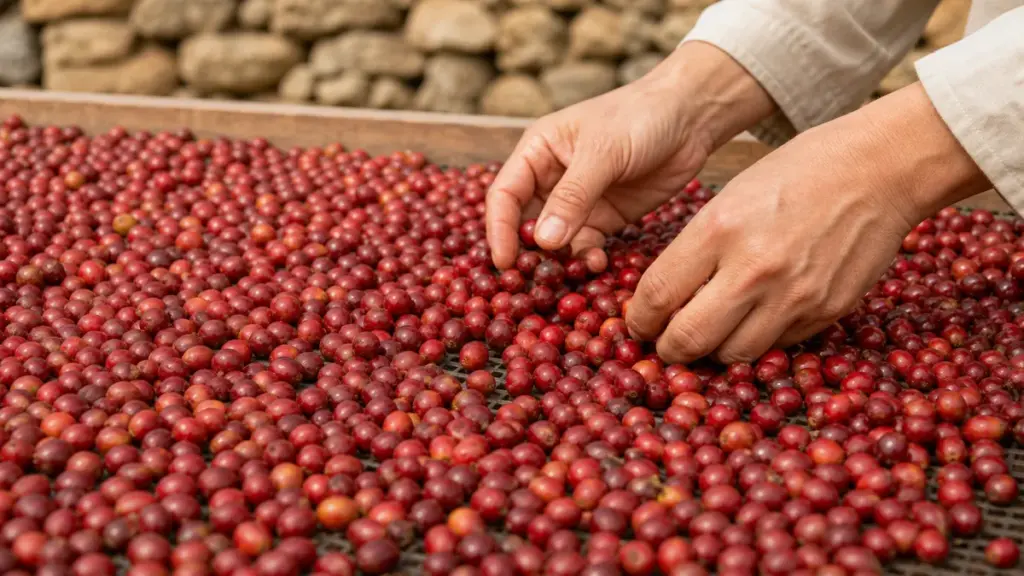
Natural processing means drying the harvested cherry with the seed still inside its fruit, then removing the dried outer layers. “Natural” names a processing method, not a certification of organic farming or environmental performance.
It is an established Yemeni tradition. Published lot documentation records drying on rooftops and raised beds, while UNESCO describes Saudi Khawlani fruit being harvested by hand, dried and subsequently hulled.
These are related practices, but drying surfaces and handling can differ between producers. A useful lot description should therefore go beyond the word “natural” and explain what actually happened after picking.
The dried outer material has its own cultural use. In Yemen, qishr names the coffee husks and a beverage prepared from them. It is distinct from a drink made by brewing roasted coffee beans.
That distinction gives the regional story another dimension: the crop has supported more than one kind of drink. Qishr is not simply a substitute name for Yemeni bean coffee, and an image of coffee husks should not be mistaken for unusually shaped roasted beans.
Yemenia and the limits of variety labels
Yemenia is best understood as a genetic group within Coffea arabica, rather than a single uniform variety. Qima Coffee uses the name for the population described as New-Yemen in research published in 2021.
That study identified a cluster distinct from the cultivated varieties and Ethiopian accessions included in its comparison. The finding is evidence of previously under-described diversity in cultivated Yemeni coffee, not evidence that a new coffee species appeared.
Local names need similar care. Research published in 2022 recorded names used on 148 farms and genetically examined 88 coffee trees. It found geographical patterns in naming but no significant association between the local name and genetic identity.
A bag labelled Udaini or Tufahi therefore tells you something about local naming, but does not necessarily identify one genetically uniform planting. Nor should every Yemeni coffee be relabelled Yemenia.
Some broad agricultural summaries still describe Yemen largely through Typica and Bourbon. This guide follows the dedicated genetic studies for finer distinctions, while treating local names as valuable cultural and farming information rather than dismissing them as meaningless.
What the coffee tastes like, and how it is served
Yemeni coffee is often described through chocolate and wine-like fruit, but there is no compulsory regional flavour. As specific examples, Dark Woods describes one Haraz natural through stone fruit, chocolate and red grape, while Camden CoffeeTech describes another through caramel, nuts and sweet spices.
These are the sellers’ sensory descriptions of particular coffees, not results of testing conducted for this page. Use them to choose a direction you enjoy, then check the individual lot rather than expecting the country name to predict everything.
Preparation adds another layer. Across the Gulf, qahwa is tied to hospitality, conversation and rules of service. UNESCO’s Arabic coffee inscription covers traditions in Qatar, Oman, Jordan, the United Arab Emirates and Saudi Arabia.
The British Museum documents brewing with spices, particularly cardamom, and the addition of rose water in Oman. Such ingredients belong to the recipe: they should not be confused with a roaster describing an unflavoured coffee as having a spice-like aroma.
A growing origin and a serving tradition can overlap, but neither proves the other. Ask separately where the beans grew and how the drink was made.
Finding Middle Eastern coffee in the UK
UK roasters list Yemeni coffees, including named Haraz lots, but a product page is not proof of immediate availability. Listings checked for this guide included pre-order and stock-notification language, so confirm the dispatch position before ordering.
For a useful purchase, look for:
- Growing origin: the country and, preferably, a district, village or producer group.
- Crop information: the harvest or crop year, where available, rather than only the roast date.
- Processing details: how the cherries were dried and whether further processing was used.
- Product contents: plain coffee beans, ground coffee with added spices, or qishr.
- Traceability: an identified importer, exporter, cooperative or sourcing relationship.
When comparing offers, consider pack weight, processing, sorting, traceability and delivery terms together. FAO’s assessment identifies difficult transport and export conditions as constraints on Yemen’s supply chain; an origin story alone does not explain an individual retail offer.
For workplace or wholesale purchasing, request itemised written quotations covering the coffee, delivery, minimum order and supply arrangements. Middle Eastern coffee is most usefully approached through a documented lot, not through the assumption that rarity or historical importance guarantees the right cup for you.
FAQ
Is coffee grown in the desert?
The coffee described here is grown in mountain and valley farming systems, not simply planted across open desert. Yemen’s terraced western highlands and Saudi Arabia’s south-western growing areas are the relevant settings. The surrounding country may be dry, but the farm’s elevation, water availability and local conditions still matter.
Can qishr go into a bean-to-cup machine?
No, qishr should not be treated as coffee beans for a bean-to-cup machine. It is dried coffee husk used to prepare a separate beverage, whereas the machine is intended to grind roasted beans. Follow the machine manufacturer’s ingredient instructions, and prepare qishr separately using instructions supplied for the product.
Does a spice tasting note mean spices have been added?
No, a spice tasting note does not by itself mean that spices are ingredients. Roasters use sensory descriptions to communicate a coffee’s perceived character. A product deliberately blended with cardamom is different, so check its ingredients and description rather than deciding from the tasting notes alone.
Where to go next
Read Yemen for the detailed country guide, including growing regions, farming and coffee names. Return to Beans & Origins to place Middle Eastern coffee within the wider relationship between plants, processing and origin.
Sources
-
Royal Botanic Gardens, Kew, Arabica coffee: Coffea arabica, undated plant profile.
https://www.kew.org/plants/arabica-coffee
Native-range information retrieved through the indexed page. -
World Coffee Research, Yemeni coffee: how genetically diverse is it?, 2020, with subsequent research references incorporated into the page.
https://worldcoffeeresearch.org/news/2020/yemeni-coffee-how-genetically-diverse-is-it
Used for Yemen’s cultivation and dispersal role. -
CIRAD, Coffee: Plant and uses, undated web reference.
https://www.cirad.fr/en/our-activities-our-impact/tropical-value-chains/coffee/plant-and-uses
Used for the alternative early chronology and Mocha’s trading role. -
British Museum, Life in a cup: coffee culture in the Islamic world, large-print exhibition guide, 2021.
https://www.britishmuseum.org/sites/default/files/2021-10/Life_in_a_cup_coffee_culture_in_the_Islamic_world_large_print_guide_1021.pdf
Used for Ottoman trade networks, preparation and Gulf serving traditions. -
FAO, Yemen: Where Every Cup of Coffee Tells a Story, 1 October 2026.
https://www.fao.org/neareast/news/details/yemen--where-every-cup-of-coffee-tells-a-story/en
Used for western highland farming, qishr and current agricultural pressures. -
FAO and International Finance Corporation, Coffee value chain in Yemen: Export potential and investment opportunities, assessment report, 2023; UN publication page dated 2025.
https://yemen.un.org/en/download/179154/290202
Used for water management, harvest variability and supply-chain constraints. -
UNESCO, Knowledge and practices related to cultivating Khawlani coffee beans, inscription documentation, 2022.
https://ich.unesco.org/en/RL/knowledge-and-practices-related-to-cultivating-khawlani-coffee-beans-01863
Used for Saudi cultivation, terracing, hand harvesting, drying and hulling. -
UNESCO, Arabic coffee, a symbol of generosity, expanded inscription documentation, 2024.
https://ich.unesco.org/en/RL/arabic-coffee-a-symbol-of-generosity-02111
Used for participating countries and hospitality traditions. -
Khemira and colleagues, Assessment of genetic diversity and phylogenetic relationship of local coffee populations in southwestern Saudi Arabia using DNA barcoding, PeerJ, 2023.
https://pmc.ncbi.nlm.nih.gov/articles/PMC10680449/
Primary field research documenting Saudi growing locations. -
Montagnon, Mahyoub, Solano and Sheibani, Unveiling a unique genetic diversity of cultivated Coffea arabica L. in its main domestication center: Yemen, Genetic Resources and Crop Evolution, 2021.
https://d-nb.info/1230750908/34
Primary genetic research identifying the New-Yemen cluster. -
Montagnon, Rossi, Guercio and Sheibani, Vernacular Names and Genetics of Cultivated Coffee (Coffea arabica) in Yemen, Agronomy, volume 12, article 1970, 2022.
https://mdpi-res.com/d_attachment/agronomy/agronomy-12-01970/article_deploy/agronomy-12-01970.pdf
Primary research comparing local names and genetic identity. -
Qima Coffee, Yemenia, undated research and commercial explanation.
https://www.qimacoffee.com/yemenia
Used specifically for the Yemenia name and its stated meaning. -
Royal Coffee, Yemen Sa’dah Khulani Traditional Natural, CJ1413, lot documentation, 2021.
https://cdn.royalcoffee.com/wp-content/uploads/2021/04/30105204/CJ1413-Crown-Jewel-Yemen-Sadah-Khulani-Traditional-Natural.pdf
Used for the explicitly bounded altitude, harvest and processing example. -
Dark Woods Coffee, Yemen Fawaz Ali: Mokha Haraz (Natural), undated product listing, checked November 2026.
Used for a UK listing and the roaster’s own sensory description. -
Camden CoffeeTech, Yemen Jaadi, undated product listing, checked November 2026.
https://camden-coffee.tech/products/yemen-jaadi
Used for a contrasting UK lot description and availability caveat.
This page was researched using botanical references, institutional histories, primary genetic studies, UNESCO documentation and published coffee-lot records; no first-hand tasting or farm visits are claimed.
Last checked: November 2026