Great coffee at home starts with a repeatable recipe: weigh the coffee and water, use a grind suited to your brewer, and adjust one variable at a time. Brewing & Recipes brings together the methods, extraction advice, drinks, milk skills, desserts and food pairings that help you turn that recipe into something you enjoy drinking.
In short
- Choose your route by the result you want: a mug of filter coffee, an immersion brew or a concentrated base for milk drinks.
- Write filter and immersion ratios as dry coffee to brewing water by weight, not coffee to the finished drink.
- Match the grind to the recipe before chasing a particular brewing time. Grind, flow and extraction affect one another.
- Temperature is a tool, not a universal quality score. Controlled research found little sensory difference between the tested temperatures when brew strength and extraction were held constant.
- Treat milk drinks and coffee desserts as food: follow storage instructions, use-by dates and appropriate chilling guidance.
Explore the topics




Start here if you are new
Take this short path rather than trying to master every brewer at once:
- Choose a brewing method. Start with the equipment you already have, or identify the method that fits the drink you want and the attention you want to give it.
- Understand grind and extraction. Read this when you have a recipe but cannot explain why the result is thin, sharp, harsh or inconsistent.
- Explore coffee recipes. Once your base coffee is repeatable, move into milk drinks, iced drinks and other variations.
For your first attempts, keep the coffee, brewer and batch size unchanged. Record what you used and what you would like to improve, rather than deciding only whether the cup was “good” or “bad”.
A first good filter brew
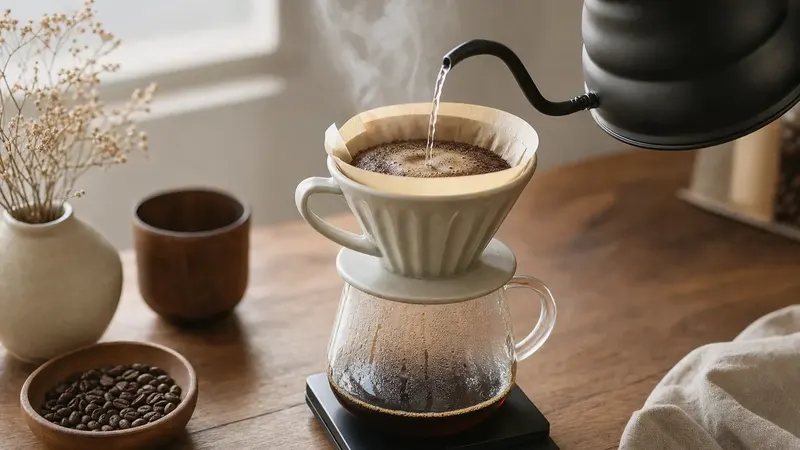
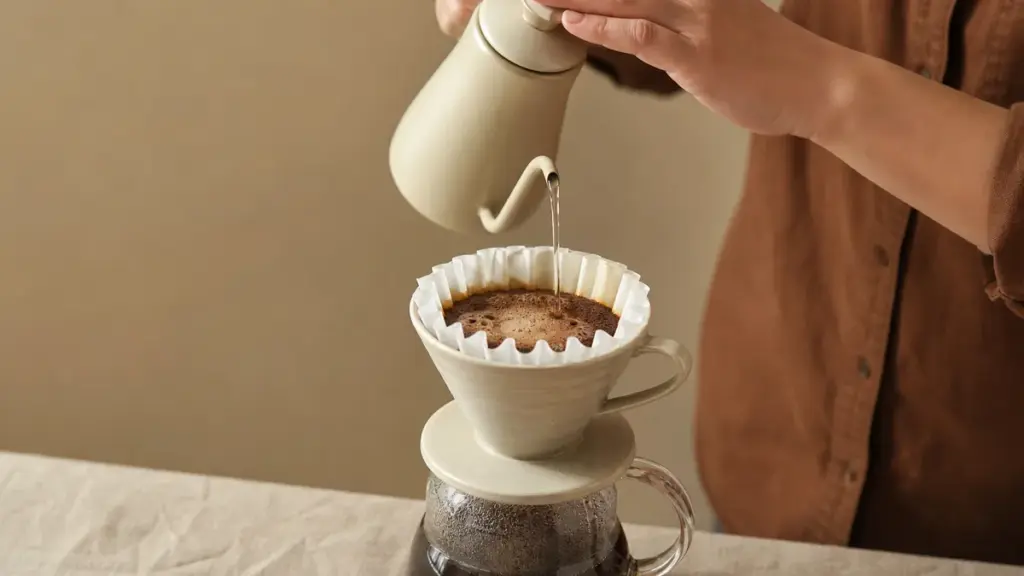
If you have a V60-style dripper, suitable paper, scales, a kettle and a server, try this route based on Hario UK’s published James Hoffmann recipe. It uses 30 g coffee and 500 g water, approximately 500 ml, a coffee-to-water ratio of about 1:16.7. Hario specifies a fine-medium grind and water at 97°C.
- Rinse the paper with hot water, then discard the rinse water.
- Add the ground coffee and make a small well in its centre.
- Start a timer and pour 60 g water, wetting all the grounds.
- Swirl gently and let this initial wetting stage, the bloom, continue until about 45 seconds.
- Pour to 300 g total by about 1 minute 15 seconds, then to 500 g by about 1 minute 45 seconds.
- Stir gently in opposite directions to release grounds from the paper, then allow the coffee to drain.
Use those timings as a repeatable starting point, not an examination. If you have a cafetière, moka pot or another brewer, take its own recipe from Brewing Methods rather than transferring this pouring sequence.
Find your route through Brewing & Recipes
The six hubs answer different questions. Begin with the one closest to the task in front of you, then follow the connections when you need more detail.
| Hub | Read it when you want to… | Useful next step |
|---|---|---|
| Brewing Methods | Choose or learn a brewing technique | Establish a repeatable base recipe |
| Grind Size and Extraction | Understand and troubleshoot the cup | Make a deliberate adjustment |
| Coffee Recipes | Turn brewed coffee into a finished drink | Choose ingredients and proportions |
| Coffee Desserts | Use coffee in baking and puddings | Follow a complete food recipe |
| Coffee and Food Pairings | Explore coffee alongside food | Compare combinations by tasting |
| Coffee Art and Latte Art | Improve presentation and pouring skills | Practise texture before patterns |
You do not need to work through the hubs in order. A baker can begin with desserts, while an espresso drinker may spend most of their time on extraction and milk.
Brewing Methods: choose the family before the gadget
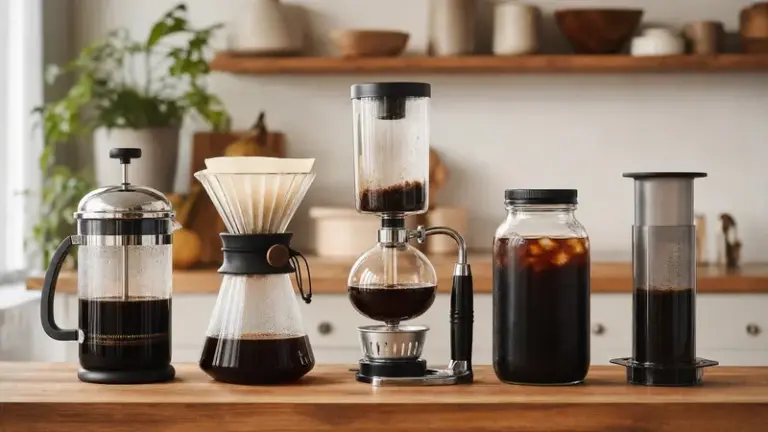
The most useful first distinction is what happens between the water and the grounds. Understanding that makes an unfamiliar brewer less mysterious and helps you recognise which instructions are transferable. Immersion holds coffee and water together; percolation passes water through a bed of grounds.
Immersion
In immersion brewing, the grounds steep in the brewing water. A cafetière is a familiar example: Hario’s published guide uses a coarse grind, a four-minute steep and a slow press. Choose this route if you would rather manage a steep than a sequence of pours.
The useful questions are whether all the coffee became wet, how long it steeped and how you separated the drink from the grounds. Keep those actions consistent before experimenting.
Gravity filter
Pour-over drippers and automatic filter brewers pass water through ground coffee and a filter. With a manual dripper, the pouring sequence is part of the recipe; an automatic brewer manages water delivery for you. Hario describes the V60’s opening and geometry as features that let the brewer influence flow and contact time.
Choose manual filter if you enjoy the process. Consider automatic filter when your priority is a repeatable batch with less hands-on pouring. In either case, follow instructions for the brewer’s intended batch size rather than assuming every quantity behaves identically.
Espresso and other pressure-assisted methods
Espresso forces hot water through a compacted bed of finely ground coffee under pressure. It deserves its own recipes and troubleshooting because grind and water flow interact strongly.
A moka pot and an AeroPress belong elsewhere within the broad pressure-assisted family, but their instructions are not interchangeable with espresso instructions. Bialetti tells moka users to leave the grounds loose and keep water below the safety valve; AeroPress specifies gentle pressing rather than force.
Cold extraction
Cold brew describes extraction at a lower temperature, not simply coffee served cold. Experimental research has examined how temperature, particle size and steeping time affect cold immersion extraction.
Use a dedicated recipe rather than leaving a hot-brew recipe to stand indefinitely. Likewise, approach brewing over ice as its own recipe exercise, with the ice included in your planning.
The brewing methods hub is the place for complete methods, equipment-specific handling and comparisons. Here, the aim is to help you choose a direction.
Grind Size and Extraction: understand the six variables
Extraction is the transfer of soluble material from ground coffee into water. Strength describes how concentrated the resulting drink is. They are related, but they are not the same measurement: a stronger drink is not automatically more thoroughly extracted.
Dose and ratio
The dose is the dry coffee used. The ratio relates that dose to another measured quantity, so always say which quantity you mean.
For filter and immersion, record coffee to brewing water by weight. As a labelled arithmetic example, 15 g coffee with 240 g water is 1:16. That calculation describes the recipe, not the amount you will collect in the cup.
For espresso, record dry dose and beverage yield separately. An illustrative 18 g in and 36 g out is 1:2. This is a notation example, not a claim that every coffee or basket should use that recipe.
Avoid changing dose, ratio and grind together. You may improve the cup, but you will not know which change helped.
Grind
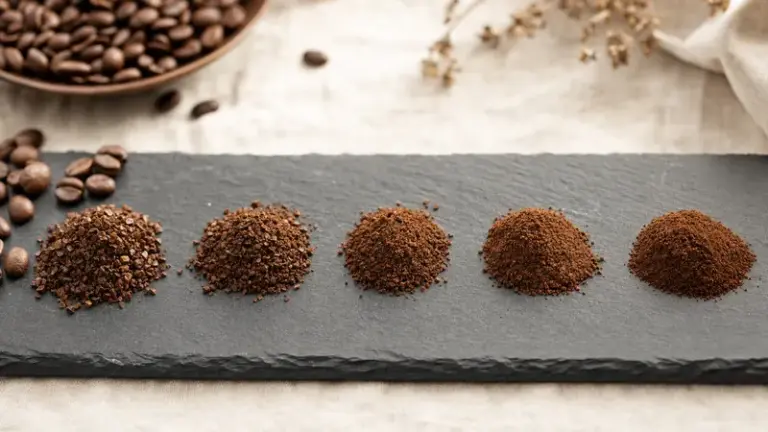
Grind size changes both access to the coffee particles and, in a flowing bed, the resistance encountered by the water. Crucially, finer is not always better: espresso experiments supported by mathematical modelling found extraction falling at very fine settings, consistent with uneven flow through the bed.
Use terms such as coarse or medium-fine as starting descriptions. Record your own grinder setting alongside the recipe, then judge adjustments by the resulting cup rather than assuming another grinder’s setting will translate.
Water
Begin with drinking water that tastes clean. For machines, follow the manufacturer’s water requirements as well as considering flavour.
The 2021 edition of SCA Standard 310 summarises its brewer test water as chlorine-free and odour-free, with calcium hardness equivalent to 50 to 175 mg/L as calcium carbonate, alkalinity of 40 to 70 mg/L as calcium carbonate, and pH 6 to 8. These are specified test conditions, not a complete treatment prescription for every home machine.
Hardness and alkalinity are different properties. Alkalinity describes acid-neutralising capacity and helps explain why two waters can make the same coffee taste different. Check your local supplier’s report rather than assuming there is one UK tap-water profile, and do not select brewing water by pH alone.
Temperature and time
Record where a temperature applies. Kettle water and the mixture of water and grounds are not necessarily at the same temperature; SCA brewer testing measures the latter.
There is no single temperature instruction for every method. AeroPress’s published instructions include 85°C, while the Hario recipe above uses hotter water. Follow the chosen recipe before making temperature your first adjustment.
Time also needs a definition: steeping time, pouring time and total drawdown time describe different parts of brewing. Write down the event that starts and ends your timing.
Improve the cup without chasing every number
Use a small tasting routine: smell the drink, take a sip, let it cool a little and taste again. Record concrete observations such as “thin and sharply sour” or “heavy with a drying finish”, then choose one change to investigate.
The following is a starting diagnostic, not proof of a cause. Hario’s troubleshooting guidance connects fast, thin or sour filter brews with trying a finer grind, and slow, bitter or drying brews with trying a coarser one. Espresso research adds an important warning: uneven flow can make simple grind rules unreliable.
| Symptom | Possible cause | First check or adjustment |
|---|---|---|
| Thin and sharply sour, with unusually fast filter flow | Grind too coarse for that recipe | Keep the dose and water fixed; try slightly finer |
| Bitter or drying, with unusually slow filter flow | Grind too fine for that recipe | Try slightly coarser |
| Espresso becomes less consistent as you grind finer | Uneven flow through the coffee bed | Check preparation; do not assume finer will solve it |
Once a cup tastes good, repeat it before making another change. The grind and extraction hub takes these investigations further without turning every unpleasant taste into a single-cause diagnosis.
Coffee Recipes: build the drink you actually want
Start by choosing the finished drink, not by forcing every recipe to use the same base. Hario, for example, distinguishes a concentrated AeroPress preparation suitable for milk drinks from true espresso. A substitution can be useful without being identical.
For each recipe, establish:
- Which brewing method supplies the coffee.
- Whether the coffee is used hot, chilled or over ice.
- When milk, sweeteners or other ingredients are added.
- How much the recipe makes.
- Which ingredients need refrigeration.
Keep the base coffee repeatable while adjusting the finished drink. If you change the brew and the milk proportion together, it becomes difficult to identify the improvement you preferred.
The coffee recipes hub is your route to complete ingredient lists and methods. Use it for the detail rather than assembling a drink from disconnected tips.
Milk: texture first, then the finishing touches
For steamed milk, microfoam means a finely textured mixture of milk and small bubbles, rather than a separate cap of stiff froth. Breville’s teaching guidance treats texture and temperature as the two central skills and recommends practising with the same milk for consistency.
Learn your machine’s steaming sequence before attempting decoration. Sage’s Bambino manual gives 60 to 65°C as its milk-texturing temperature guidance and instructs users to wipe and purge the wand after steaming. Use a thermometer while learning rather than relying only on how hot the jug feels.
Keep your chosen milk or plant drink consistent during practice, and follow its storage instructions. Treat milk quantity as part of the drink recipe, not an afterthought added until the cup is full.
Refrigerated ingredients should remain chilled until needed. FSA guidance advises a fridge temperature of 0 to 5°C and following packaging instructions and use-by dates.
Coffee Desserts: follow the whole recipe
Coffee desserts are a different task from brewing a drink. A tiramisu recipe, for example, has to coordinate the coffee soak, cake or biscuits, filling and chilling stages. King Arthur Baking’s published version uses a measured espresso-powder soak rather than treating the coffee element as an unspecified leftover.
Choose a complete recipe first, then use its specified coffee ingredient. Do not casually replace a dry ingredient with an unmeasured quantity of liquid.
The coffee desserts hub is the next stop for baking and puddings, including preparation and storage instructions. Read those instructions before starting, especially where cream, eggs or make-ahead assembly are involved.
For recipes containing raw or lightly cooked eggs, pasteurised egg products offer an alternative identified in FSA guidance. People requiring medically supervised diets need advice appropriate to their circumstances.
For cooked leftovers, FSA guidance advises cooling and refrigerating within two hours, then eating within 48 hours or freezing. Follow any shorter ingredient or recipe limit.
Coffee and Food Pairings: use comparison, not commandments
Treat pairing as a tasting exercise rather than a list of approved matches. For a first comparison, try one coffee with plain shortbread, dark chocolate and a piece of fruit. These are suggested contrasts, not guaranteed successes.
Taste the coffee alone, taste the food, then return to the coffee. Ask whether you prefer the combination, whether a flavour becomes more noticeable and whether the finish feels pleasant.
Keep the coffee recipe unchanged during the comparison. Afterwards, repeat with another coffee if you want to explore further.
The food pairings hub helps you organise that exploration. Use your own observations to decide what belongs beside breakfast, an afternoon biscuit or dessert.
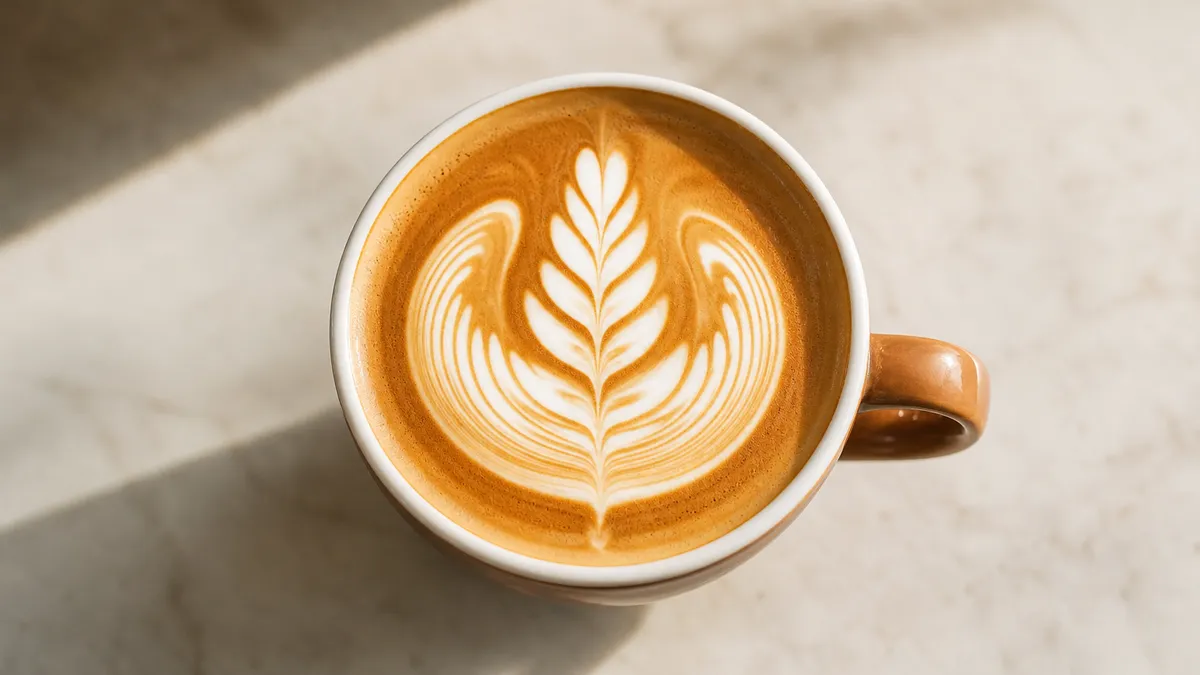
Coffee Art and Latte Art: practise one skill at a time
Latte art combines prepared espresso with suitably textured milk. Breville’s teaching material uses the heart as a foundation pattern and identifies a milk jug, suitable cup and steam-equipped espresso machine among the tools for learning.
Begin with repeatable milk texture. Then practise one simple pattern rather than switching between hearts, tulips and more elaborate designs after every attempt.
Judge the practice drink as a drink, too. Set separate goals for taste, texture and appearance so that an attractive surface does not distract you from what you wanted to improve.
Visit coffee and latte art for the detailed pouring and presentation route. Keep decorative experiments separate from changes to the underlying coffee recipe.
Go deeper: what brewing research can and cannot tell you
Brewing numbers are useful when they explain an observation. They are less useful when they become targets detached from the coffee you want to drink.
In a controlled drip-coffee study, researchers compared brewing at 87°C, 90°C and 93°C, adjusting grind and time to achieve specified strengths and extraction yields. Under those conditions, temperature had little appreciable effect on the sensory profile, while strength and extraction mattered. That does not show that temperature is irrelevant to every brewer or recipe.
Espresso research offers a similar lesson about grind: a model assuming even flow did not fully describe what happened at the finest settings. Experiments pointed towards uneven flow as the explanation. The practical lesson is to question a failing adjustment, not repeat it simply because a rule says “finer extracts more”.
For your own learning, keep a short brewing record: coffee, brewer, dose, water, grind setting, temperature instruction, timing and tasting notes. Use it to ask a specific question on the next attempt.
Where to go next
Begin with brewing methods, Brewing Methods, to establish your technique, then use grind and extraction, Grind Size and Extraction, when you want to understand or improve the result. Continue through Brewing & Recipes with coffee recipes, Coffee Recipes, for finished drinks, or coffee desserts, Coffee Desserts, when coffee is becoming an ingredient.
Sources
-
Specialty Coffee Association, Home Coffee Brewers: Specifications and Test Methods, SCA Standard 310-2021H, 2021. Retrieved copy of the SCA document:
https://coffeegeek.com/wp-content/uploads/2023/10/SCAGoldCupStandard.pdf -
Specialty Coffee Association, Water and Coffee Acidity: How to Adapt Your Water for Different Extraction Methods, 25 Magazine, issue 9, undated retrieved page.
https://sca.coffee/sca-news/25/issue-9/english/water-and-coffee-acidity-how-to-adapt-your-water-for-different-extraction-methods-25-magazine-issue-9-pxjby -
Batali, Ristenpart and Guinard, Brew temperature, at fixed brew strength and extraction, has little impact on the sensory profile of drip brew coffee, Scientific Reports, 2020. Retrieved abstract and publication record:
https://pubmed.ncbi.nlm.nih.gov/33020560/ -
Cameron and colleagues, Systematically Improving Espresso: Insights from Mathematical Modeling and Experiment, Matter, 2020. University of Huddersfield research record and abstract:
https://pure.hud.ac.uk/en/publications/systematically-improving-espresso-insights-from-mathematical-mode/ -
Wang and Lim, Effects of grind size, temperature, and brewing ratio on immersion cold brewed and French press hot brewed coffees, Applied Food Research, 2023. Retrieved publication abstract:
https://doi.org/10.1016/j.afres.2023.100334 -
Hario UK, Hario V60 Recipe & Interview with Hario Ambassador James Hoffmann, 2022.
https://www.hario.co.uk/blogs/hario-ambassadors/hario-v60-recipe-interview-with-hario-ambassador-james-hoffmann -
Hario UK, Find Your Perfect Grind: A Hario Coffee Grinder Guide, 2026.
https://www.hario.co.uk/blogs/news/find-your-perfect-grind-a-hario-coffee-grinder-guide -
Hario Europe, About the V60 Dripper, undated.
https://www.hario-europe.com/pages/nf-about-the-v60-dripper -
AeroPress, Getting Started With the AeroPress Coffee Maker, undated current instructions.
https://aeropress.com/pages/how-to-use -
Bialetti, How to use the Moka Express?, updated 2023.
https://bialetti-cookware.zendesk.com/hc/en-us/articles/5416235346322-How-to-use-the-Moka-Express -
Breville, Microfoam Milk and Latte Art, undated teaching pages.
https://www.breville.com/us/en/coffee-journey/tutorials/espresso-tutorials/microfoam-milk.html
https://www.breville.com/us/en/coffee-journey/tutorials/espresso-tutorials/latte-art.html -
Sage, The Bambino Instruction Book, UK manual, document code SES450_UK_UG1_G21, 2021.
https://assets.sageappliances.com/BES450/SES450_UK_UG1_G21_FA_WEB.pdf -
Food Standards Agency, How to chill, freeze and defrost food safely, 2017, current retrieved guidance, applying to England, Northern Ireland and Wales.
https://www.gov.uk/government/publications/how-to-chill-freeze-and-defrost-food-safely/how-to-chill-freeze-and-defrost-food-safely -
Food Standards Agency, Advice on safe storage, handling and use of eggs for catering, current 2026 guidance.
https://www.gov.uk/guidance/advice-on-safe-storage-handling-and-use-of-eggs-for-catering -
King Arthur Baking, Tiramisu, updated 2025.
https://www.kingarthurbaking.com/recipes/tiramisu-recipe -
Specialty Coffee Association, Certified Home Equipment, undated current programme page.
https://sca.coffee/certified-home-brewer
Researched using retrieved standards, manufacturer instructions, original research abstracts and official food-safety guidance; practical tasting exercises are editorial suggestions, not claims of first-hand testing.
Last checked: November 2026