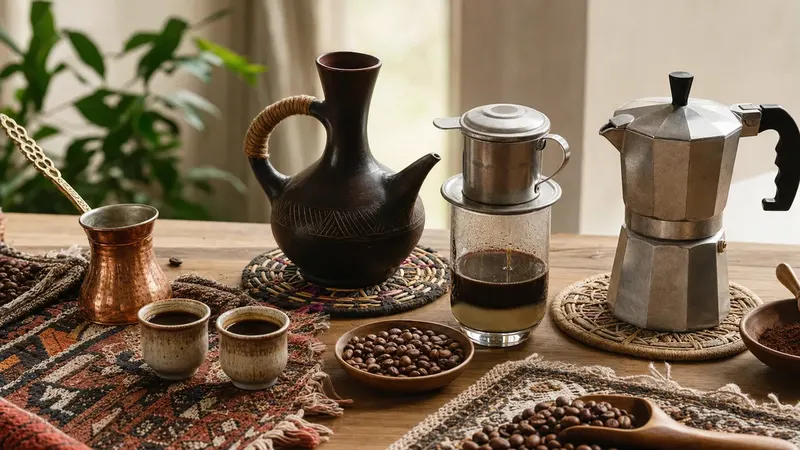
Coffee shapes culture through hospitality, shared rituals, creative work and the places where people meet. Culture & Travel is your gateway to those connections, helping you explore world traditions, discover coffee shops and roasters, plan thoughtful visits and take part in coffee communities without needing expert brewing knowledge.
In short
- Start with the people and the occasion, not just the drink: serving, waiting and sharing can matter as much as preparation.
- Use the six hubs below to choose between traditions, the arts, places to visit, travel, gifts and community.
- Distinguish a coffee-growing destination from a city known for its cafés: they offer different experiences.
- Check venues with their operators and overseas travel with current FCDO advice before making arrangements.
- Treat heritage recognition, environmental claims and historic café stories as things to understand precisely, not badges of quality.
Explore the topics
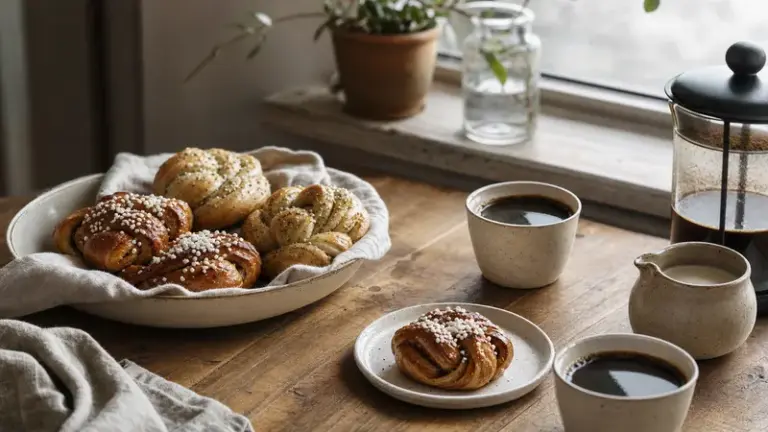
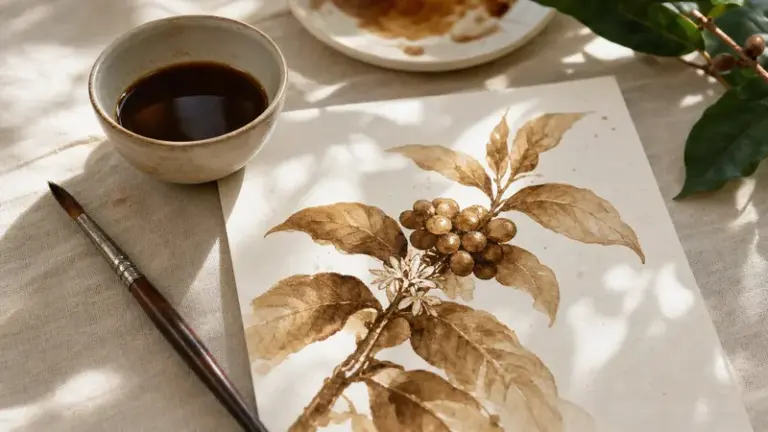
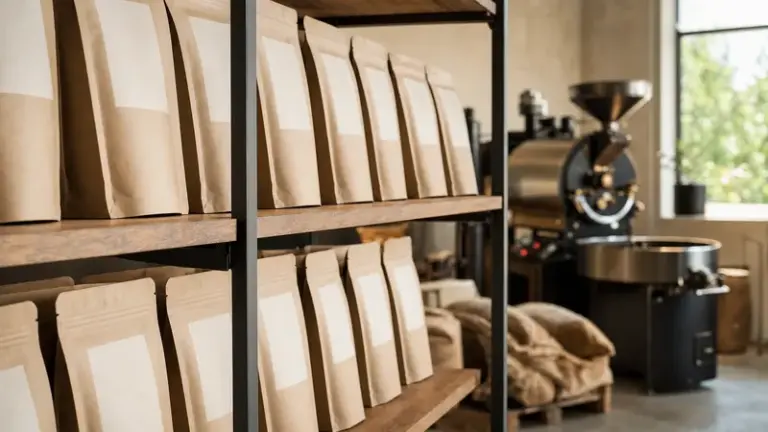
Start here if you are new
Follow this short path, then branch into the subjects that interest you.
- Begin with coffee culture. Read this first to understand why an invitation to coffee can mean hospitality, friendship or participation in a shared ritual. It provides the context for approaching unfamiliar customs with curiosity rather than a checklist of supposed rules.
- Continue to coffee shops and roasteries. Use this to turn that interest into a visit, whether you want somewhere welcoming to sit, a guided tasting or a closer look at roasting.
- Move on to coffee and travel. Read this when coffee becomes part of a journey, so you can distinguish an appealing idea from a visit that needs advance booking, local guidance or additional preparation.
There is no need to complete the path before joining in. A conversation at a nearby coffee shop is a perfectly good beginning.

Find your way around Culture & Travel
Choose a hub by the question you want answered. These are different routes through the subject, not levels of expertise.
| Hub | Choose it when you want to… | A useful starting question |
|---|---|---|
| world coffee culture | Understand customs, hospitality and everyday rituals | What does sharing coffee mean here? |
| coffee and the arts | Explore music, literature, visual art and creative spaces | Is coffee the subject, setting or social connection? |
| shops and roasteries | Find and assess places to drink, taste and learn | What kind of visit would suit me? |
| coffee travel | Build coffee experiences into a journey | Am I visiting a growing region, a café culture or both? |
| merchandise and gifts | Choose useful objects, keepsakes and experiences | Will this suit the recipient’s actual habits? |
| fun and community | Take part in shared activities and informal learning | How can everyone feel welcome to join in? |
For a specific outing, begin with the relevant practical hub. For a broader understanding of why coffee brings people together, begin with culture or the arts.
World traditions: understand the occasion before the cup
Coffee traditions are not simply recipes with national names. They include who prepares the drink, how guests are welcomed, what accompanies it and how knowledge passes between generations.
UNESCO’s account of Turkish coffee, for example, describes finely ground coffee brewed slowly in a pot and served in small cups with water. The heritage it recognises also includes conversation, friendship, family learning and occasions such as engagements. The equipment alone does not explain the tradition.
Arabic coffee offers another example of preparation and social meaning belonging together. UNESCO describes serving it as an expression of generosity and hospitality, with etiquette concerning serving order and the handling of the cup. Its account also connects gatherings around coffee with poetry, discussion and shared memories.
These descriptions are useful introductions, not instructions to impose on every host. Ask what happens in the particular household, gathering or venue you are visiting, and follow the welcome you are given.
Look beyond the most familiar café stories
In Ethiopia, UNESCO’s cultural account describes coffee preparation bringing relatives, friends and neighbours together. Roasting, grinding, brewing and successive services make preparation part of the shared occasion rather than something hidden away before guests arrive.
Japan’s kissaten, traditional coffee shops, offer a different connection between drink and setting. The Japan National Tourism Organization describes establishments ranging from neighbourhood gathering places to shops devoted closely to coffee. Some music-focused examples centre attentive listening rather than conversation.
Vietnam’s official tourism account describes the phin, a small metal filter through which coffee drips into the vessel below, alongside drinks such as iced coffee with sweetened condensed milk. Here, watching preparation provides a useful entry point into the experience.
Read coffee traditions when you want the context behind these differences. Use it to compare particular practices without treating any country as if everyone drinks the same thing in the same way.
A useful habit is to ask two questions: “How is this made?” and “When would people normally share it?” The second often opens the more interesting conversation.
Coffee and the arts: subject, setting and meeting place
There are several ways into coffee’s relationship with the arts. Coffee can be the subject of a work, a café can supply its setting, or a coffee house can be a place where creative people gather.
Johann Sebastian Bach’s Coffee Cantata, BWV 211, provides a direct example. The Netherlands Bach Society dates its creation to around 1734 for concerts at Café Zimmermann in Leipzig. Its comic story concerns a young woman’s determination to keep drinking coffee despite her father’s objections.
Visual art invites a different kind of attention. Vincent van Gogh’s Terrace of a Café at Night (Place du Forum), dated approximately 16 September 1888 by the Kröller-Müller Museum, uses the contrast between a warmly lit terrace and a deep-blue night sky. The café is not merely somewhere a drink might be served: its light and arrangement are central to the painting.
For the social connection, the Austrian Commission for UNESCO describes Viennese coffee houses as places of literary communication. That is a more precise starting point than suggesting that coffee itself produces creativity.
Explore coffee in the arts to follow these connections through particular works and settings. It is the useful next stop when a painting, song or literary café catches your attention and you want to separate documented history from an attractive anecdote.
For your own visit, try a simple observation exercise. Notice the sound, lighting, seating and pace of service, then consider how those details might change the mood of a scene. You do not need to write a novel to become a more attentive reader of a room.
Coffee shops and roasteries: choose the experience you want
Start by deciding what would make a visit worthwhile. Somewhere suitable for a long conversation may not be the best choice for watching coffee preparation, and neither necessarily offers access to roasting equipment.
A coffee shop is principally a place serving drinks. A roastery is a place where green coffee is roasted; do not assume that a business describing itself as a roaster also welcomes visitors to its production space. Check its own visitor information.
As a concrete example, Square Mile Coffee Roasters advertises a guided tour and tasting at its working East London roastery. Its published description distinguishes sessions where visitors may see roasting from those held after roasting has finished. That illustrates why the session details matter more than the phrase “roastery visit”.
Before choosing a venue, consider:
- Purpose: somewhere to sit, a guided tasting, a class or a production tour.
- Access: step-free routes, seating, toilets and any particular assistance you need.
- Participation: whether the event welcomes beginners and explains unfamiliar terms.
- Practicalities: booking, opening hours, group arrangements and photography.
- Comfort: whether the atmosphere suits conversation, quiet observation or a family visit.
A cupping is an organised way of tasting and comparing coffees. You do not need an established flavour vocabulary to ask whether an introductory session would suit you.
Use visiting coffee shops and roasteries for the fuller approach to finding and assessing places. Judge them against your purpose rather than assuming that specialist equipment, a fashionable interior or a long menu guarantees a satisfying visit.
Ask staff questions when they have time to answer. “What would you suggest for someone who usually drinks this?” is more useful than testing them with a technical question whose answer you do not need.
Coffee and travel: plan around people as well as places
There are three useful ways to frame coffee travel: exploring a drinking tradition, visiting places where coffee is grown and processed, or following a personal interest such as roasting, architecture or café history.
These can overlap, but they should not be confused. A city’s café itinerary does not necessarily explain the working lives behind the beans, while a farm visit is not automatically an introduction to everyday drinking customs.
Colombia’s Coffee Cultural Landscape provides a documented example of production and culture belonging together. UNESCO’s World Heritage account connects coffee cultivation on small plots with settlements, architecture, family traditions and adaptation to mountainous terrain. The interest extends beyond seeing coffee plants.
Build a manageable itinerary
Begin with one clear aim, then check that the proposed visit actually serves it.
- Choose the experience. Decide whether you want to observe preparation, taste coffees, visit a working farm or understand a historic setting.
- Confirm access directly. Ask the operator what visitors may see, what requires booking and whether the experience involves walking, steps or other access considerations.
- Ask who will interpret it. Find out whether your guide represents the venue, a producer organisation or another operator, and what the visit covers.
- Leave room for ordinary life. Avoid treating every stop as a demonstration arranged around your arrival.
- Check the wider journey. Review transport, accommodation, relevant entry requirements and current official travel advice.
For UK travellers, the Foreign, Commonwealth & Development Office provides country-specific information on entry requirements, safety, health risks and legal differences. Its insurance guidance advises appropriate cover for your circumstances and intended activities. Check both before making arrangements and again before departure.
Read planning coffee travel for the next stage. This gateway offers ways to think about a trip, not a current safety assessment of any destination.
At a working farm or processing site, ask before entering production areas, touching equipment or photographing people. A visit should make room for the work being done, rather than turn that work into scenery.
Merchandise and gifts: choose something with a purpose
A good coffee gift begins with the recipient’s habits, not the giver’s enthusiasm. Before choosing anything, establish what they enjoy drinking, how they prepare it and whether they would welcome another object.
Use these questions to narrow the choice:
- Do they use whole beans, ground coffee or neither?
- If they need ground coffee, do you know their brewing method?
- Would they prefer something practical, something decorative or an experience?
- Would a class or visit suit their interests, access needs and availability?
- If you are choosing a souvenir, can the seller explain who made it and where?
Treat these as prompts for a better choice, not a reason to interrogate someone about every detail of their kitchen. If equipment compatibility is uncertain, ask rather than guess.
The same care applies to environmental claims. The Competition and Markets Authority’s shopper guidance warns against relying on vague terms such as “green” or “eco” and recommends looking for supporting evidence. A coffee-themed product is not environmentally preferable simply because its packaging looks rustic.
Explore choosing coffee gifts when you want help matching an object or experience to its recipient. Keep the cultural connection specific: the maker, material, use or documented story is more meaningful than a generic claim of authenticity.
For workplace gifts, consider whether the item will be used by one person or shared. A communal tasting should remain an invitation, with a comfortable way for colleagues to decline.
Fun and community: make participation easy
You do not need to recognise tasting notes, own specialist equipment or drink coffee to help create a welcoming gathering. Start with an activity people can understand without preparation.
For a small tasting, ask each participant to describe what they notice before introducing the organiser’s descriptions. “This reminds me of toasted bread” is a useful contribution; nobody needs to produce an impressive-sounding answer.
Other possible activities include a café sketching session, a discussion of a coffee-related artwork, a shared reading or a visit organised around an accessible venue. Choose the activity around the people involved rather than making everyone fit a specialist format.
For a workplace or neighbourhood group:
- Explain the invitation plainly. Say what will happen and whether participants are expected to bring anything.
- Offer alternatives. Make water and a non-coffee option available, without asking people to justify their choice.
- Remove the performance element. Let people listen, observe or leave a tasting unfinished.
- Keep questions welcome. Explain terms as they arise rather than beginning with a lecture.
- Seek permission for photographs. Participation should not imply agreement to appear in promotional or social media posts.
Use coffee activities and community to find a route into shared enjoyment rather than competitive expertise. A successful gathering leaves people feeling included, not examined.
When joining an established group, check its purpose and expectations first. A discussion group, a professional tasting and a social meet-up may all involve coffee, but they need not ask the same things of participants.
Read coffee heritage with a critical eye
The deeper question behind Culture & Travel is not simply where coffee is enjoyed, but whose stories are being told.
Know what heritage recognition means
“UNESCO-listed” needs qualification. Turkish coffee culture and tradition entered UNESCO’s Representative List of the Intangible Cultural Heritage of Humanity in 2013. The current Arabic coffee entry records inscription in 2024.
Viennese coffee house culture, by contrast, entered Austria’s national inventory of intangible cultural heritage in 2011. Colombia’s Coffee Cultural Landscape entered the World Heritage List in 2011. These are different forms of recognition, covering different things.
None should be treated as an award for the quality of an individual café’s drinks. Look at what the actual record recognises before repeating a claim.
Keep hospitality and difficult history in the same account
An appealing account of coffee culture should also make room for exploitation and exclusion. The V&A explains how the fashion for sweetened tea, coffee and chocolate increased demand for sugar and enslaved labour on West Indian plantations.
That history does not make present-day hospitality less meaningful. It does mean that a reference work should resist telling coffee’s cultural story only through elegant rooms and celebrated customers.
When reading a venue’s history, distinguish a documented event from a promotional story. When choosing a visit, ask whose perspective you will hear. And when bringing a tradition home, describe what you learned from a particular host or source rather than claiming to represent an entire culture.
FAQ
Is coffee culture only about specialist coffee?
No, coffee culture includes ordinary habits and shared occasions as well as specialist interests. UNESCO’s Turkish and Arabic coffee records emphasise hospitality, conversation and the transmission of knowledge. You can explore those meanings through a family gathering or a local venue without learning technical tasting language or acquiring brewing equipment.
Can I explore this subject without drinking coffee?
Yes, you can approach it through art, music, objects, architecture and conversation. A coffee-related activity need not centre consumption. If you are considering a tasting or guided visit, tell the organiser what interests you and ask whether observing without drinking would fit the session.
How should I record a coffee experience respectfully?
Separate what you observed from what someone explained to you, and ask permission before recording people. Note the date, setting and source of any historical claim. In a personal account, describe a particular experience rather than turning it into a statement about everyone in that country or community.
Where to go next
Begin with Coffee Culture for the meaning behind shared rituals, then use Coffee Shops and Roasteries to turn that understanding into a thoughtful local visit. Choose Coffee and the Arts to follow a creative connection, or Coffee and Travel when you are ready to build a journey around it.
Sources
-
UNESCO, Turkish coffee culture and tradition, 2013 inscription, current listing record.
https://ich.unesco.org/en/RL/-00645 -
UNESCO, Arabic coffee, a symbol of generosity, 2024 inscription, current listing record.
https://ich.unesco.org/en/RL/arabic-coffee-a-symbol-of-generosity-02111 -
Austrian Commission for UNESCO, Viennese coffee house culture, 2011 inventory entry, current record.
https://www.unesco.at/en/culture/intangible-cultural-heritage/inventory/element/article/viennese-coffee-house-culture -
UNESCO, Éloi Ficquet, Ethiopia, the home of coffee, 2023.
https://www.unesco.org/en/articles/ethiopia-home-coffee -
Japan National Tourism Organization, James Hadfield, Kissaten: Japan’s Old-School Coffee Shops, 2021.
https://www.japan.travel/en/blog/kissaten-japans-old-school-coffee-shops/ -
Vietnam Tourism, A taste of Vietnam: The story behind its beloved coffee culture, undated, current page.
https://vietnam.travel/things-to-do/taste-vietnam-story-behind-its-beloved-coffee-culture/ -
Netherlands Bach Society, Kaffeekantate, All of Bach work and performance commentary, undated, current page.
https://www.bachvereniging.nl/en/bwv/bwv-211 -
Kröller-Müller Museum, Terrace of a Café at Night (Place du Forum), collection record KM 108.565, undated, current record.
https://www.krollermuller.nl/en/collection/vincent-van-gogh-terrace-of-a-caf-at-night-place-du-forum-km-108-565 -
Square Mile Coffee Roasters, Roastery Tour and Tasting, undated, current operator description, checked November 2026.
https://shop.squaremilecoffee.com/products/coffee-tasting-event -
Foreign, Commonwealth & Development Office, Foreign travel advice, continuously maintained country directory, checked November 2026.
https://www.gov.uk/foreign-travel-advice -
Foreign, Commonwealth & Development Office, Foreign travel insurance, updated 2024, current guidance checked November 2026.
https://www.gov.uk/guidance/foreign-travel-insurance -
UNESCO World Heritage Centre, Coffee Cultural Landscape of Colombia, 2011 inscription, current property record.
https://whc.unesco.org/en/list/1121 -
Victoria and Albert Museum, The Wedgwood anti-slavery medallion, undated, current museum article.
https://www.vam.ac.uk/articles/the-wedgwood-anti-slavery-medallion -
Competition and Markets Authority, Green claims code for shoppers, 2021.
https://www.gov.uk/government/publications/green-claims-code-for-shoppers/green-claims-code-for-shoppers
This page was researched using heritage records, museum collections, official tourism information, UK government guidance and a venue operator’s published description; practical suggestions are editorial guidance, not first-hand testing.
Last checked: November 2026