Coffee’s environmental impact runs from growing and processing the crop to heating water, adding milk and disposing of packaging and grounds. There is no single footprint for every cup: farming conditions, land-use change, drink size, preparation and waste all affect the result, so the useful approach is to examine the whole chain rather than judge the bag or pod alone.
In short
- Compare equivalent drinks. Results per serving, per litre and per amount of caffeine can produce different rankings.
- Keep carbon and nature separate. A greenhouse-gas calculation does not answer every question about forests, wildlife or water.
- Ask what a claim covers. Packaging-only evidence cannot establish the footprint of the whole drink.
- Check the actual disposal route. “Compostable” packaging does not belong automatically in a food-waste bin.
- Treat reuse as a specific project. Ask what is recovered, what processing it needs and what it replaces.
Guides in Coffee and the Environment
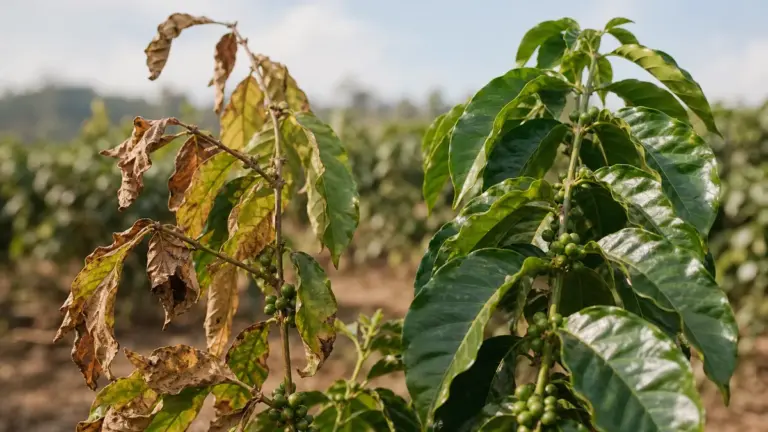 Coffee and Climate ChangeHow warming, drought and pests affect coffee, what suitable-land projections really mean, and how varieties, shade and conservation can help farms adapt.Read the guide
 Coffee and the Environment: The Complete GuideUnderstand coffee’s environmental impact, from forests and water to milk, brewing and pods, with practical steps for drinkers and UK workplaces.Read the guide
 Coffee Carbon FootprintCompare coffee carbon footprints per kilogram and cup, understand farming, brewing and milk emissions, and scrutinise carbon-neutral claims in the UK.Read the guide
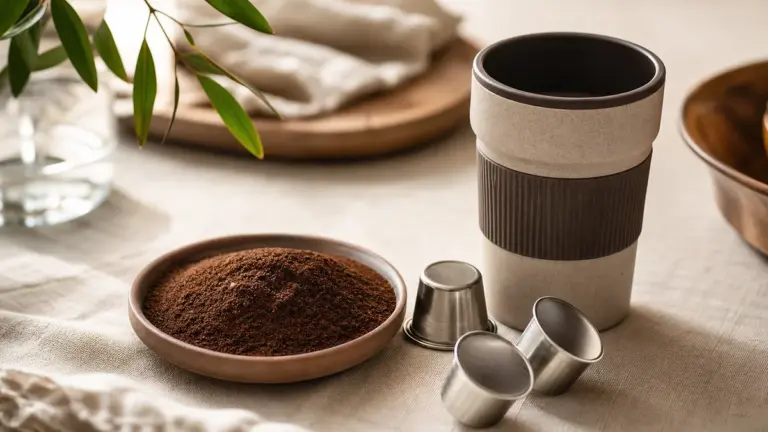 Coffee Pods and the EnvironmentAre coffee pods worse for the environment? Compare life-cycle evidence, capsule materials, UK recycling routes and workplace waste arrangements.Read the guide
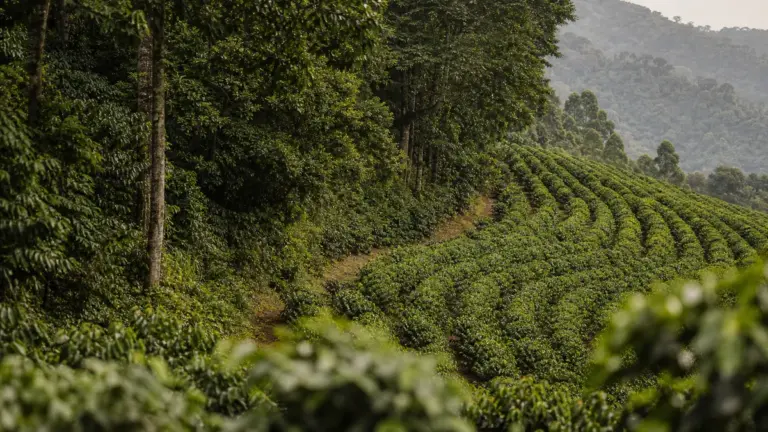 Deforestation and CoffeeHow coffee links to forest loss, what agroforestry can change, and the EU and UK rules on deforestation, traceability and sourcing, checked November 2026.Read the guide
 Eco-Friendly Coffee PackagingUnderstand recyclable, biodegradable and compostable coffee bags, check valves and labels, and find the right UK collection route for each package.Read the guide
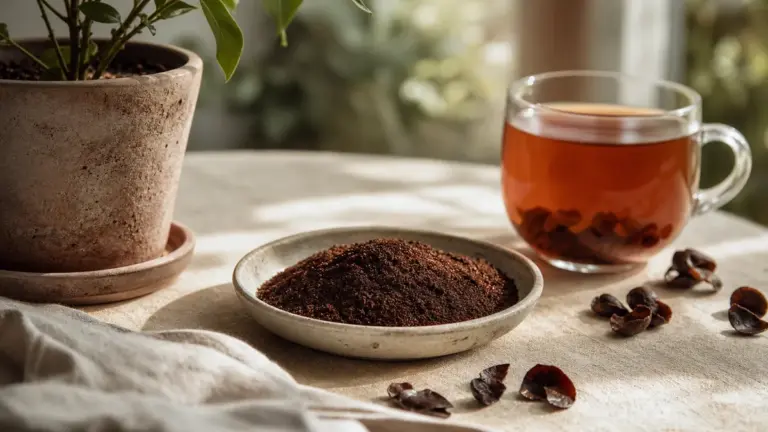 Reusing Coffee Grounds and CascaraFind sensible uses for spent coffee grounds, understand cascara tea, and check England’s workplace food-waste rules and UK novel-food requirements.Read the guide
Start here if you are new
Follow this short route through the subject:
- Start with the complete environment guide for the connected journey from farm to disposal. Choose it when you want an explanation of the whole system rather than one environmental claim.
- Read about the carbon footprint to understand emissions calculations and comparisons between drinks. It is the useful next step before accepting a headline figure for “a cup of coffee”.
- Move to coffee packaging when you need to decide what to buy and where its wrapper should go. Use it to turn a broad environmental preference into a disposal decision you can actually follow.
This hub maps the questions and directs you to the detailed treatment of each. For the wider context of producers, businesses and sustainability, return to industry and sustainability.
Coffee and the environment: choose your question
Use the table to identify the issue you are trying to understand. The middle column sets the scope; the final column suggests the evidence worth requesting.
| Area | What it examines | Useful evidence to ask for |
|---|---|---|
| Carbon | Greenhouse-gas emissions across a defined supply chain | Calculation method, included stages and comparison unit |
| Climate | Risks to production and ways farms can adapt | Location-specific research and adaptation plans |
| Deforestation | Whether coffee production replaces forests | Farm traceability and land-use evidence |
| Packaging | Materials, product protection and disposal | Material specification and a verified collection route |
| Pods | Portioning, brewing and single-serve packaging together | Whole-drink comparisons and realistic recovery assumptions |
| Reuse | Further uses for grounds and processing by-products | Processing requirements and evidence of what is replaced |
These are related questions, not interchangeable measures of “greenness”. Life cycle assessment, usually shortened to LCA, models environmental effects across specified stages of a product’s life. Reviews of coffee LCAs find substantial differences in their boundaries, assumptions and reporting, which limits simple comparisons between published results.
Before following a ranking, decide what you need it to answer. Choosing a workplace drink system, checking a supplier’s forest policy and sorting used packaging are different tasks. A good answer to one may leave the others untouched.
Carbon: understand the comparison before the number
A coffee carbon footprint expresses greenhouse-gas emissions as carbon dioxide equivalents, allowing different gases to be combined in one climate measure. Coffee research identifies cultivation as a major contributor, while preparation can be particularly important for energy-related impacts. The balance changes with the production system and the stages included.
Read the dedicated carbon article when comparing brewing methods, supplier calculations or claims about lower-emission coffee. It explains why a result for packaged beans cannot be treated as a result for a finished drink.
The functional unit, meaning the quantity or service being compared, is especially important. A UK-focused peer-reviewed modelling study found that the ranking of coffee drinks changed depending on whether the comparison was per serving, per litre or per amount of caffeine. Milk production was also a major contributor in its assessment of milk-containing drinks. These are modelled findings under stated assumptions, not measurements of every cup served in Britain.
For a useful comparison, request the serving size, coffee dose, milk quantity, electricity assumptions and treatment of waste. Ask whether the calculation includes cultivation, processing, transport, packaging, preparation and disposal. If one assessment stops at the roastery and another includes the kitchen, do not place their headline numbers side by side.
Our suggested starting point is an inventory of your own routine: what is prepared, what is consumed and what is discarded. Use that inventory to identify the questions a supplier’s environmental assessment must answer, rather than importing a generic “per cup” figure.
Climate: the risks to coffee and the response on farms
Coffee both contributes to climate change and faces risks from it. World Coffee Research treats adaptation and emissions mitigation as connected priorities, with variety development, agricultural research and decision tools forming part of the response. Adaptation means preparing for changing conditions; mitigation means reducing the contribution to climate change.
Read coffee and climate change when you want to understand growing suitability, weather risks and the choices available to producers. It is also the right destination for interpreting projections without turning them into predictions of an exact disappearance date.
Agroforestry, growing coffee alongside trees, is one important approach. A systematic review and meta-analysis found evidence of protective effects against climate-related pressures, while also identifying trade-offs. Shade can moderate conditions, but excessive shade and humidity can favour disease; the appropriate design depends on the location and management system.
This is why “more shade” is not a complete purchasing specification. Ask which trees are retained or planted, how the system is managed and how farmers receive technical support. World Coffee Research’s resources include both variety-selection tools and information on shade trees, reflecting the need for more than one intervention.
For readers buying coffee, the useful distinction is between a general climate promise and a documented programme. Look for named activities, a defined area of work and reporting against the programme’s aims.
Deforestation: look beyond the presence of trees
Coffee is among the commodities covered by the EU’s deforestation regulation. The regulation addresses products placed on or exported from the EU market and requires traceability back to production land. It should not be described as a universal UK purchasing rule.
Choose deforestation and coffee when your question is about forest conversion, traceability or what a supplier means by “deforestation-free”. It is the place for the detailed distinction between a sourcing commitment and evidence that the commitment has been met.
As checked in November 2026, the Council’s published timetable gives 30 December 2026 for the regulation’s general application and 30 June 2027 for micro and small operators. These dates are still ahead at this article’s check date. Businesses should establish their role and applicable requirements rather than assume that every participant has identical obligations.
What certification can tell you
Read the scope of a certification scheme, not just its logo. Organic standards, for example, restrict manufactured fertilisers and pesticide use; that is useful information about production practices, but it is not a product-specific carbon calculation.
Certification and regulatory compliance also need careful separation. Rainforest Alliance’s policy distinguishes its additional EUDR-aligned requirements from the requirements determining ordinary certification. A certification claim should therefore not be expanded into an unsupported claim about every legal or environmental question.
For procurement, ask for the relevant certificate, its scope and the traceability evidence supporting the particular forest claim. Avoid making one badge answer questions it was not designed to answer.
Packaging: judge function and destination together
Packaging deserves scrutiny, but a packaging assessment is not automatically a whole-coffee assessment. Research focused on coffee formats has found substantial differences between their packaging burdens; broader LCA reviews show why the selected boundaries must remain visible when interpreting such findings.
Use the packaging article when comparing bags, material claims or collection instructions. Keep the enquiry concrete: what is this item made from, which parts need separating, and who accepts it after use?
The Competition and Markets Authority’s Green Claims Code says environmental claims must be clear, substantiated and considered in the context of the product’s life cycle. A narrow improvement should not create a misleading impression about the whole product. “Less packaging” and “lower environmental impact” are different claims requiring appropriate evidence.
For a home or office purchase, request disposal instructions for the exact format, not merely the material family. Then check those instructions against your collector’s service. Treat a proposed specialist collection as a practical arrangement to verify, not as proof that every used item will be recovered.
Pods: assess the drink as well as the capsule
Read coffee pods and the environment before deciding that single-serve coffee is either the worst option or an environmental solution. It is the detailed route through packaging, portion control, preparation and end-of-life assumptions.
A peer-reviewed comparative LCA found that coffee wastage, materials and energy assumptions could change the comparison between brewing systems. This helps explain why a pod can perform favourably in one model while still creating a single-use packaging item that needs handling. Neither observation cancels the other.
Ask two separate questions: what is the modelled impact of the drink, and what happens to the used capsule? For a workplace scheme, obtain confirmation that business-generated pods are accepted. Check preparation instructions, collection arrangements and what the scheme reports about processing.
Do not put compostable pods into an English workplace food-waste bin simply because of the label. Current government guidance excludes compostable packaging from that stream and directs workplaces towards residual waste or a dedicated collection.
Reuse: distinguish grounds from other coffee by-products
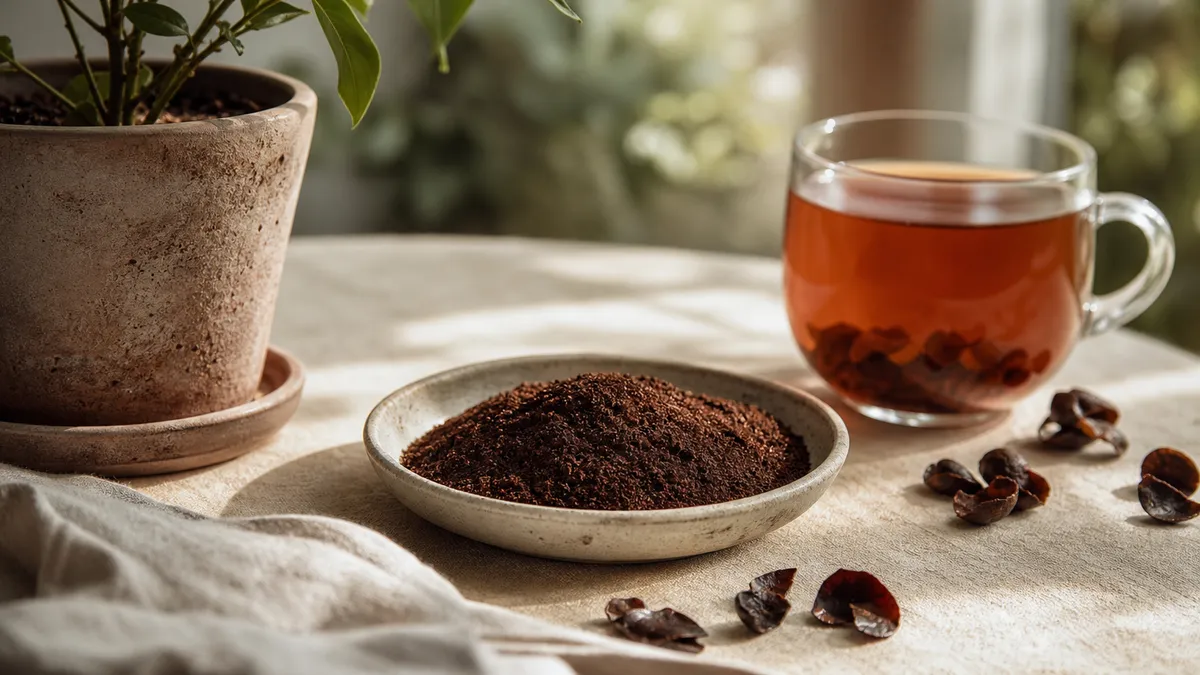
Reusing coffee grounds and cascara is the practical next read for understanding which material you have and what can sensibly happen to it. Spent grounds are the residue after brewing. Cascara is coffee-fruit material, including dried pulp or skin, rather than something produced by a workplace coffee machine.
For gardening, the Royal Horticultural Society recommends incorporating grounds into compost. It cautions against thick applications that can obstruct water and air reaching roots. “Useful in compost” does not mean “suitable as a deep mulch around every plant”.
For more elaborate recovery projects, ask what the process requires and what product it replaces. Coffee LCA research includes considerable work on by-product recovery, but its methods and reporting remain inconsistent. An attractive new use is therefore a starting point for assessment, not sufficient evidence of an overall environmental benefit.
Workplace grounds in England
England’s Simpler Recycling rules took effect on 31 March 2025, with an extension until 31 March 2027 for micro-firms with fewer than 10 full-time-equivalent employees. Food waste includes coffee grounds. These dates and instructions are specific to England, not a UK-wide collection rule.
Keep the workplace plan straightforward: identify the grounds stream, agree collection instructions, assign responsibility and check the bins. Investigate a separate reuse project only when someone can explain its handling and destination.
FAQ
Does “carbon neutral” mean a coffee has no environmental impact?
No, a carbon claim does not establish that a coffee has no environmental impact. Ask what the claim covers and what evidence supports it, rather than extending it to forests, biodiversity or waste. The Green Claims Code requires claims to avoid misleading impressions, including those created by highlighting one favourable aspect while obscuring others.
Can a home composting label settle a workplace disposal question?
No, the workplace’s collection instructions still determine what belongs in its bins. In England, government guidance says compostable packaging cannot be recycled with workplace food waste. Check whether a dedicated collection accepts the exact item; do not assume that a compostability claim makes it compatible with the site’s ordinary waste service.
Should I compare coffees using emissions per kilogram or per drink?
Use the unit that matches your decision, and keep it consistent. A kilogram-based comparison can inform a product enquiry, while a drink comparison must specify the serving and ingredients. The UK-focused modelling study demonstrated that different functional units can change rankings, so none should be presented as the only meaningful comparison.
Where to go next
Read Coffee and the Environment: The Complete Guide for the connected explanation, then Carbon Footprint to interpret emissions comparisons. Choose Deforestation and Coffee for sourcing evidence, or Reusing Coffee Grounds and Cascara when the immediate task is handling coffee by-products.
Use this Coffee and the Environment hub to choose the right question before choosing the claimed solution.
Sources
-
Sustainable Production and Consumption, Unravelling life cycle impacts of coffee: Why do results differ so much among studies? (2024).
https://www.sciencedirect.com/science/article/pii/S2352550924001027 -
Sustainable Production and Consumption, Environmental and economic sustainability assessment of the production and consumption of different types of coffee in the UK (2024).
https://www.sciencedirect.com/science/article/pii/S2352550924001647 -
Environmental Impact Assessment Review, A systematic review of life cycle assessment and environmental footprint for the global coffee value chain (2025).
https://www.sciencedirect.com/science/article/pii/S0195925524003275 -
World Coffee Research, Climate Change + Coffee (undated, current programme page).
https://worldcoffeeresearch.org/programs/climate-mitigation -
Frontiers in Climate, Mitigating climate risks in coffee production through agroforestry: global evidence from a systematic review and meta-analysis (2025).
https://www.frontiersin.org/journals/climate/articles/10.3389/fclim.2025.1699037/full -
Council of the European Union, EU deforestation-free products regulation (current guidance, checked 2026).
https://www.consilium.europa.eu/en/policies/deforestation-free-products/ -
Soil Association, Why organic? (undated, current guidance).
https://www.soilassociation.org/what-we-do/championing-organic/why-organic/ -
Rainforest Alliance, Policy: Alignment with the European Union Deforestation Regulation (EUDR) (current policy, correction dated 22 September 2026).
https://knowledge.rainforest-alliance.org/docs/alignment-with-the-eudr-policy -
Italian Journal of Food Science, Streamlined life cycle assessment of packaging waste in coffee preparation and consumption (2025).
https://www.itjfs.com/index.php/ijfs/en/article/view/3256 -
Competition and Markets Authority, Making environmental claims on goods and services (2021).
https://www.gov.uk/government/publications/green-claims-code-making-environmental-claims/environmental-claims-on-goods-and-services -
Journal of Industrial Ecology, Environmental Implications of Consumer Convenience: Coffee as a Case Study (2018, first published online 2017).
https://onlinelibrary.wiley.com/doi/10.1111/jiec.12487/full -
Department for Environment, Food & Rural Affairs, Simpler recycling: workplace recycling in England (current guidance, checked 2026).
https://www.gov.uk/guidance/simpler-recycling-workplace-recycling-in-england -
Royal Horticultural Society, How to use coffee grounds for plants (undated, current advice).
https://www.rhs.org.uk/advice/grow-your-own/features/using-coffee-grounds-for-plants -
European Commission, Summary of the notification: Coffee cherry pulp (2021 notification summary, used only for the material’s description).
https://food.ec.europa.eu/system/files/2021-02/novel-food_sum_ongoing-not_2020-1762.pdf
This hub was researched using retrieved peer-reviewed studies, official regulatory guidance and specialist agricultural and horticultural sources; recommendations are editorial synthesis, not first-hand testing.
Last checked: November 2026