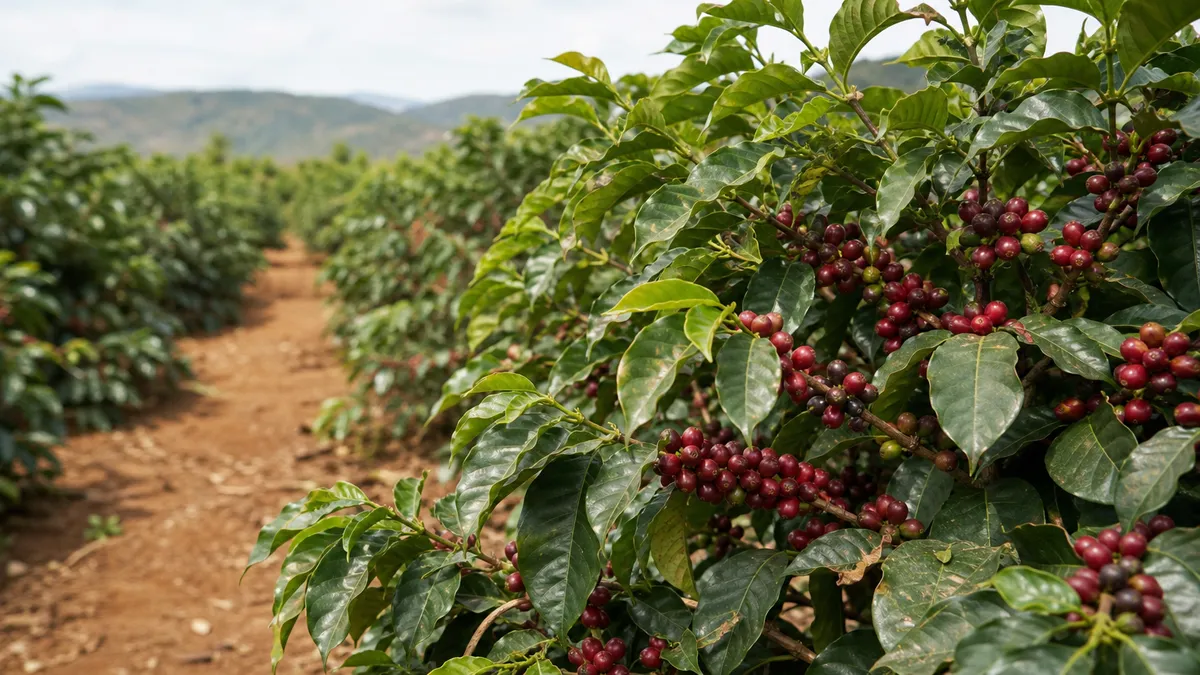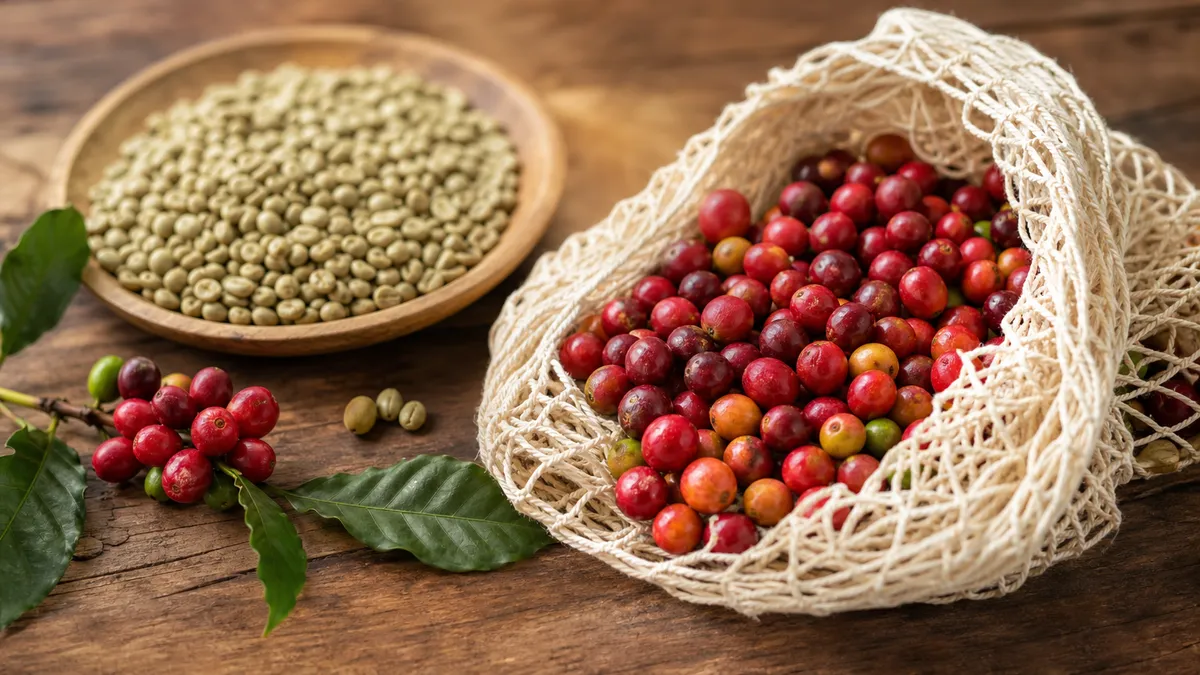
Oceania grows both arabica and robusta coffee, with Papua New Guinea’s highland smallholder gardens and Australia’s much smaller, often mechanised industry offering two contrasting starting points. For buyers, the useful distinction is not a single “Oceanian flavour”, but where the coffee grew, who processed it and what the particular lot tastes like.
In short
- Papua New Guinea’s coffee industry is dominated by smallholders, although estates and larger blocks also contribute.
- Australian-grown coffee is a different proposition from coffee merely roasted in Australia: most coffee consumed there is imported.
- PNG highland varieties include Typica, Bourbon and Arusha; established Australian plantings include K7 and Catuai.
- PNG’s main harvest normally falls in May to July. Australia’s harvest differs between tropical and subtropical districts.
- Choose a named origin and processing method rather than treating Oceania as a flavour category.
Guides in Oceania
 Australian-Grown Coffee: Regions, Varieties and TasteDiscover Australian-grown coffee, from Queensland and northern NSW to mechanised harvesting, arabica varieties, harvest seasons and typical flavours.Read the guide
 Papua New Guinea CoffeeDiscover Papua New Guinea coffee: highland garden growing, Typica varieties, washed processing, flavour and what UK buyers should look for in a lot.Read the guide
Start here if you are new
- Read Papua New Guinea first to understand coffee gardens, highland growing districts and the journey from smallholder to exporter.
- Follow with Australia for the contrast: a small domestic crop, machinery-friendly farm layouts and research into varieties suited to local conditions.
For the wider framework of species, varieties and geographical origin, start with beans and origins.
Oceania coffee at a glance
This guide concentrates on PNG and Australia, the two country guides in this section. They are not the whole Pacific coffee story: Hawaii also produces coffee, as recorded in United States Department of Agriculture statistics. The comparison below should therefore be read as a route into two contrasting origins, not an exhaustive inventory of every Pacific producer.
Origin fact panel
| Feature | Regional reference |
|---|---|
| Growing environments and altitude | PNG’s Coffee Industry Corporation rates arabica sites at 1,100 to 1,899 metres within its two highest altitude-suitability categories. These are agronomic bands, not national production limits. Australia combines lower-elevation subtropical districts with tropical tablelands. |
| Main species and varieties | PNG: predominantly arabica, with a smaller lowland robusta sector; Typica, Bourbon, Arusha, Mundo Novo, Caturra and Catimor appear in grower guidance. Australia: commercial arabica, including established K7 and Catuai plantings. |
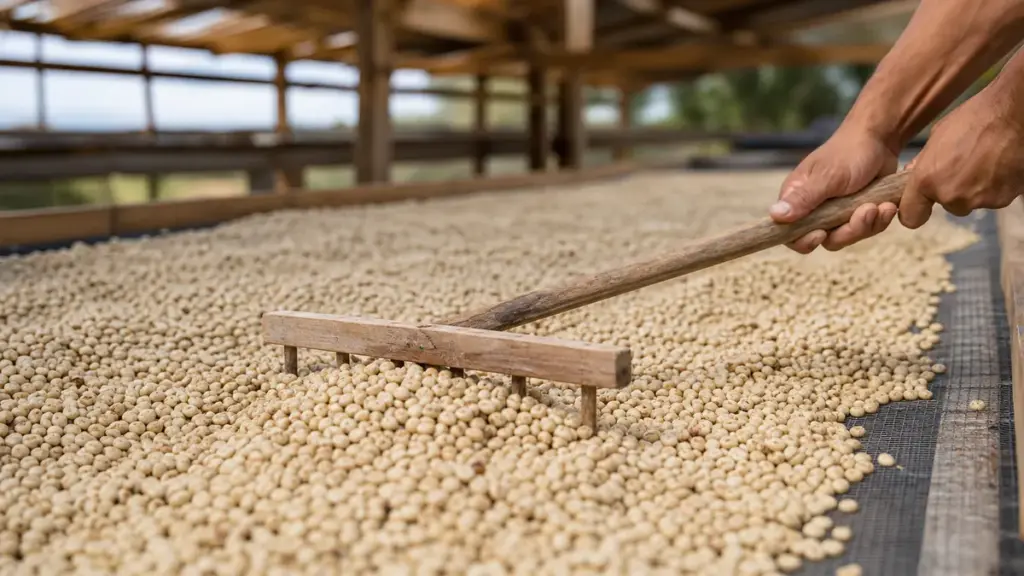
| Processing | PNG smallholders commonly pulp, ferment, wash and dry coffee. Australian research documents washed, mechanically demucilaged and natural processing, among other variations. |
| Harvest months | PNG: normally May to July for the main harvest, with additional picking outside that peak. Australia: generally May to August in tropical districts and September to January in subtropical districts. |
| Cup pointers | PNG lots can combine chocolate and caramel with citrus, berries or tropical fruit. Australian sensory research describes fruity and nutty flavours, smooth texture and low to medium acidity. These are pointers, not guarantees. |
The altitude bands come from the CIC handbook; varieties, harvesting and processing are documented in the grower resources listed below. Cup descriptions draw on Australian sensory research and identified PNG importer lots, rather than a claim that every coffee shares those characteristics.
Papua New Guinea: coffee gardens and highland livelihoods
Read Papua New Guinea when a bag names a highland district or producer group and you want to understand the supply chain behind it. That country guide provides the closer view; the regional lesson is how much coffee can depend on numerous small gardens rather than a handful of large plantations.
PNG’s principal producing provinces include Eastern Highlands, Western Highlands, Jiwaka, Morobe and Simbu. Arabica is associated mainly with the highlands, while robusta, the trade name for Coffea canephora, is grown in warmer lowland areas.
“Coffee garden” is a useful description, not a suggestion that production is insignificant. Coffee can grow alongside a household’s food crops, with families harvesting and carrying out initial processing themselves. Smallholder coffee then passes through buyers, mills and exporters before becoming the traceable lot a roaster purchases.
Small-scale does not mean a simple supply chain
A Bank of Papua New Guinea study describes growers using hand pulpers, sun-drying their coffee and selling parchment to roadside buyers or factories. Parchment is the thin protective layer still surrounding the dried seed before final milling.
This means a named mill on a bag is not necessarily the farm where the cherries grew. Ask whether it received fresh cherries or already processed parchment, and whether the lot represents an estate, a village group or a wider collection area.
Fieldwork by researchers working with the International Food Policy Research Institute and the University of Goroka documented practical constraints in Simbu and Eastern Highlands communities. These included ageing trees, coffee berry borer damage and uneven access to markets and agricultural support. The findings describe the communities studied, not every PNG farm.
For buyers, the implication is to look for evidence of careful aggregation and processing, rather than assuming that either “smallholder” or “estate” automatically predicts quality.
Australia: a small crop with a different production model
Read Australia when you want to distinguish genuinely Australian-grown beans from the country’s much larger roasting and café industry. Growing origin and roasting location answer different questions.
AgriFutures identifies the Atherton Tablelands in Queensland and the Northern Rivers district of New South Wales as major production concentrations. The industry also includes growers in south-east Queensland.
Australian-grown coffee remains a niche product. AgriFutures’ 2026 cultivar-report overview states that more than 99% of coffee consumed in Australia is imported. A bag roasted in Melbourne or Sydney therefore tells you nothing, by itself, about where its beans grew.
Mechanisation matters, but it is not universal
Compared with PNG’s predominantly manually harvested smallholder gardens, Australian commercial production makes greater use of mechanical harvesting. Suitable farms can be arranged in accessible rows, with pruning and plant shape managed around machinery.
This does not mean that every Australian farm mechanically harvests its coffee. The Australian Coffee Growers’ Manual explicitly discusses smaller plantations where hand harvesting is feasible. Nor does a small national industry mean that each Australian farm is smaller than a PNG garden.
Mechanical harvesting also changes where selection happens. Machinery can collect fruit at different stages of ripeness, making separation and processing important after harvest. Australian processing research documents systems designed to remove immature and over-mature fruit from the preferred ripe-cherry stream.
The useful comparison is therefore between production systems, not between supposedly “traditional” quality and “industrial” quality.
Comparing the two origins
The criteria here are growing environment, farm organisation, harvesting and the information a buyer should seek. Neither country receives an automatic quality ranking.
| Criterion | Papua New Guinea | Australia |
|---|---|---|
| Main growing setting | Tropical highlands for arabica; warmer lowlands for robusta | Tropical tablelands and subtropical eastern districts |
| Production organisation | Smallholder gardens dominate, alongside blocks and estates | A small national industry with individual commercial farms |
| Harvesting emphasis | Manual picking in smallholder systems | Mechanical harvesting is significant; hand harvesting also occurs |
| Buyer’s key question | Which growers supplied the lot, and where was it processed? | Were the beans grown in Australia, and at which farm? |
| Useful starting preference | Explore named highland lots with chocolate, fruit or citrus descriptions | Explore farm-identified lots described as smooth, fruity or nutty |
What production figures can, and cannot, tell you
PNG’s CIC reported production of 1,002,855 bags, or 60,171 tonnes, for 2023 in its January to March 2024 newsletter. This is a dated reported output, not a claim about the current harvest.
Australian figures need additional care. An AgriFutures feature published in 2025 describes annual production as less than 300 tonnes, while its February 2026 cultivar-report overview gives about 600 tonnes annually in a passage discussing the industry in 2025. The retrieved summaries do not explain the difference.
Both establish the industry’s small scale, but they do not support a precise, harmonised comparison. Do not turn them into a country production ratio without matching the reporting year, product basis and collection method.
Varieties: familiar names, different growing conditions
Arabica, Coffea arabica, is a species. Typica, Bourbon and Catuai are variety names within arabica; they are not countries, processing methods or roast levels.
PNG grower guidance covers Typica, Bourbon, Arusha, Mundo Novo, Caturra and Catimor. A bag may list several because its contributing gardens contain mixed plantings. Unless a producer has separated the harvest, a variety list should not be read as a single-variety claim.
The CIC handbook also uses “Blue Mountain” for a Typica-type coffee introduced into PNG. On a PNG label, that name does not turn the coffee into Jamaican-grown coffee: botanical material and geographical origin must remain separate.
Australia’s established K7 and Catuai plantings illustrate why variety choice is about farm management as well as flavour. World Coffee Research describes K7 as tall and Catuai as compact. Those differences matter when growers need to maintain trees within a practical harvesting height.
AgriFutures’ 2026 trial overview identifies Marsellesa, IPR107, Paraiso and Parainema among promising replacement cultivars. Their suitability for mechanised harvesting is part of the research outcome. It is not evidence that these names already dominate the coffee available to UK buyers.
What does Oceania coffee taste like?
There is no defensible single regional flavour. The more useful approach is to separate documented lot descriptions from broader sensory findings.
For PNG, InterAmerican Coffee’s Eastern Highlands offerings show the range. Its Kezame description combines chocolate, caramel and berries; Kerepo includes stone fruit, citrus, honey and floral notes. These are the importer’s assessments of identified offerings, not independent tasting results from this website.
Australian evidence includes a research project analysing coffee from 28 Australian farms, with a fixed roasting approach and assessment by 15 tasting panels. Southern Cross University reports fruity and nutty flavours, smooth texture, light to medium body and low to medium acidity.
That is stronger evidence than an unsupported national tasting slogan, but it still describes the coffees studied. It cannot predict every farm, harvest or roast.
Here, acidity means the bright, fruit-like sensation in the cup; body means its perceived weight or texture. Neither term is a quality score on its own. Use those descriptions to find a coffee you might enjoy, then judge the actual lot.
Buying Oceania coffee in the UK
Treat the following as a buying checklist rather than a recommendation for a particular seller.
- Confirm the growing country. Especially with Australian branding, ask where the beans were grown, not just where they were roasted.
- Look for a named producer, group or mill. For a PNG collection lot, ask what that name represents.
- Request the processing method. “Washed” should describe processing, not serve as a general promise of quality.
- Ask for the harvest or crop information. Do not confuse it with the roast date, which records a different stage.
- Choose from the actual tasting description. A chocolate-led PNG lot and a citrus-led PNG lot may suit different preferences despite sharing a country.
For a useful comparison, choose coffees with reasonably similar intended brewing styles and ask each roaster how they recommend preparing them. This is an editorial suggestion for making the comparison easier to interpret, not a regional brewing rule.
The strongest Oceania purchase is one whose provenance and flavour description answer your questions. A regional name should begin the enquiry, not finish it.
FAQ
Does PNG’s smallholder share have one agreed percentage?
No single percentage should be presented as timeless. A Bank of Papua New Guinea paper published in 2012 gives approximately 85% of production, while the national trade portal’s CIC profile gives 87%. Both support smallholder dominance, but their different reporting contexts make them unsuitable for claiming an exact current share.
Does “Blue Mountain” on PNG coffee mean it came from Jamaica?
No. The CIC handbook uses Blue Mountain as a name for Typica-type planting material grown in PNG. The coffee’s growing origin remains Papua New Guinea. Read the country and producer information separately from the variety name, and ask the seller to clarify any label that blurs the two.
Does the main PNG harvest end all picking for the year?
No. ACIAR grower guidance places the normal main harvest in May to July but describes additional cherry ripening outside that peak. Local conditions affect the pattern. A harvest calendar is therefore background information, not a substitute for the crop dates supplied for a particular coffee.
Where to go next
Read Papua New Guinea for a closer look at highland gardens and producer supply chains, then Australia for farms, harvesting systems and Australian-grown provenance. Return to Beans & Origins to place Oceania alongside the wider questions of species, varieties and origin.
Sources
-
Coffee Industry Corporation, The Papua New Guinea Coffee Handbook, second edition, June 2016. Altitude suitability, varieties and processing terminology.
https://www.cic.org.pg/wp-content/uploads/2021/08/52029_CIC-Handbook.pdf -
Coffee Industry Corporation, CIC News, January to March 2024, page 7. Reported 2023 production and principal producing provinces.
https://cic.org.pg/wp-content/uploads/2024/08/CIC-nwsltr-01-2024.pdf_final.pdf -
Bank of Papua New Guinea, Supply Response of Coffee in Papua New Guinea, Working Paper BPNGWP2012/01, September 2012. Smallholder production, processing and species distribution.
https://www.bankpng.gov.pg/sites/default/files/2024-09/Supply-Response-of-Coffee-sector-in-PNG.pdf -
Australian Centre for International Agricultural Research, Smallholder Coffee Production in Papua New Guinea: Farmer Training Guide, Unit 1, Module 2, Coffee Nursery Development, undated module, hosted in 2024. Variety descriptions.
https://www.aciar.gov.au/sites/default/files/2024-03/FTG_Unit1_M2_04_screen.pdf -
Australian Centre for International Agricultural Research, Smallholder Coffee Production in Papua New Guinea: Farmer Training Guide, Unit 3, Module 1, Coffee Harvesting and Processing, undated module, hosted in 2025. Harvest timing and processing.
https://www.aciar.gov.au/sites/default/files/2025-04/FTG_Unit3-M1-PDF_harvest-%26-process.pdf -
Development Policy Centre, Opportunities and challenges for coffee production in PNG’s highlands, 26 June 2024. Researchers’ account of fieldwork with IFPRI and the University of Goroka.
https://devpolicy.org/opportunities-and-challenges-for-coffee-production-in-pngs-highlands-20240626/ -
AgriFutures Australia, David Peasley and Jos Webber, Australian Coffee Growers’ Manual, June 2024, publication 24-130. Harvest seasons and hand-harvesting provision; relevant passages retrieved through indexed document search.
https://www.agca.au/_files/ugd/61d322_7a404588343048399dab74decb62d82c.pdf?index=true -
Rural Industries Research and Development Corporation, James Drinnan, Influence of processing on the flavour of Australian Coffee, April 2007, publication 07/065. Farm layout, harvesting selection and processing mechanisms, used as historical technical evidence rather than a current industry census.
https://era.dpi.qld.gov.au/id/eprint/7385/1/07-065.pdf -
AgriFutures Australia, Assessing the Performance of International Coffee Cultivars in Australia, 10 February 2026, publication 25-120, published overview. Production estimate, growing concentrations and cultivar-trial findings.
https://agrifutures.com.au/product/assessing-the-performance-of-international-coffee-cultivars-in-australia-2/ -
AgriFutures Australia, Brewing an Australian future: The rise of locally grown coffee, 2025. Alternative Australian production estimate.
https://agrifutures.com.au/news/brewing-an-australian-future-the-rise-of-locally-grown-coffee/ -
World Coffee Research, Arabica Coffee Varieties, living online catalogue, “K7” and “Catuai” entries, accessed 2026. Plant stature and variety terminology.
https://varieties.worldcoffeeresearch.org/varieties/k7
https://varieties.worldcoffeeresearch.org/varieties/catuai -
Southern Cross University, A double shot for Australia’s emerging coffee-growing industry, 5 December 2023. Sensory findings, study design and growing environments.
https://www.scu.edu.au/news/2023/coffee-wheel-and-terroir/ -
InterAmerican Coffee, Papua New Guinea Limited Edition Coffees, undated live origin page, accessed 2026. Identified offering descriptions and smallholder supply-chain context.
https://interamericancoffee.com/papua-new-guinea-limited-edition-coffees/ -
Papua New Guinea National Trade Office, The Coffee Industry Corporation (CIC), undated live profile, accessed 2026. Alternative smallholder-share figure.
-
USDA National Agricultural Statistics Service, Coffee, annual Hawaii coffee report, released 23 January 2026, accessed November 2026. Confirmation of Hawaiian coffee production.
https://esmis.nal.usda.gov/publication/coffee/2026-01-23
Research combined official agricultural guidance, national industry reporting, primary sensory research summaries and clearly attributed importer descriptions; no first-hand testing is claimed.
Last checked: November 2026