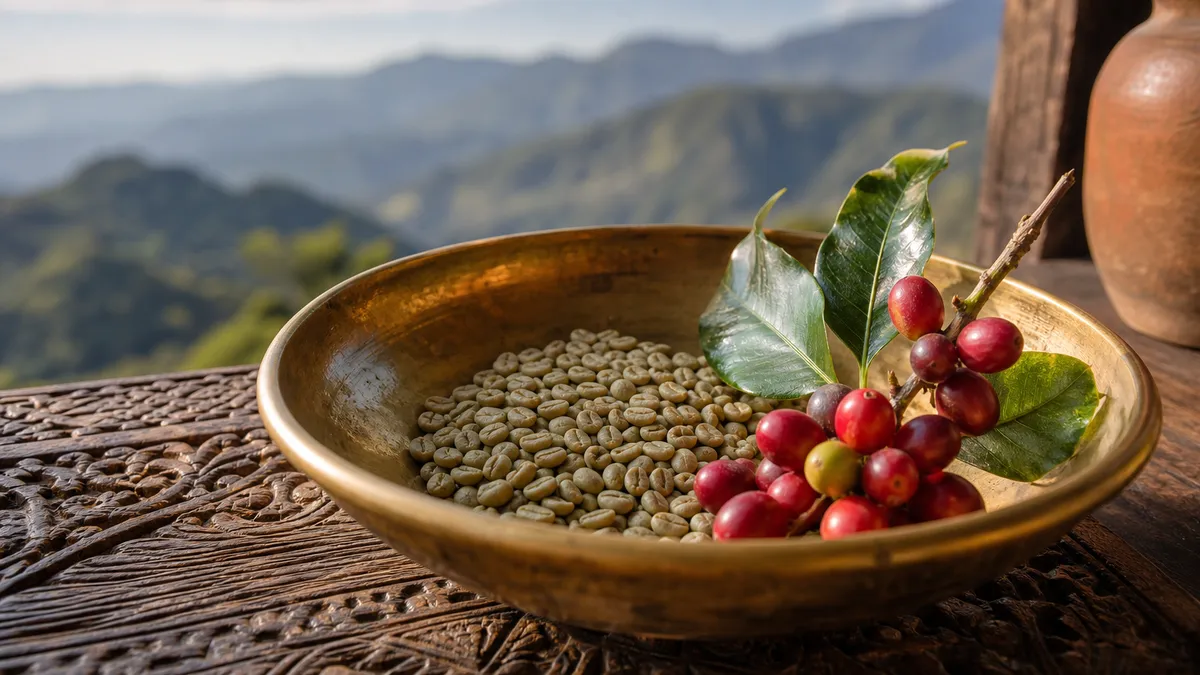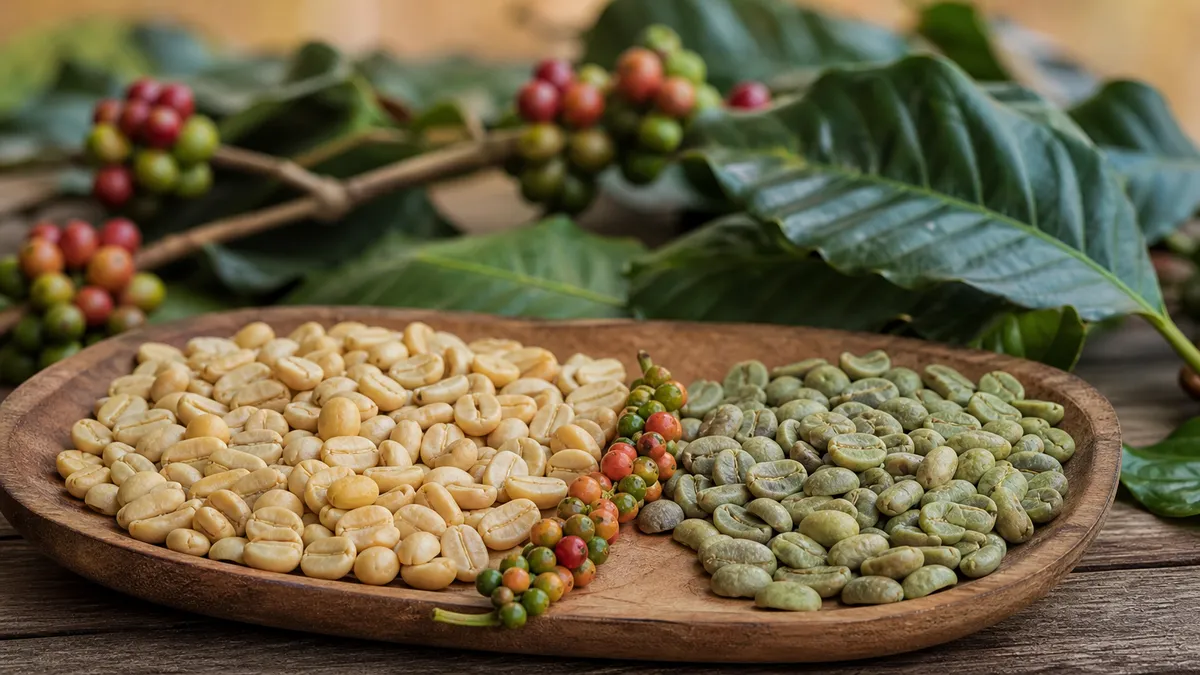
South Asia grows both arabica and robusta coffee, with India producing by far the largest crop of the three origins covered here. India is known for shade-grown estates and distinctive monsooned coffee, while Sri Lanka and Nepal offer smaller origins whose individual farms and processing methods deserve closer attention.
In short
- Monsooned coffee is a post-harvest preparation, not a coffee species or a description of everything grown in a monsoon climate.
- India and Sri Lanka grow both arabica and robusta; Nepal’s commercial coffee sector centres on arabica.
- Shade trees and mixed cropping are important features, particularly in India, but do not by themselves establish organic certification.
- For flavour, distinguish heavy, mellow monsooned coffee from washed coffees with more noticeable acidity.
- Buy by named origin, species, processing method and roast suitability, rather than expecting one “South Asian” taste.
Guides in South Asia
 Indian Coffee: Regions, Varieties and Monsooned MalabarDiscover Indian coffee through shade-grown estates, arabica and robusta, regional cup profiles, grading terms and the Monsooned Malabar process.Read the guide
 Sri Lanka and Nepal CoffeeDiscover Sri Lanka’s coffee revival and Nepal’s foothill farms, with sourced origin facts, tasting notes and practical advice for choosing UK offerings.Read the guide
Start here if you are new
Begin with beans and origins if species, varieties and processing methods are unfamiliar. It provides the background needed to understand what a coffee label is telling you.
Next, read India to explore the region’s largest producer and the difference between its conventional and monsooned coffees. Follow with Sri Lanka and Nepal when you want to investigate these smaller origins beyond a country name on a bag.
South Asia coffee: origin facts
These are orientation figures and examples, not boundaries within which every farm must fit. Elevations are metres above sea level; harvest timing varies with location and weather.
| Feature | Regional guide |
|---|---|
| Altitude | India’s Coffee Board gives indicative growing elevations of 1,000 to 1,500 m for arabica and 500 to 1,000 m for robusta. Nepal’s national export strategy describes a principal mid-hill belt of 800 to 1,600 m. Sri Lankan agricultural guidance generally places arabica above 800 m and robusta below it. |
| Species and varieties | Coffea arabica and Coffea canephora, traded as robusta. Indian arabica names include S795, Kent, Cauvery and Selection 9. Nepal’s export strategy records Bourbon, Typica and Yellow Caturra. Sri Lankan recommendations include Lakparakum arabica and S274 robusta. |
| Processing | Washed and natural processing occur in the region. India also prepares monsooned coffee from selected dry-processed beans. |
| Harvest months | India: generally November to January for arabica and December to February for robusta. Nepal’s export strategy gives January to March. A Sri Lankan sector study reports harvesting around May or October, depending on region; ask for the individual lot’s harvest period. |
| Cup profile | There is no single regional profile. Useful reference points include mellow, heavy-bodied monsooned coffee; chocolate and nut-led robusta; and arabicas offering fruit, citrus, floral or spice notes. These are tendencies and documented examples, not guaranteed flavours. |
The countries compared
The production figures below retain their original reporting periods and descriptions. They are not a synchronised regional total, and the published tables do not establish an identical processing basis for every country.
| Country | Main coffee areas | Coffee to investigate | Published production |
|---|---|---|---|
| India | Karnataka, Kerala and Tamil Nadu, with additional production in Andhra Pradesh, Odisha and the north-east | Washed arabica, natural arabica and robusta, and monsooned preparations | Coffee Board final estimate for 2025/26: 373,000 tonnes, comprising 111,000 tonnes arabica and 262,000 tonnes robusta |
| Sri Lanka | Central highlands including Nuwara Eliya, Kandy, Matale and Badulla; lower-elevation robusta areas include Kegalle and Kurunegala | Traceable highland arabica and clearly identified robusta lots | Department of Export Agriculture estimated annual production for 2025: 3,416 tonnes |
| Nepal | Mid-hill districts including Gulmi, Palpa, Syangja, Kavrepalanchok and Nuwakot | Named arabica estates, cooperatives and washing-station lots | National Tea and Coffee Development Board reported production for fiscal year 2022/23: 394.4 tonnes |
Production sources checked in November 2026. The Nepal figure is an older, explicitly dated reference, not a claim about its current annual crop.
India: more than monsooned coffee
India is the natural starting point because it offers several quite different coffee styles. Its Coffee Board describes a mixed, two-tier shade canopy, with coffee sharing estates with crops such as pepper, cardamom, banana and orange.
Do not let Monsooned Malabar stand in for the whole country. The Board describes washed Mysore Nuggets Extra Bold arabica as having noticeable acidity and a hint of spice, while its Robusta Kaapi Royale description emphasises body and a soft, mellow flavour.
Choose the India guide when you need to distinguish growing regions, varieties and named preparations. A coastal processing name and a hillside growing origin answer different questions about the same coffee.
Sri Lanka: an origin to read at lot level
Sri Lanka grows both major commercial species. Its agricultural guidance identifies cooler highland areas for arabica and warmer, lower areas for robusta, while recognising that suitability also depends on the planting material.
The Export Development Board gives useful flavour examples: honey and fruit around Bandarawela, and citrus and floral characteristics around Kotmale. Treat these as origin descriptions rather than a promise that every bag from either area will taste alike.
Nepal: mid-hill arabica, not summit-grown coffee
Nepal’s national export strategy describes arabica grown mainly by small farmers in the mid-hills. “Himalayan” is useful geographic context, but a named district and farm elevation tell you more about the growing conditions.
There are exceptions to broad altitude summaries. Blaser Trading lists its Plantec estate coffee at 670 to 730 m, below the principal belt in the national strategy, illustrating why the individual lot’s details should take precedence over a regional shorthand.
Use Sri Lanka and Nepal for a closer reading of these origins and their distinct production histories.
What monsooned coffee actually is
Monsooning deliberately changes already processed green coffee through exposure to humid seasonal air. It is neither a variety nor a method of leaving ripe cherries outdoors in the rain.
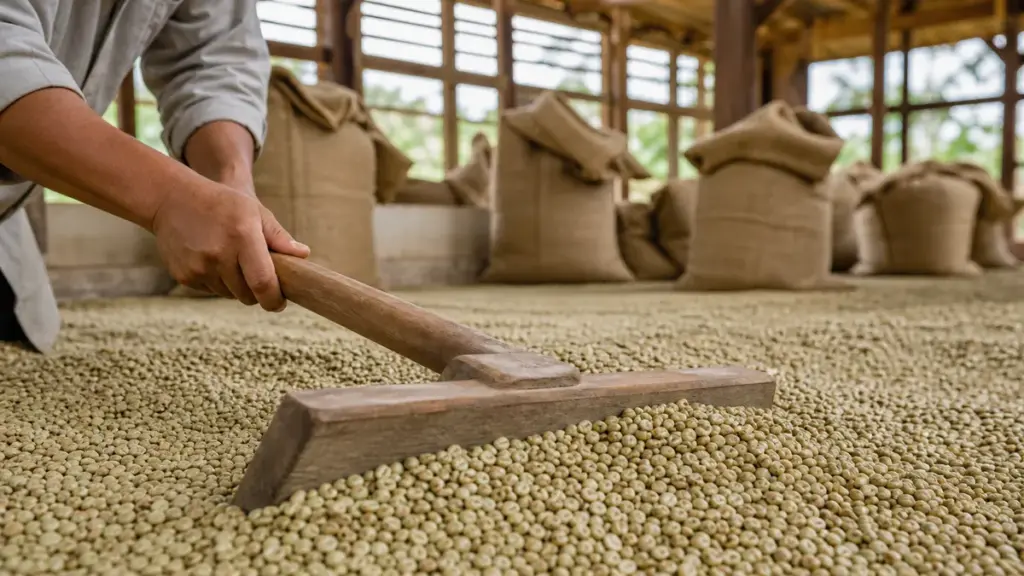
The Coffee Board describes preparation at curing works on India’s west coast during June to September. Selected dry-processed arabica or robusta beans are spread in ventilated warehouses, raked and loosely bagged so that moist air can circulate.
As the beans absorb moisture, they swell and change towards pale yellow or straw. Repeated handling helps make the treatment more uniform and control mould growth; the Board describes a preparation period of 12 to 16 weeks.
In the cup, the defining direction is reduced perceived acidity and a heavy, mellow character. The Board’s description includes a pronounced aged or musty character, which helps explain why the style can divide opinion.
Buying judgement: choose monsooned coffee because you want that particular sensory character, not because it is automatically better than an ordinary washed or natural lot. If you favour lively citrus notes and a lighter-feeling cup, it would not be my first recommendation.
Shade-grown estates and mixed farming
Shade-grown coffee is cultivated beneath taller trees rather than in an entirely open planting. India’s mixed estates are a prominent example, but shaded systems also appear in Nepal; Sri Lankan guidance allows coffee with or without shade according to local conditions.
The mechanism matters. A canopy changes the light and temperature experienced by the coffee plants, while the wider planting system affects soil cover and nutrient cycling. Shade is therefore an agricultural management choice, not merely an attractive backdrop.
Nor is there a universal rule that more shade or greater altitude produces better coffee. A peer-reviewed study in Gulmi, Syangja and Palpa compared shaded and unshaded coffee across elevation bands. Within that study, coffee at 900 to 1,100 m under shade performed particularly well for production and several physical bean attributes.
That was a field comparison involving particular farms and planting material, not proof of an optimum for all Nepalese coffee. Its measurements also do not establish a universal flavour ranking.
For buyers, ask what “shade-grown” means on the specific farm. Keep it separate from claims about certified organic production, biodiversity outcomes or working conditions, each of which needs its own supporting evidence.
A short history of South Asian coffee
The three countries do not share one introduction story or one route into commercial production.
- 1860s: coffee leaf rust devastated Sri Lanka’s plantation sector, according to the Market Development Facility’s historical account. Tea subsequently replaced much of the island’s coffee cultivation.
- 1938: Nepal’s national export strategy dates its first coffee planting to seeds brought from Myanmar and planted in Aapanchaur.
- 1940s: India’s Coffee Board dates the release of S795 to this decade. The variety remains an important part of Indian arabica cultivation.
- Late 1970s: Nepal’s export strategy records government seed distribution helping coffee expand as a commercial crop.
India’s familiar Baba Budan story belongs alongside this timeline, but with a different evidence label. The Coffee Board recounts the tradition of seven beans brought from Yemen to Karnataka; it should be presented as a foundation story rather than an independently established count.
Understanding species, varieties and flavour
Arabica and robusta are different species; S795 and Bourbon are variety names. Monsooned describes preparation, while a place name identifies geography. Keeping those categories separate makes otherwise crowded labels much easier to read.
S795 also shows why simple labels can conceal complicated breeding histories. World Coffee Research records its parentage as S288 crossed with Kent, with Coffea liberica ancestry entering through S288. It is nevertheless catalogued and traded as an arabica variety, not as a separate bag category of liberica coffee.
Flavour evidence needs similar care. Kerala’s agricultural information service describes Wayanad robusta with chocolate and nut characteristics, while Sri Lanka’s export board records fruit, honey, citrus and floral examples.
For Nepal, Blaser Trading describes one washed estate coffee with spicy, floral and nutty notes and a caramel-like finish. That is a supplier’s description of a particular coffee, not evidence for a national flavour fingerprint.
The most useful question is therefore not “What does South Asia taste like?” but “Which species, process and named lot gives me the character I enjoy?”
Buying South Asian coffee in the UK
Use this checklist when comparing roasters’ descriptions:
- Identify the origin precisely. Prefer a named estate, cooperative, district or washing station over “Asian coffee”. Ask whether the product is a single-country coffee or a blend.
- Check the species. For Indian and Sri Lankan coffee, do not assume that “single-origin” means arabica. Ask for blend composition where it matters to your choice.
- Read the processing description. Washed coffee has its fruit removed before the later processing and drying stages; natural coffee dries within the fruit. Monsooning is a further, distinct preparation.
- Ask which harvest the lot comes from. A country’s usual picking months do not establish the age of the beans currently being sold.
- Choose for your intended drink. As a practical preference, I would begin with a mellow, body-led coffee for milk drinks, and a roaster-described citrus or floral arabica for drinking black.
- Interrogate broad quality claims. Ask for lot-specific tasting information and traceability rather than treating a large bean, high elevation or unusual country name as sufficient evidence.
For an office bean-to-cup machine, ask the roaster and machine supplier to confirm suitability for the equipment and drinks being served. A sample assessed in that workplace is more useful than assuming that everyone wants the strongest-tasting option.
For a first comparison of South Asian coffee, I would choose an Indian washed arabica alongside a monsooned coffee. Add a traceable Sri Lankan or Nepalese arabica afterwards, so you explore a different origin without mistaking the monsooning process for the region’s default flavour.
FAQ
Does “Malabar” mean the coffee was grown beside the sea?
Not necessarily: the name can identify the coastal monsooning preparation rather than the farm’s location. Coffee grown in inland hill regions can be taken to west-coast curing works for treatment. Ask for both the growing origin and the processing location if you want a complete account of the lot.
Is all Nepalese coffee organic?
No blanket certification claim should be assumed from the country name. Nepal’s sector literature describes widespread organic practices, but a description of farming practice is not evidence that every exported lot holds certification. If certification matters to your purchase, ask the seller for documentation covering the actual coffee.
Can South Asian coffee be fruity rather than earthy?
Yes, and monsooned coffee should not define your expectations of the whole region. Sri Lanka’s Export Development Board describes honey and fruit characteristics in Bandarawela coffee and citrus and floral notes around Kotmale. Look for a named lot with an appropriate processing and roast description rather than relying on nationality alone.
Where to go next
Read India to separate its growing regions from its named coffee preparations, then Sri Lanka and Nepal for a closer look at the smaller origins. Return to Beans & Origins when you want to connect these countries with the wider questions of species, varieties and processing.
Sources
- Coffee Board of India, Coffee Regions: India, undated live reference.
https://coffeeboard.gov.in/coffee-regions-india.html - Coffee Board of India, Coffee Statistics, live table including final estimates for 2025/26.
https://coffeeboard.gov.in/coffee-statistics.html - Coffee Board of India, Specialty Coffees, undated live reference, including monsooning and named preparations.
https://coffeeboard.gov.in/Specialitycoffee.aspx - World Coffee Research, Arabica Coffee Varieties: S795, live catalogue entry, undated.
https://varieties.worldcoffeeresearch.org/varieties/s795 - Sri Lanka Department of Export Agriculture, Coffee, undated live cultivation reference.
https://deasrilanka.com/crop/coffee/ - Sri Lanka Department of Export Agriculture, Estimated Annual Production of Export Agricultural Crops (MT), 2015 to 2025, table through 2025.
https://deasrilanka.com/wp-content/uploads/2026/08/Production-2015-2025.pdf - Market Development Facility, Arabica Coffee Value Chain Analysis: Sri Lanka, October 2020.
https://marketdevelopmentfacility.org/wp-content/uploads/MDF-Sri-Lanka-Coffee-Report.pdf - Sri Lanka Export Development Board, Ceylon Coffee from Sri Lanka, undated live reference.
https://www.srilankabusiness.com/food-and-beverages/coffee-from-sri-lanka.html - Government of Nepal and International Trade Centre, Nepal National Sector Export Strategy: Coffee, 2017 to 2021, 2017. Copy of the full official document hosted by Jaankaari, as the original TEPC address no longer responds.
https://jaankaari.info/wp-content/uploads/2023/09/NepalNationalExportStrategyCoffee-1.pdf - National Tea and Coffee Development Board, Nepal, Coffee Statistics, official table for fiscal years 2073/74 to 2081/82; 2079/80 is fiscal year 2022/23. Accessed November 2026.
https://www.teacoffee.gov.np/pages/coffee-statistics-17/ - USDA Foreign Agricultural Service, Coffee Annual: India, report IN2024-0021, 2024.
https://apps.fas.usda.gov/newgainapi/api/Report/DownloadReportByFileName?fileName=Coffee+Annual_New+Delhi_India_IN2024-0021.pdf - Paudel, Parajuli, Regmi and Budhathoki, Effect of altitude and shade on production and physical attributes of Coffee in Gulmi, Syangja and Palpa districts of Nepal, Journal of Agriculture and Natural Resources, 4(1), 2021.
https://media.neliti.com/media/publications/331392-effect-of-altitude-and-shade-on-producti-abec4b12.pdf - Blaser Trading, Nepal Mount Everest Supreme, undated live supplier specification and sensory description.
https://www.blasertrading.ch/en/nepal-mount-everest-supreme - Farm Information Bureau, Government of Kerala, Kerala Karshakan E-Journal, August 2025, coffee geographical indications feature.
https://fibkerala.gov.in/sites/default/files/inline-files/E_J_KK_August2025.pdf%201_compressed.pdf
This page was researched from national coffee and agricultural bodies, an official export strategy, peer-reviewed field research and explicitly attributed supplier descriptions; production periods and evidence limitations have been retained.
Last checked: November 2026