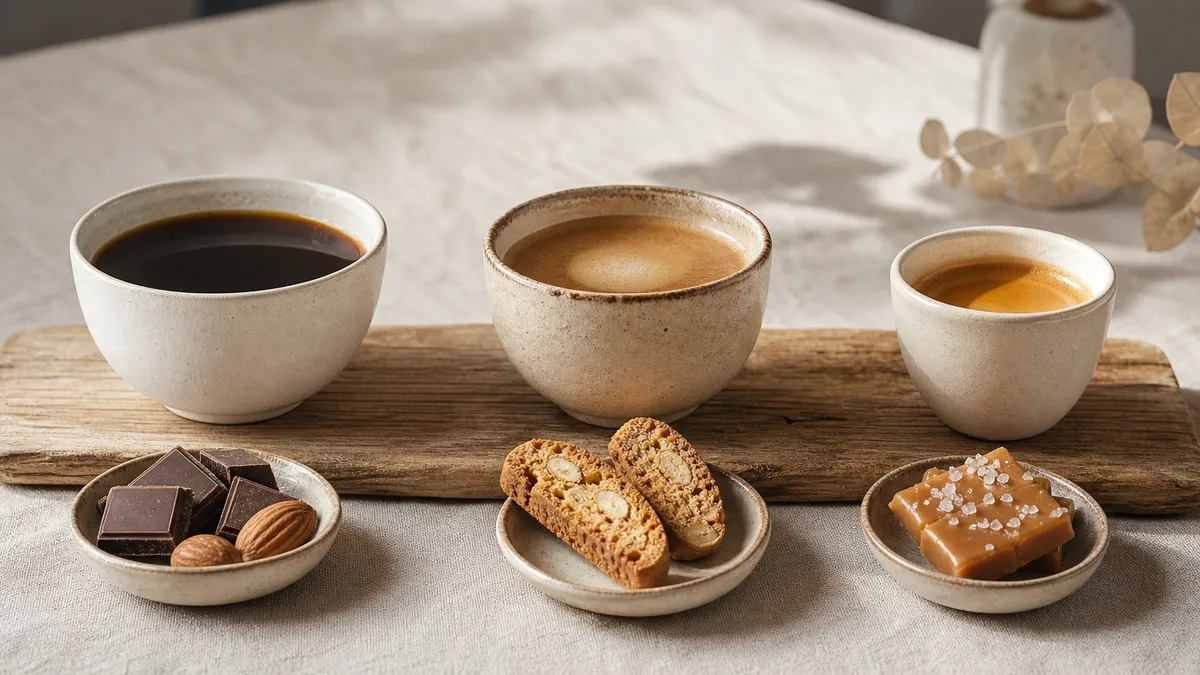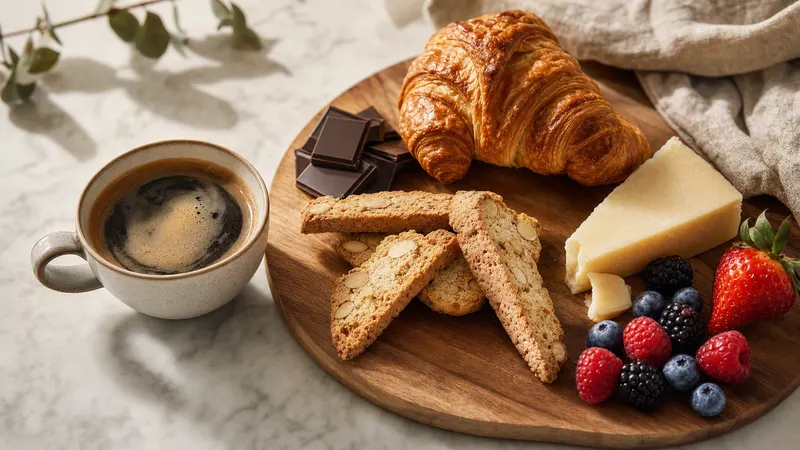
Chocolate, pastries and cheese are useful starting points for coffee and food pairings: choose a food that echoes a flavour in your cup, or try a deliberate contrast. Begin with coffee you already enjoy, then compare small bites rather than treating roast level or country of origin as a fixed matching rule.
In short
- Start with the coffee’s actual flavour: chocolatey, nutty, fruity, floral or strongly roasted.
- Choose a plain pastry before a heavily filled or iced one if you want an easy comparison.
- Try cheese as a savoury alternative, beginning with a small portion rather than a mixed cheeseboard.
- Treat the suggested combinations below as tasting experiments, not scientifically established matches.
- Keep the coffee recipe unchanged while comparing foods, so you can tell what the pairing contributes.
Guides in Coffee and Food Pairings
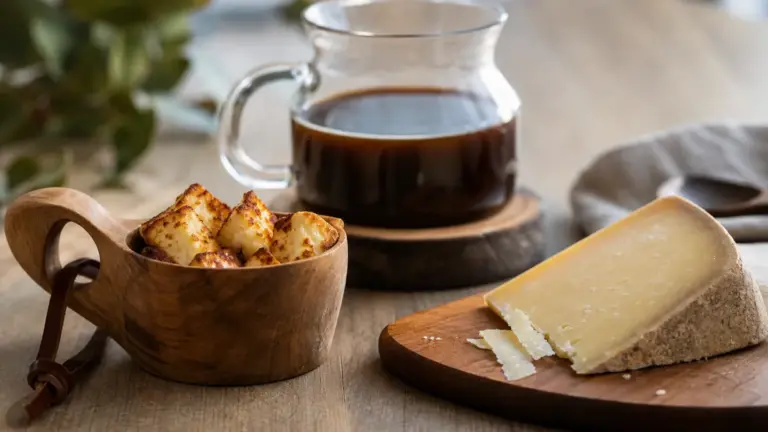 Coffee and CheeseDoes coffee go with cheese? Explore pairings by cheese style and roast, try a simple tasting, and learn how Nordic kaffeost puts cheese in…Read the guide
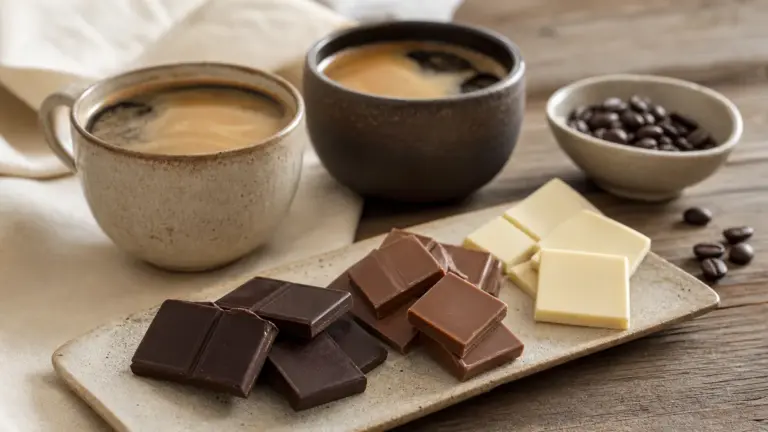 Coffee and Chocolate PairingsFind chocolate to match your coffee, understand cocoa percentages, and use a simple tasting method to compare milk, dark and origin-led pairings.Read the guide
 Coffee and Food Pairings: The Complete GuideLearn coffee and food pairing through complement, contrast, acidity, body and sweetness, with practical examples and a repeatable tasting method.Read the guide
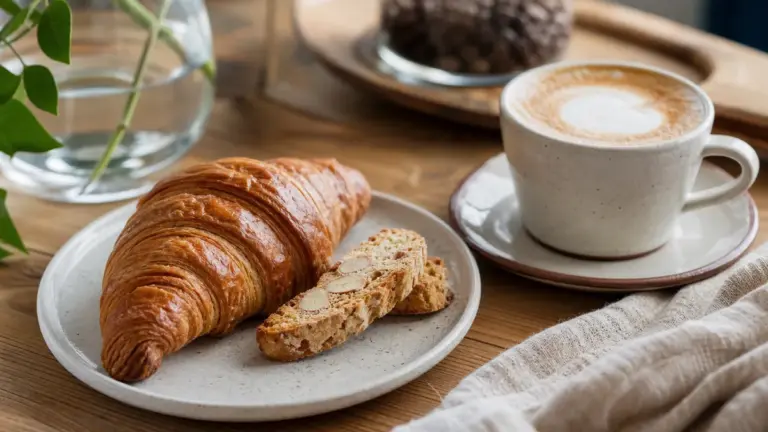 Coffee and PastriesFind coffee matches for croissants, biscotti and British bakes, with clear pairing logic, espresso drink suggestions and a simple tasting method.Read the guide
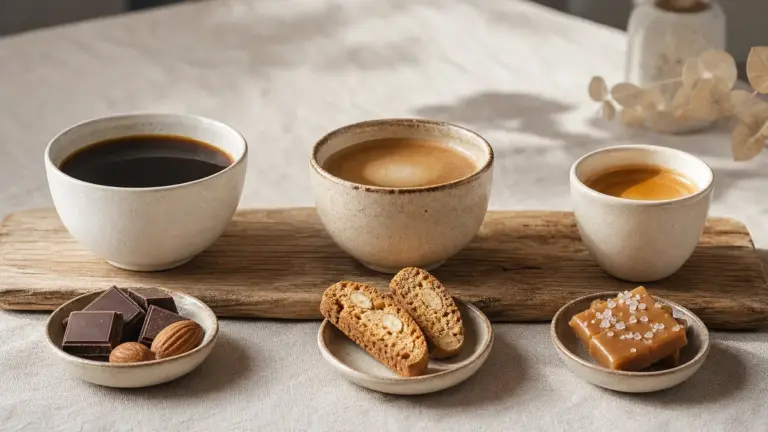 Pairing Coffee by Roast and OriginMatch light, medium and dark roasts with fruit, nuts and chocolate, then use origin notes and a simple tasting method to refine your coffee…Read the guide
Start here if you are new
This hub maps the pairing guides within brewing and recipes. Use it to choose your next read; the individual guides take each subject further.
- Learn the approach. Start with the complete pairing guide when you want a repeatable way to compare foods with coffee, rather than a list of suggested combinations.
- Try a familiar food. Move to chocolate pairings for an accessible side-by-side tasting using small pieces of different chocolates.
- Compare coffees afterwards. Read about roast and origin once you have a favourite food and want to understand which coffee characteristics to look for.
You do not need to recognise every flavour on a tasting wheel. “The coffee becomes sharper after the pastry” or “both still taste good together” are useful observations.
For a first attempt, our editorial suggestion is to take one familiar coffee and compare it with a plain croissant and a small piece of milk chocolate. The aim is not to identify a winner for everyone, but to notice which combination you would willingly have again.
Coffee and food pairings at a glance
The criteria here are shared flavour, relative intensity and ease of comparison. These are suggested starting points, not tested rankings.
| Pairing area | Suggested first experiment | What to compare | Best next read |
|---|---|---|---|
| Chocolate | A chocolatey coffee with milk chocolate, then dark chocolate | Sweetness, bitterness and the finish after swallowing | Coffee and Chocolate Pairings |
| Plain pastries | A nutty coffee with a plain croissant | Whether the coffee and pastry remain distinct | Coffee and Pastries |
| Filled pastries | A fruity coffee with a fruit-filled pastry | Whether the filling complements or dominates the cup | Coffee and Pastries |
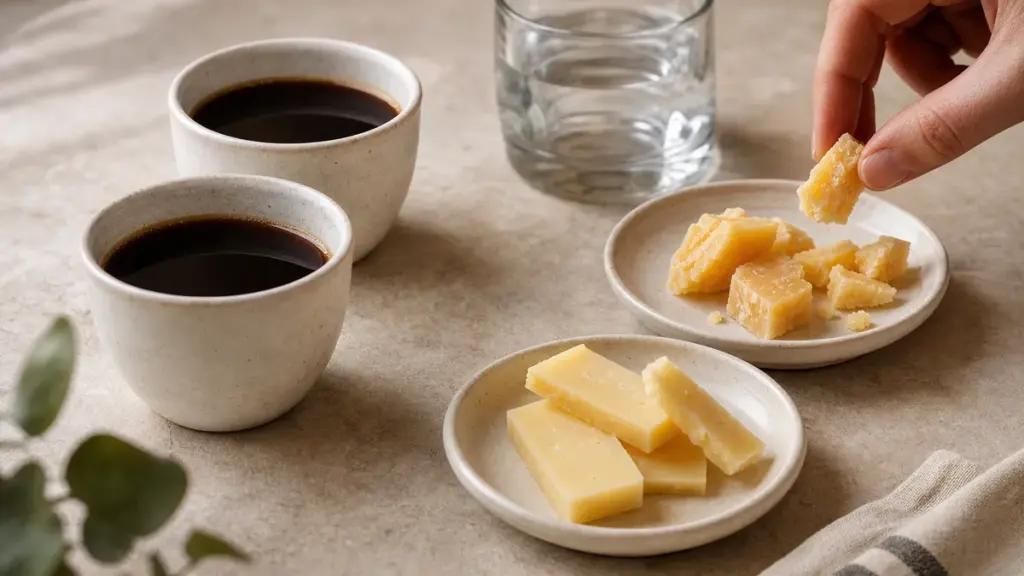
| Cheese | A rounded coffee with mild Gouda, then mature Cheddar | Saltiness, savoury flavour and the coffee’s aftertaste | Coffee and Cheese |
| Roast and origin | The same plain food with contrasting coffees | Which differences remain noticeable alongside food | Pairing by Roast and Origin |
Choose the food you actually want to eat. A technically interesting combination is not much use if you dislike one half of it.
Chocolate: compare the whole bar, not just its description
Chocolate is a practical place to begin because you can serve small, separate pieces and repeat the comparison without preparing a dish. Keep the first tasting simple: leave filled chocolates, mint and strongly flavoured additions for another session.
Our suggested starting point is a coffee you describe as chocolatey or nutty, tasted with milk chocolate and then with a darker bar. Ask whether the combination becomes pleasantly cocoa-rich, excessively bitter, or simply less interesting than either item alone.
Treat the packaging as a way to identify the samples, not as an answer to which one will work. Taste each chocolate separately before judging it with coffee, and note sweetness, bitterness and how long its flavour stays with you.
Choose coffee and chocolate pairings when you want to compare chocolate styles systematically or select chocolate around a particular coffee. It is the focused next read for building a chocolate tasting, rather than choosing between chocolate, pastry and cheese.
If your favourite chocolate overwhelms the cup, try a smaller bite before changing the coffee. That is a simple adjustment you can assess immediately.
Pastries: begin with the simplest version
Pastries offer several different pairing questions. Are you matching coffee with the pastry itself, with a chocolate filling, with fruit, or with icing?
For a first comparison, we suggest a plain croissant alongside a filled pastry. Taste the plain pastry first, then ask what changes when the filling enters the combination. This keeps the exercise focused on something you can identify rather than trying to explain the entire mouthful at once.
A useful proposed comparison is a nutty-tasting coffee with a plain croissant and an almond pastry. Another is a fruity coffee with a plain pastry and a fruit-filled version. Neither is a guaranteed match; each gives you a clear question about whether a shared flavour makes the pairing more enjoyable.
Read coffee and pastries when breakfast pastries, buns or afternoon baking are your main interest. Use it to narrow the choice around the food you are serving, rather than starting again with every possible coffee.
For a shared table, offer plain and filled items separately. Let people choose their own combination, and avoid presenting a pairing suggestion as the correct way to enjoy a familiar breakfast.
Cheese: explore the savoury side
Cheese deserves its own route through coffee pairing, rather than being treated as an odd addition to the dessert plate. It also calls for more attention to the particular cheese and the way the coffee is served.
In published interviews, cheesemongers suggest considering flavour intensity, texture, acidity and aftertaste, as well as whether the coffee is espresso, filter or milk-based. Their recommendations are professional tasting opinions, not controlled evidence that a particular cheese must suit a particular roast.
Our suggested first experiment is a rounded coffee with mild Gouda, followed by a small piece of mature Cheddar. Compare each cheese separately with the coffee before adding crackers, chutney or fruit. This lets you decide whether you enjoy the basic savoury combination.
Leave more forceful cheeses until you have found a pairing you like. There is no need to begin with the most challenging item on the cheeseboard.
Choose coffee and cheese when you want to explore savoury pairings or plan a dedicated tasting. It is the appropriate next read for selecting cheeses and comparing serving styles without turning this hub into a cheese-by-cheese catalogue.
Roast and origin: useful clues, not matching rules
Roast level can help you choose contrasting coffees, but it cannot settle a pairing on its own. Country of origin is also too broad a label to replace tasting what is in the cup.
A controlled sensory study of immersion coffee found lighter roasts generally more floral, fruity and sour, and darker roasts more bitter, burnt and roasted. Those were findings for the coffees and experimental conditions studied, not guarantees for every bag.
For pairing, translate the coffee into a few plain observations:
- What aroma or flavour stands out?
- Is the cup delicate or forceful?
- Does it taste pleasantly bright, sharply sour, noticeably bitter or rounded?
- What remains after swallowing?
World Coffee Research’s Sensory Lexicon provides reference language for describing coffee’s aroma, flavour and texture. Use such language to make comparisons clearer, not as a vocabulary test.
An important distinction is that roast level is not brew strength. Strength describes the concentration of dissolved coffee material in the drink. Extraction describes how much soluble material has been removed from the grounds. A pairing comparison becomes harder to interpret if you change both the beans and the way you brew them.
Read pairing by roast and origin when you are choosing coffee for a favourite food or comparing contrasting bags. It is the next step for interpreting roast descriptions and origin information without assigning a whole country one flavour.
Set up a small, useful tasting
Keep the first session manageable. The following is an editorial tasting method, not a formal sensory-testing protocol.
- Choose one coffee and two foods. Pick items you enjoy separately, with a clear difference between them.
- Brew your usual recipe. Record the coffee and water quantities so you can repeat it. Follow your brewer’s instructions rather than changing the method to suit an imagined pairing.
- Taste the coffee alone. Write a short description before eating anything.
- Taste a small bite, then sip. Notice what happens to both the coffee and the food’s lingering flavour.
- Repeat with the other food. Take plain water between comparisons if you find that helpful.
- Choose what you would serve again. Record enjoyment as well as flavour observations.
Keep the water source consistent too. The SCA’s technical discussion of water explains that alkalinity, the water’s acid-buffering capacity, affects the acidity of brewed coffee. Changing water during a comparison introduces another variable.
Do not try to rescue an unpleasant cup with increasingly elaborate food. First decide whether you enjoy the coffee on its own; then investigate what the food adds.
For group tastings, let people write their impressions before discussing them. This is a practical way to preserve individual observations rather than steering everyone towards the first confident description.
What pairing research can and cannot tell you
There is direct experimental evidence that eating something before coffee can change how the coffee is perceived. That does not mean science has produced a universal matching chart.
A peer-reviewed study published in 2022 examined coffees after basic-taste solutions and alongside sweet or savoury food. Effects depended on the coffee and sensory attribute, and the researchers found that some samples benefited from particular foods while others were better enjoyed alone.
The practical lesson is to test the combination, not merely compare two sets of tasting notes. A shared descriptor such as “chocolate” is a useful hypothesis, but enjoyment remains the deciding observation.
It is also worth distinguishing three questions: do the items share flavours, does either become more pleasant, and do you enjoy consuming them together? Your answer need not be the same for all three.
Serving safely at home or work
Keep food safety separate from tasting preference. Follow packaging instructions for cheese and chilled fillings, respect use-by dates, and bring out small quantities rather than leaving the entire supply on the table.
Food Standards Agency guidance for England, Wales and Northern Ireland recommends a fridge temperature of 0 to 5°C and keeping chilled food outside the fridge for the shortest possible time. A pairing session is not a reason to disregard storage instructions.
For shared food, retain ingredient information and ask about allergies before serving. Check the actual products rather than assuming that a plain-looking pastry or dark chocolate is suitable.
Use separate serving utensils where needed to prevent allergen cross-contact. The FSA also cautions that vegan labelling does not mean a product is necessarily free from animal-derived allergens such as milk.
FAQ
Can I use instant coffee for a pairing tasting?
Yes, use instant coffee if that is what you enjoy drinking. Prepare it consistently and compare foods with the drink you would normally serve. There is no need to change equipment before exploring your preferences. Begin with a plain pastry or a small piece of chocolate, then record which combination you would choose again.
Should I add milk or sugar before comparing foods?
Prepare the coffee as you intend to drink it with the food. If that means milk or sugar, keep the additions consistent throughout the comparison. You can run a separate tasting without them later, but changing the drink halfway through makes it harder to decide whether the food or the altered coffee caused your preference.
Does a successful pairing have to improve both items?
No, you can reasonably choose a pairing simply because you enjoy eating and drinking the items together. For a more revealing comparison, ask separately whether the coffee tastes better, whether the food tastes better and whether the overall experience is pleasant. Do not reject a favourite combination just because it produces no surprising new flavour.
Where to go next
Read Coffee and Food Pairings: The Complete Guide for a fuller tasting framework, or Coffee and Chocolate Pairings for a focused first experiment. Continue with Coffee and Cheese for savoury exploration, then Pairing by Roast and Origin when you want to choose the coffee around the food.
Sources
-
World Coffee Research, Sensory Lexicon, version 2.0, October 2017. Reference framework for describing coffee aroma, flavour and texture.
URL: https://worldcoffeeresearch.org/resources/sensory-lexicon. -
Rune, C. J. B., Münchow, M., Perez-Cueto, F. J. A. and Giacalone, D., Pairing coffee with basic tastes and real foods changes perceived sensory characteristics and consumer liking, International Journal of Gastronomy and Food Science, volume 30, 100591, 2022. Primary experimental research on coffee perception and food pairing.
URL: https://www.diva-portal.org/smash/get/diva2%3A1694965/FULLTEXT01.pdf. -
Batali, M. E. and colleagues, Sensory Analysis of Full Immersion Coffee: Cold Brew Is More Floral, and Less Bitter, Sour, and Rubbery Than Hot Brew, Foods, volume 11, issue 16, 2440, 2022. Primary controlled research on roast, origin, brewing temperature and sensory properties.
URL: https://pmc.ncbi.nlm.nih.gov/articles/PMC9407127/. -
Perfect Daily Grind, Ana Pipunic, How to pair specialty coffee and cheese, 15 May 2023. First-hand interviews with cheesemongers, used as professional opinion rather than experimental proof.
URL: https://perfectdailygrind.com/2023/05/how-to-pair-specialty-coffee-and-cheese/. -
Specialty Coffee Association, Marco Wellinger, Water and Coffee Acidity: How to Adapt Your Water for Different Extraction Methods, 25 Magazine, issue 9, publication year not displayed on the retrieved page. Technical explanation of alkalinity and coffee acidity.
URL: https://sca.coffee/sca-news/25/issue-9/english/water-and-coffee-acidity-how-to-adapt-your-water-for-different-extraction-methods-25-magazine-issue-9-pxjby. -
Food Standards Agency, How to chill, freeze and defrost food safely, 18 December 2017, current retrieved guidance. Food storage advice for England, Wales and Northern Ireland.
URL: https://www.gov.uk/government/publications/how-to-chill-freeze-and-defrost-food-safely/how-to-chill-freeze-and-defrost-food-safely. -
Food Standards Agency, Food allergy and intolerance advice for consumers, updated 7 August 2026. Ingredient information, allergen cross-contact and the distinction between vegan and allergen-free food.
URL: https://www.gov.uk/government/publications/food-allergy-and-intolerance-advice-for-consumers/food-allergy-and-intolerance-advice-for-consumers.
This hub was researched using retrieved sensory research, coffee reference material, professional interviews and official food safety guidance; proposed combinations and the tasting method are editorial suggestions, not claims of first-hand testing.
Last checked: November 2026