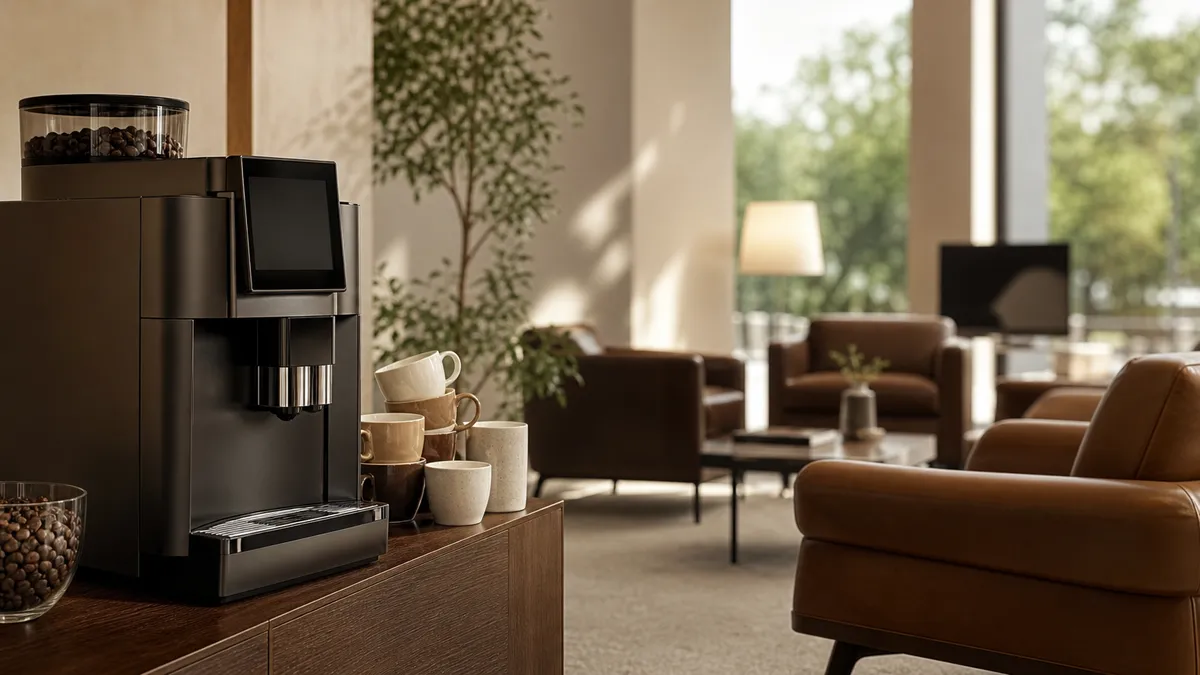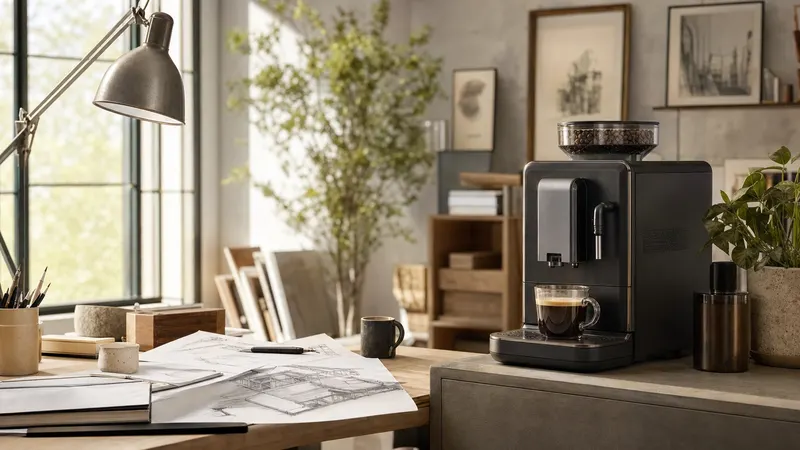
The right coffee set-up depends on who uses it, how many drinks they need at the busiest time, and who will clean and replenish it. Coffee for every workplace starts with those practical questions: a small staff kitchen, a hotel breakfast room and a hospital staff area should not automatically get the same machine.
In short
- Size the service around people actually on site, visitors and peak demand, not the organisation’s total headcount.
- Compare daily capacity with drink-specific hourly output. They describe different things.
- Choose between self-service, staffed espresso preparation and batch brewing before comparing individual machines.
- Include milk storage, cleaning access, water treatment, waste handling and servicing in the plan.
- Use the workplace guides below to narrow the choice, then request a demonstration using your expected drink mix.
Guides in Coffee for Every Workplace
 Coffee Machines for Car Dealerships and Retail Staff AreasChoose coffee machines for dealership customers and retail staff, with guidance on self-service, peak demand, milk hygiene, installation and contracts.Read the guide
 Coffee Machines for Healthcare SettingsChoose coffee machines for hospitals, care homes and clinics, with practical checks for hygiene, hot drink safety, accessibility, shifts and servicing.Read the guide
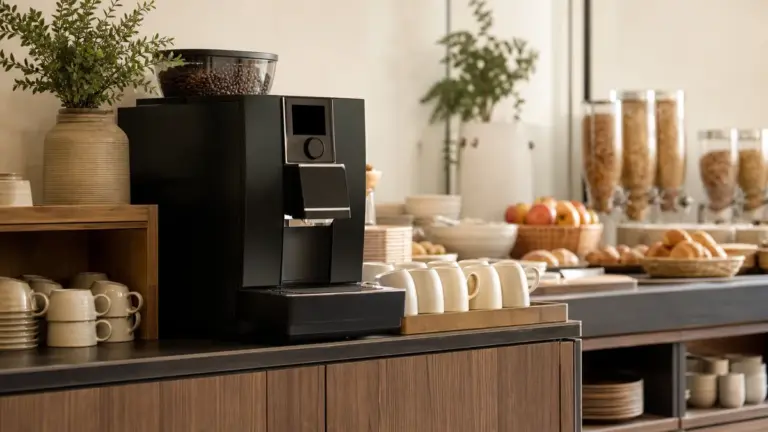 Coffee Machines for Hotels, Restaurants and CafésMatch hospitality coffee machines to breakfast queues, waiter service and café workflows, with practical checks on capacity, milk, training and support.Read the guide
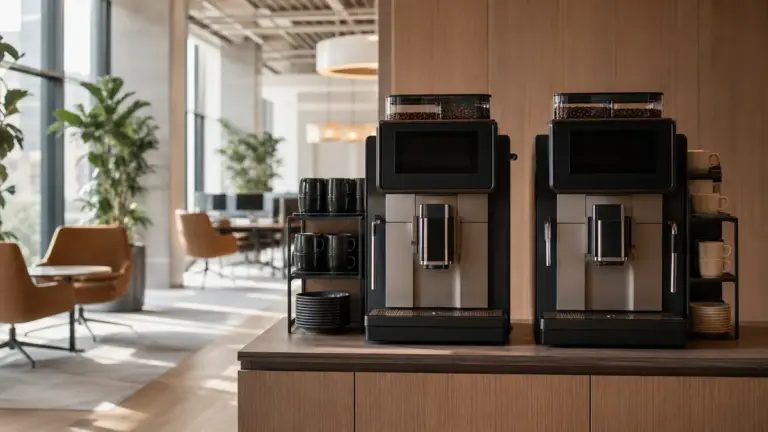 Coffee Machines for Large OfficesPlan coffee for offices of 100 or more people: compare station layouts, peak queues, batch brew, service agreements, telemetry and maintenance duties.Read the guide
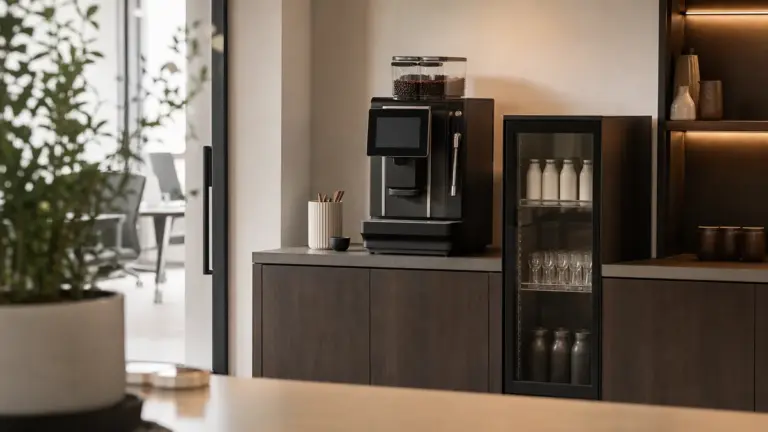 Coffee Machines for Medium-Sized OfficesChoose office coffee equipment for 20 to 100 people using peak demand, milk systems, plumbing, service terms and a practical one-or-two-machine decision.Read the guide
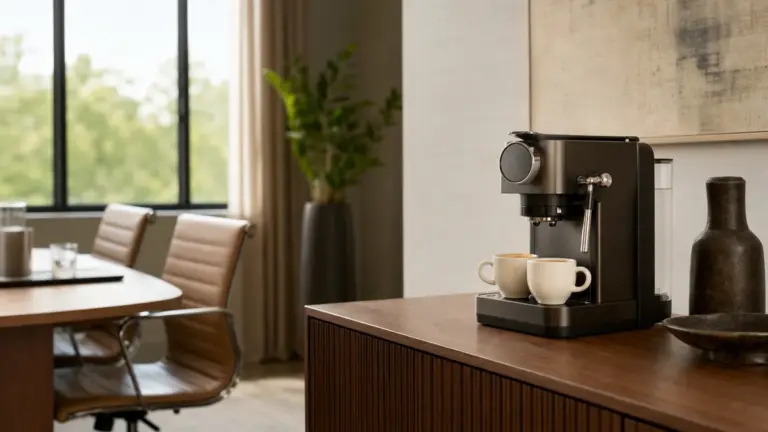 Coffee Machines for Meeting Rooms and Reception AreasChoose guest coffee machines by noise, footprint, drink quality and arrival bursts, with capsule versus bean-to-cup advice and practical supplier checks.Read the guide
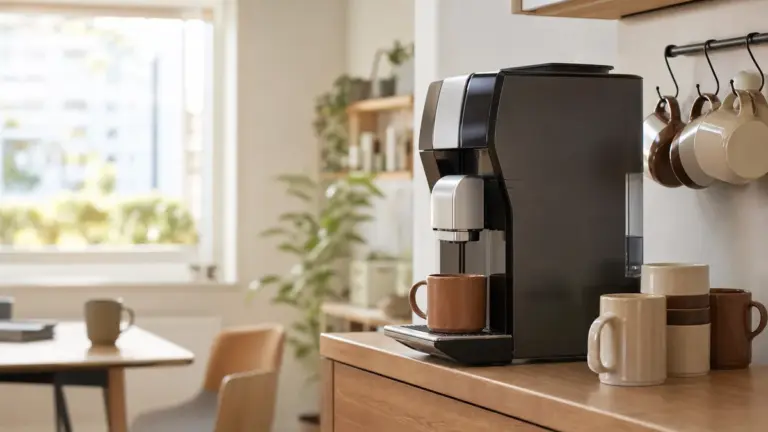 Coffee Machines for Schools and UniversitiesChoose coffee machines for staff rooms, student self-service and campus events, with guidance on capacity, caffeine, payment, hygiene and holiday shutdowns.Read the guide
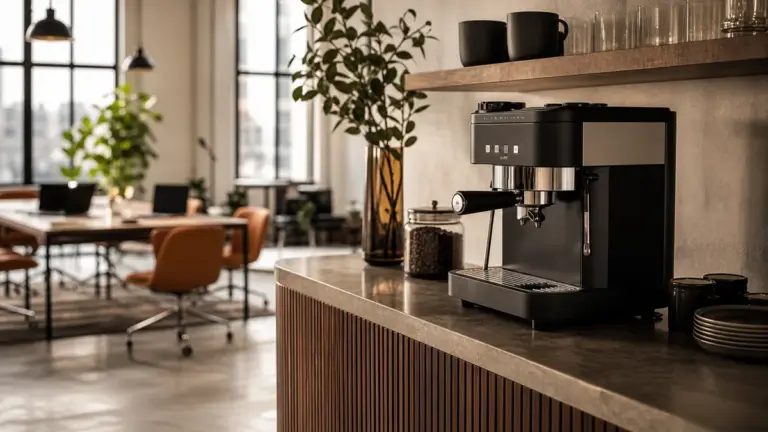 Coffee Machines for Shared WorkspacesChoose coffee machines for shared workspaces: compare capacity, payment access, plant milk, cleaning duties and supplier support before you commit.Read the guide
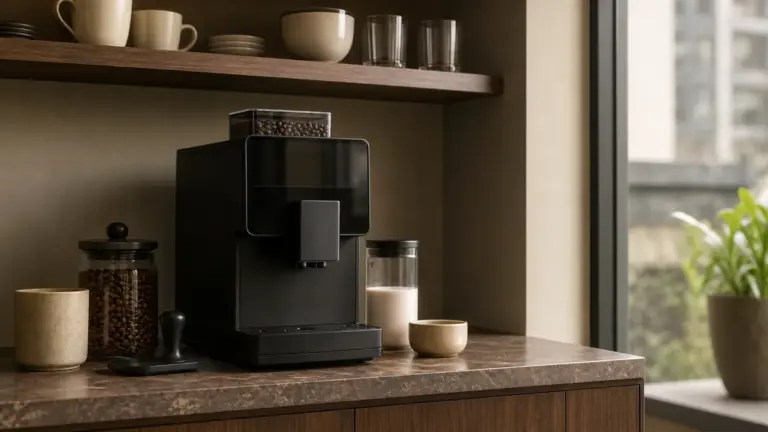 Coffee Machines for Small OfficesCompare bean-to-cup, capsule and filter machines for small offices, with practical checks on demand, cleaning, plumbing, servicing and coffee waste.Read the guide
Start here if you are new
- Begin with office coffee for the wider decisions about equipment, drinks and running a workplace coffee service.
- Read small-office machines to understand a straightforward staff-kitchen set-up, even if you expect to need something larger.
- Move to medium-sized offices when shared demand, replenishment and queues become central to the decision.
The routes below are editorial starting points, not fixed equipment specifications. Choose by demand, supervision, available space and the work needed to keep the service running.
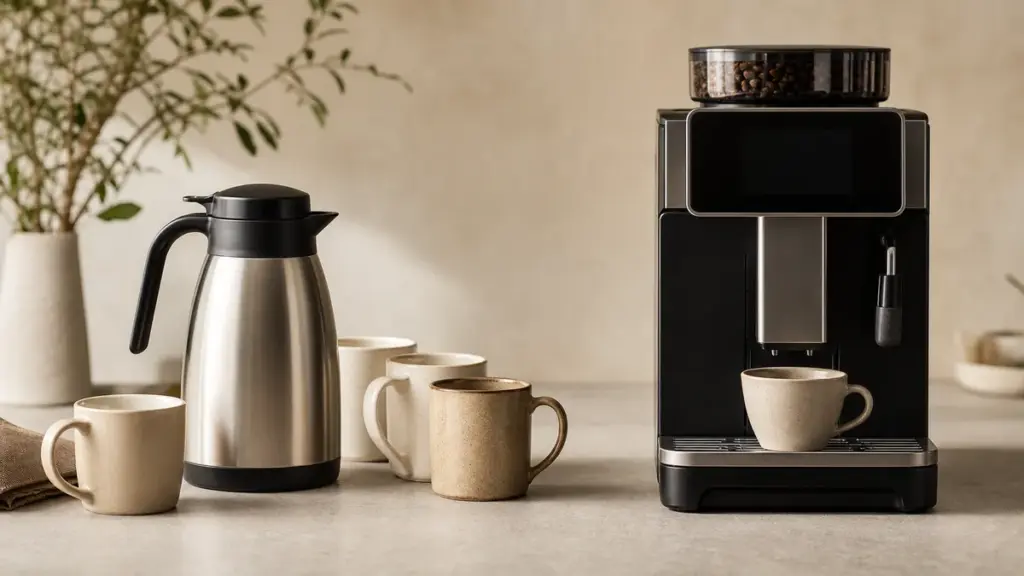
Coffee for every workplace: the overview
A bean-to-cup machine grinds beans and brews individual drinks automatically. Batch brewing prepares several servings of filter coffee together, while a traditional espresso machine puts more of the preparation in the operator’s hands.
Use this table to identify the service style worth investigating first.
| Workplace | Starting point to investigate | Main selection criterion | Trade-off to resolve |
|---|---|---|---|
| Small office | Compact professional bean-to-cup or simple filter service | Actual daily use and cleaning ownership | Drink choice versus upkeep |
| Medium-sized office | Commercial bean-to-cup | Busy-period output and replenishment | One central point versus several |
| Large office | Distributed commercial machines, possibly with batch brewing | Queues, coverage and continuity | Central oversight versus local responsibility |
| Shared workspace | Self-service commercial machine | Unfamiliar users and clear responsibility | Broad access versus supervision |
| Meeting rooms and reception | Nearby bean-to-cup or prepared batch service | Serving a group promptly | Individual choice versus simultaneous service |
| Hotels, restaurants and cafés | Staffed espresso, automatic service or a combination | Service format and operator availability | Preparation control versus automation |
| Schools and universities | Separate staff, student and hospitality provision | Access, supervision and demand patterns | Shared infrastructure versus distinct services |
| Healthcare | Locally approved staff or public-area provision | Hygiene ownership and appropriate location | Availability versus supervision |
| Retail and dealerships | Separate staff and customer provision where needed | Interruptions, presentation and replenishment | Convenience versus staff involvement |
These are alternatives to compare, not automatic recommendations. A short menu that is consistently available may serve a workplace better than an extensive menu nobody has time to maintain.
Choose an office set-up by demand, not labels
“Small”, “medium” and “large” are useful navigation labels, but they do not establish machine capacity. Build an estimate from attendance and actual consumption.
The following matrix contains illustrative planning scenarios, not measured consumption averages or manufacturer recommendations. Each assumes everyone attending drinks two coffees, with no visitors or other users.
| Planning scenario | People attending daily | Assumed coffees per person | Calculated daily drinks |
|---|---|---|---|
| Small office example | 20 | 2 | 40 |
| Medium office example | 60 | 2 | 120 |
| Large office example | 150 | 2 | 300 |
Replace every assumption with your own figures, then add visitors, training sessions and events separately. Count the busiest ordinary day as well as the average one.
Small offices: keep the routine manageable
Start with the people who will refill the water, empty the grounds and complete the cleaning. Compare a compact professional bean-to-cup machine with a simpler filter arrangement if most people want black coffee.
Read small-office machines when the main question is how to provide a useful drinks choice without creating an elaborate maintenance routine. Before choosing, ask the supplier to confirm that the intended workplace use falls within the machine’s published application and warranty terms.
Medium-sized offices: investigate the queue
For a medium office, make the busiest break part of the demonstration. Ask users to select drinks, collect them and leave the area, rather than watching an operator prepare isolated examples.
Read medium-office machines when you need to compare replenishment, drink throughput and the position of a shared tea point. Include milk drinks in the trial if they form part of the expected menu.
Large offices: plan coverage and continuity
For a large office, compare a central service with machines distributed across floors or departments. Assess walking routes, queues, cleaning responsibility and what happens when equipment is unavailable.
Use large-office machines when the task is organising a service across several teams or locations. Request a written plan for routine maintenance, breakdown response and temporary alternative provision, rather than treating servicing as an afterthought.
Shared spaces, meeting rooms and reception
Shared workspaces
In a shared workspace, design for someone encountering the machine for the first time. During a demonstration, ask an unfamiliar user to select a drink, position a cup and recognise when help is needed.
Assign responsibility for beans, milk, cleaning and faults explicitly. Do not leave “the users” as the unnamed owner of the service.
Read shared-workspace machines when several organisations or changing groups use the same facilities. That guide is the next step for deciding which tasks belong to the workspace operator and which belong to occupiers.
Meeting rooms and reception areas
For meetings, decide whether everyone needs a drink together or can serve themselves over an extended arrival period. Compare individual preparation with coffee brewed before the group arrives.
Keep noisy preparation and routine cleaning out of the meeting itself where practical. Check the route for carrying drinks, collecting used cups and replenishing supplies.
Use meeting-room and reception machines when visitor experience and discreet operation matter more than an extensive staff-kitchen menu. Include reception staff in the decision if they will be expected to operate or supervise the equipment.
Hotels, restaurants and cafés
Separate the service occasions before choosing equipment. Breakfast self-service, restaurant table service and a staffed coffee counter may justify different arrangements within the same building.
Compare traditional espresso preparation where trained staff will control the drinks with automatic preparation where users need a repeatable selection process. Consider batch brewing alongside either option when groups need black coffee together.
Read hospitality machines to work through those service formats. Ask suppliers to demonstrate the complete workflow, including milk handling, cleaning and the drinks most likely to be ordered together, not just their most impressive speciality.
Where drinks are prepared and sold, allergen management must include accurate information, avoiding cross-contamination and appropriate staff training. Treat the milk arrangements as part of the food service, not merely an equipment accessory.
Education, healthcare and retail
Schools and universities
Treat a staffroom, student self-service point, campus café and conference facility as separate briefs. Specify who may use each service and who supervises it.
For school staff areas, assess the location of hot drinks and the route between preparation and consumption. For university provision, record demand around teaching breaks, events and periods when buildings are less occupied.
Read education machines when access arrangements and several different user groups shape the choice. Include shutdown, cleaning and reopening instructions in the operating plan.
Healthcare settings
Distinguish staff refreshment provision from public catering and patient services. Do not assume that equipment suitable for an office kitchen is automatically appropriate for every healthcare location.
Ask the local infection prevention and control team, estates team and relevant service manager to approve the proposed location and operating arrangements. Allocate cleaning and replenishment across the shifts that will actually use the service.
Use healthcare machines when local approval, supervision and continuity need particular attention. Patient drink provision should remain within the organisation’s clinical and catering arrangements, rather than being designed from a general workplace guide.
Car dealerships and retail staff areas
Decide whether customer hospitality and staff refreshments should share equipment. Consider what happens when a customer needs assistance while staff are serving, restocking or taking a break.
For the customer area, prioritise an understandable selection process and a clear response to spills or faults. For the staff area, prioritise convenient access and an achievable cleaning routine.
Read retail and dealership machines when the service must fit around customer-facing work. Test the proposed arrangement with the people expected to replenish and supervise it.
Check peak output separately from daily capacity
Manufacturer capacity figures need careful reading. As checked in November 2026, JURA publishes a recommended maximum daily output of 50 drinks for the W8, alongside hourly figures of 74 coffees or 50 cappuccinos under its stated DIN 18873-2 measurement basis.
Those are manufacturer-published specifications, not independent performance results. The hourly figures do not override the recommended daily output, and the different drink figures show why the menu matters.
At a larger scale, Franke’s current UK page for the new A600 claims average daily capacity of up to 200 cups. Neither example is a recommendation for a particular headcount.
For your own site, count drinks required within the busiest service window. For example, an assumed requirement for 24 drinks in 20 minutes is equivalent to 72 drinks per hour during that window, calculated as 24 × 60 ÷ 20. It does not imply continuous demand throughout the day.
Ask suppliers to demonstrate that workload with your cup sizes and drink mix. Include user selection, milk replenishment, grounds disposal and any interruptions, rather than comparing brewing figures alone.
Specify the whole service
Space, water and cleaning
Measure the complete installation, including milk storage, opening lids, cleaning access and the route for removing waste. Ask the installer to confirm electrical, water and drainage requirements for the exact configuration.
Obtain the local water supplier’s hardness information, then have the installer confirm suitable treatment and machine settings. Thames Water, for example, provides a postcode-based water-quality checker.
Hardness describes dissolved calcium and magnesium and is commonly expressed as milligrams per litre as calcium carbonate. It varies locally and can cause scale in heated equipment, so do not substitute a single national figure for the workplace’s supply information.
Allocate cleaning to named roles, with cover for absence. Have the supplier demonstrate the full routine before acceptance.
Servicing and the ownership calculation
Request itemised written quotations covering equipment, installation, water treatment, training, consumables, planned servicing and breakdown support. Ask what is excluded and what the supplier means by response time.
To assess your own cost per drink, add the relevant expenditure over one consistent period and divide it by the expected drinks served during that period. Include beans, milk, cleaning materials, filters, energy, staff time and equipment provision, using a consistent VAT basis. Keep downtime and alternative provision visible rather than hiding them inside the calculation.
UK requirements to build into the plan
The following points were checked in November 2026.
Workplace facilities: HSE guidance for Great Britain requires access to drinking water and somewhere to rest and eat meals. Coffee provision should complement those facilities, not replace drinking water.
Plumbing: in England and Wales, the Water Supply (Water Fittings) Regulations 1999 require adequate backflow prevention. This prevents water flowing backwards from an appliance towards the supply. Ask installers in Scotland or Northern Ireland to identify the applicable local requirements.
Pressure systems: machines incorporating steam boilers may fall within the Pressure Systems Safety Regulations 2000 in Great Britain. HSE identifies steam at any pressure as a relevant fluid. Check applicability, examination requirements and responsibilities with the supplier and HSE guidance.
VAT: coffee and milk sold as food are generally zero-rated, while catering and hot takeaway drinks are generally standard-rated. HMRC provides specific treatment for some education and healthcare supplies, so do not apply a blanket catering assumption across those settings.
Waste: in England, workplace recycling rules took effect on 31 March 2025, with micro-firms having until 31 March 2027. The exemption concerns businesses with fewer than 10 full-time-equivalent employees across the business, not just one site. Coffee grounds are food waste; compostable packaging, including compostable pods, must not go into the ordinary food-waste collection. Check separate requirements for workplaces elsewhere in the UK.
FAQ
Should a hybrid office use average attendance or its busiest day?
Use both, but assess service capacity against the busiest realistic day. Average attendance helps estimate consumption and replenishment, while peak attendance tests whether the arrangement remains usable. Keep exceptional events separate: an occasional conference may justify temporary provision rather than determining the permanent service throughout the building.
Can the same machine serve dairy and plant-based drinks?
Only choose that arrangement after checking the machine’s specified milk configuration and your allergen procedures. A plant-based ingredient does not by itself establish that the finished drink is free from milk cross-contamination. For food businesses, accurate information, cross-contamination controls and appropriate staff training remain essential.
Is an automatic cleaning programme enough to make a machine unattended?
Do not treat “automatic cleaning” as a complete operating plan. Ask the supplier to demonstrate the exact tasks still assigned to staff, including replenishment, waste removal and care of associated milk equipment. Decide who checks completion and deals with faults before placing the machine in a lightly supervised area.
Where to go next
Return to Office Coffee for the wider service-planning framework, or read Coffee Machines for Medium-Sized Offices to investigate shared demand and replenishment. Coffee Machines for Shared Workspaces develops the responsibility questions, while Coffee Machines for Meeting Rooms and Reception Areas focuses on serving visitors. Choose the route that matches the service you need: coffee for every workplace is a planning exercise before it is a machine comparison.
Sources
-
JURA, W8: technical specifications, live manufacturer page, retrieved 2026. Daily output and drink-specific hourly figures are manufacturer claims.
URL: https://cee.jura.com/en/professional/machines/w8-dark-inox-eb-15765 -
Franke Coffee Systems, A600 coffee machine, current UK manufacturer page, retrieved 2026. Capacity is a manufacturer claim for the new A600.
URL: https://www.franke.com/gb/en/coffee-systems/products/fully-automatic-coffee-machines/a600-coffee-machine.html -
Health and Safety Executive, Workplace facilities: what you must provide, live guidance, retrieved 2026.
URL: https://www.hse.gov.uk/simple-health-safety/workplace-facilities/welfare.htm -
Health and Safety Executive, Pressure Systems Safety Regulations 2000 (PSSR), live guidance, retrieved 2026.
URL: https://www.hse.gov.uk/pressure-systems/pssr.htm -
UK legislation, The Water Supply (Water Fittings) Regulations 1999, SI 1999/1148, particularly Schedule 2, paragraph 15.
URL: https://www.legislation.gov.uk/uksi/1999/1148/pdfs/uksi_19991148_en.pdf -
HM Revenue & Customs, Food products (VAT Notice 701/14), live notice, retrieved 2026, particularly section 3.7.
URL: https://www.gov.uk/guidance/food-products-and-vat-notice-70114 -
HM Revenue & Customs, Catering, takeaway food (VAT Notice 709/1), updated 8 June 2026, particularly sections 1.3, 2.6 and 2.7.
URL: https://www.gov.uk/guidance/catering-takeaway-food-and-vat-notice-7091 -
Department for Environment, Food & Rural Affairs, Simpler recycling: workplace recycling in England, updated 3 October 2025.
URL: https://www.gov.uk/guidance/simpler-recycling-workplace-recycling-in-england -
Thames Water, Check your water quality, live postcode-based service, retrieved 2026.
URL: https://www.thameswater.co.uk/help/water-and-waste-help/water-quality/check-your-water-quality -
Drinking Water Inspectorate, Water Hardness / Hard Water, live consumer guidance, retrieved 2026.
URL: https://www.dwi.gov.uk/consumers/learn-more-about-your-water/water-hardness-hard-water/ -
GOV.UK, Running a food business: allergies, live guidance, retrieved 2026.
URL: https://www.gov.uk/running-food-business/allergies
This hub was researched from manufacturer specifications, official workplace and environmental guidance, legislation, HMRC notices and water-authority information; the workplace routes are editorial recommendations, and the numerical planning examples are explicitly assumed rather than measured.
Last checked: November 2026