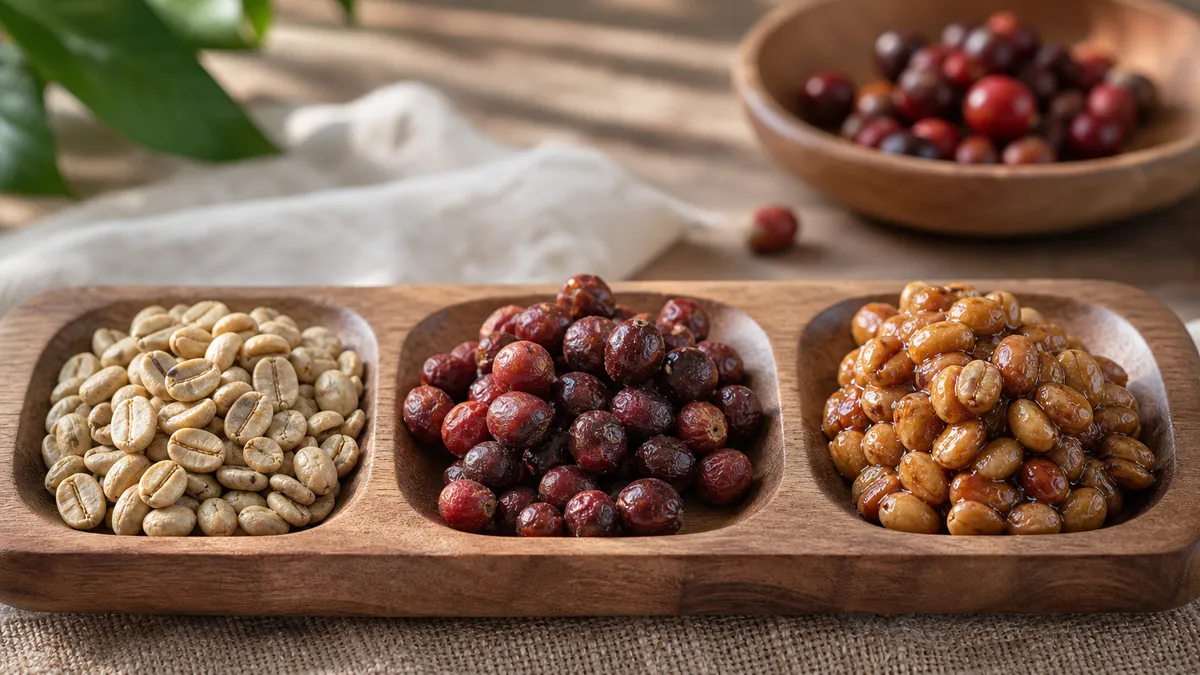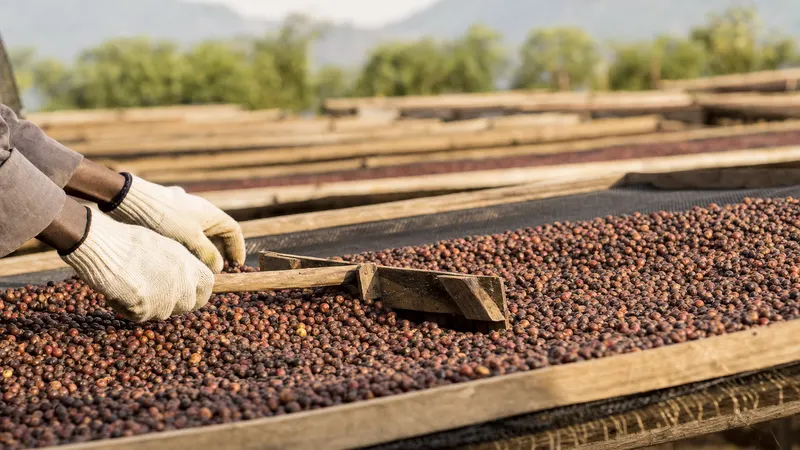
Coffee processing methods turn harvested coffee cherries into dried green beans ready for roasting. Washed, natural and honey processing differ mainly in how much fruit remains around the seed during drying, while terms such as anaerobic describe fermentation conditions that can be combined with those methods.
In short
- Read the whole description: “anaerobic natural” combines a fermentation approach with whole-cherry drying.
- Washed does not mean fermentation-free: fermentation commonly helps remove the sticky fruit layer before drying.
- Honey refers to retained mucilage, the sticky layer beneath the pulp, not added bee honey.
- Semi-washed is an ambiguous label: ask which fruit layers were removed and when the parchment was hulled.
- Processing is not a quality ranking: experimental results describe particular coffees and conditions, not a universally superior method.
Guides in Coffee Processing Methods
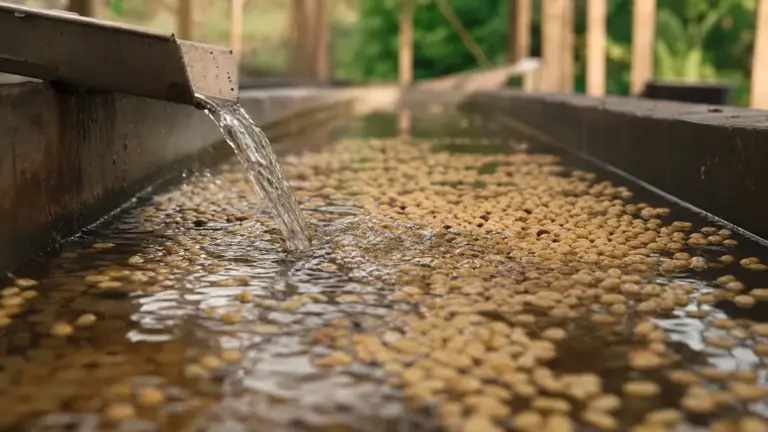 Coffee Processing Methods: Washed ProcessRead the guide
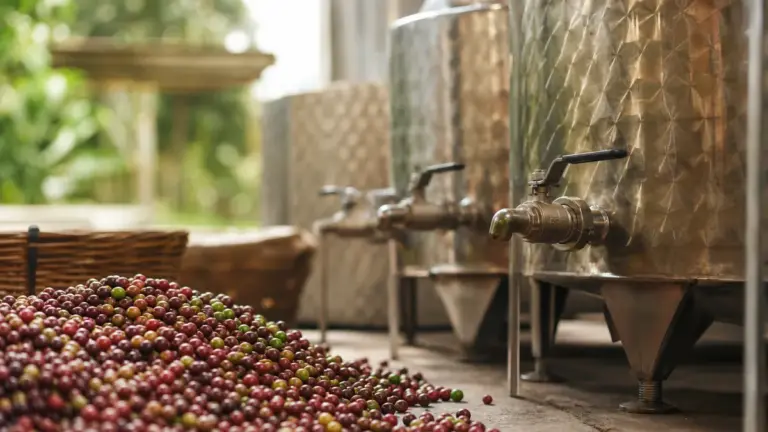 Anaerobic Fermentation CoffeeUnderstand anaerobic fermentation coffee: how sealed tanks, oxygen, time and temperature affect flavour, and what processing labels actually tell you.Read the guide
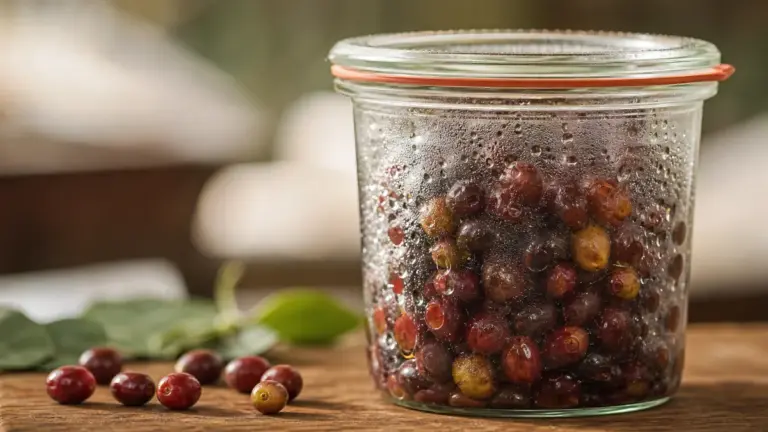 Carbonic Maceration CoffeeWhat is carbonic maceration coffee? Understand CO₂-flushed fermentation, its wine origins, likely flavours and how it differs from sealed-tank methods.Read the guide
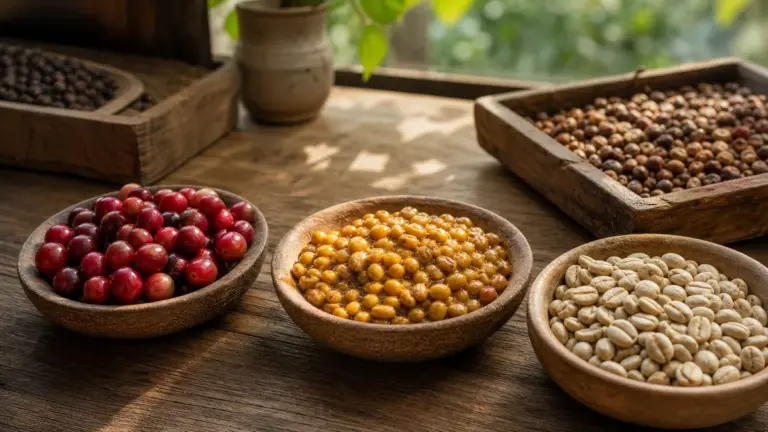 Coffee Processing: The Complete GuideLearn how coffee is processed after picking, with washed, natural, honey and wet-hulled methods compared, plus fermentation, drying, milling and storage.Read the guide
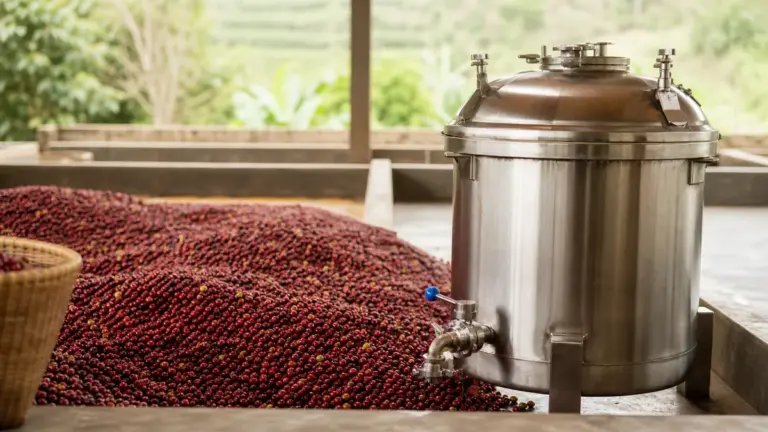 Experimental and Infused Coffee Processing ExplainedUnderstand yeast inoculation, extended fermentation, thermal shock and infused coffee, with clear labelling questions and current competition rules.Read the guide
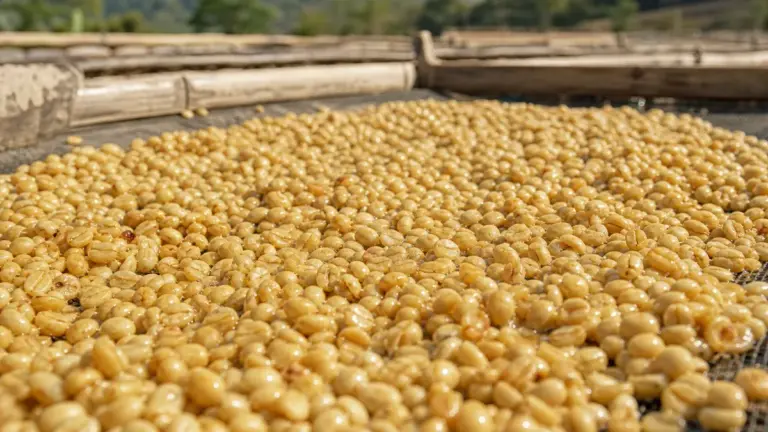 Honey Process Coffee: White, Yellow, Red and BlackLearn what honey processed coffee means, how the four honey colours differ, and why mucilage, drying and producer details matter more than the label.Read the guide
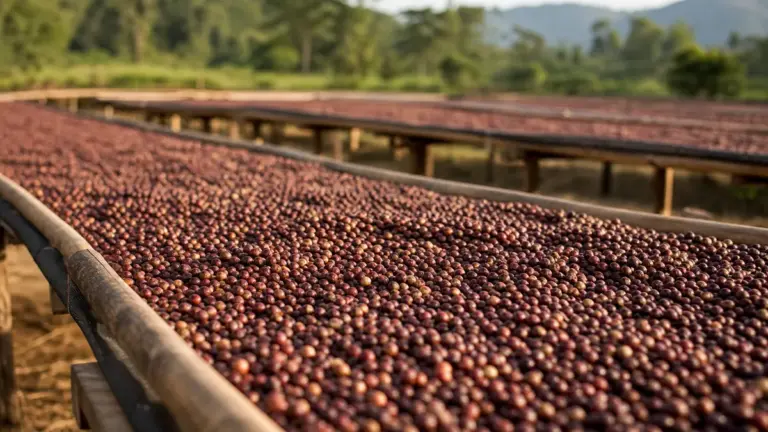 Natural Process CoffeeLearn how natural coffee dries inside the whole cherry, how patios and raised beds differ, and why turning, moisture and fermentation shape the final…Read the guide
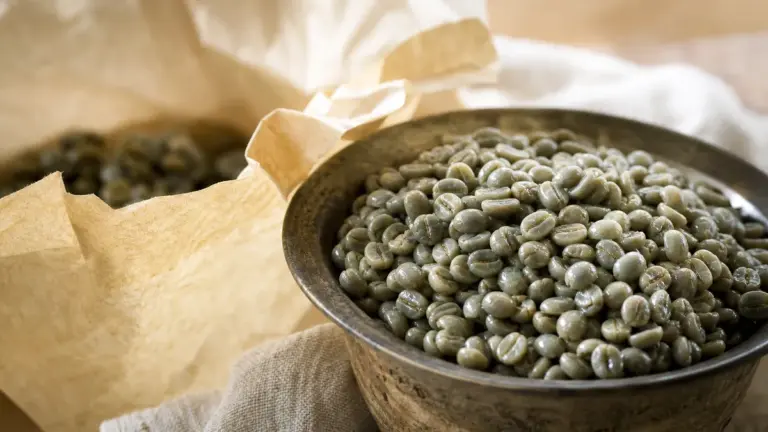 Semi-Washed ProcessUnderstand semi-washed and wet-hulled coffee, Indonesia's giling basah, parchment removal, blue-green beans, earthy flavours and the quality debate.Read the guide
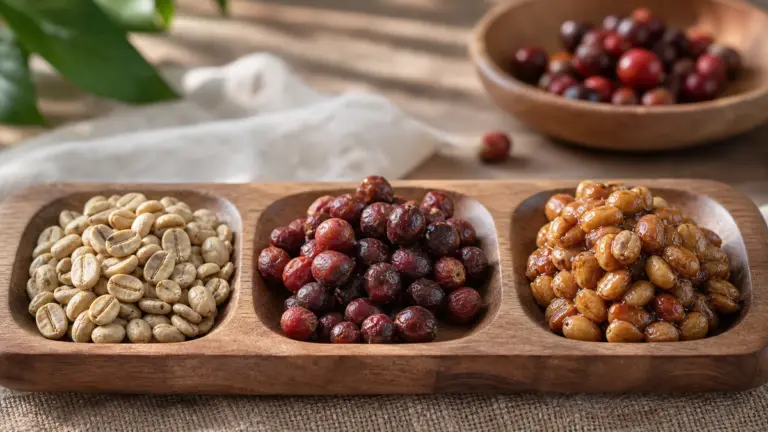 Washed vs Natural vs HoneyCompare washed, natural and honey coffee processing, including flavour, body, water use and drying risks, plus a simple side-by-side tasting method.Read the guide
Start here if you are new
Follow this short reading path rather than trying to learn every processing term at once:
- Start with the complete processing guide for the full journey from harvested cherry to export-ready green coffee.
- Read washed, natural and honey compared to understand the main distinctions you will meet on coffee bags.
- Move to anaerobic fermentation when you want to understand the additional information supplied by a fermentation label.
For the wider context of where coffee comes from and how it grows, return to beans and origins. This hub is the map of processing: use it to choose the detailed explanation you need, rather than as a production manual.
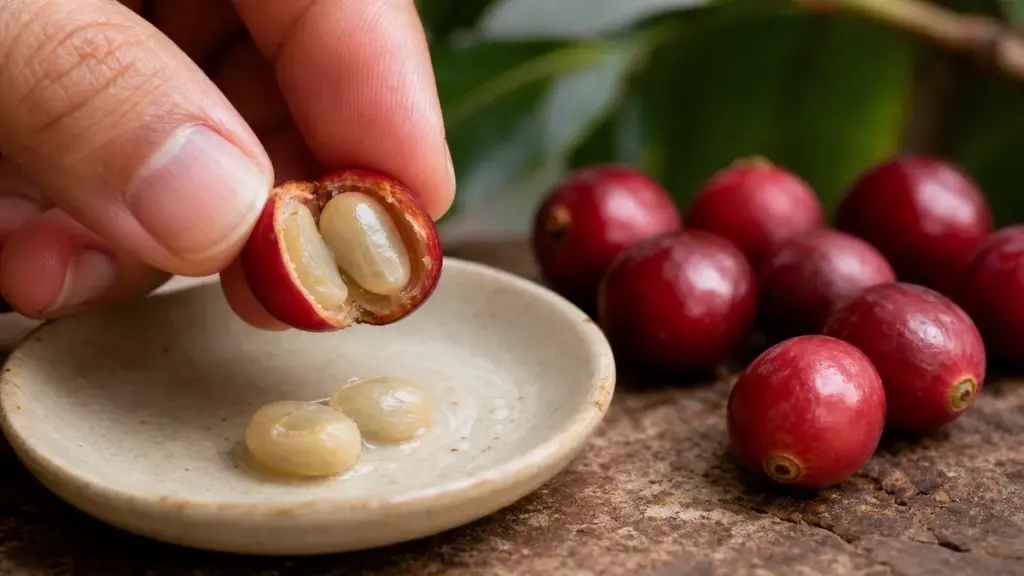
What happens after coffee is harvested?
The coffee bean is a seed inside a fruit, usually called a cherry. Around the seed are fruit skin and pulp, sticky mucilage and a protective layer called parchment. Processing separates these materials and dries the seed sufficiently for subsequent handling and storage.
The sequence matters. Producers may dry the whole cherry, remove the skin and pulp but retain mucilage, or remove both pulp and mucilage before drying. Fermentation can occur at different points, not only during a separately named tank stage.
Drying and milling are distinct operations. Drying removes moisture; hulling removes the dried fruit covering or parchment, depending on the process. Sorting and quality assessment then help prepare green coffee for sale. Wet-hulled coffee follows a different sequence because parchment is removed before drying is complete.
A useful way to read a processing description is therefore to ask two separate questions:
- What surrounded the seed during drying?
- What happened during fermentation?
Keeping these questions separate makes apparently elaborate labels much easier to interpret.
Coffee processing methods at a glance
This comparison separates physical processing routes from fermentation conditions. The rows overlap: an anaerobically fermented coffee can subsequently be processed as a natural, honey or washed coffee.
| Method or label | Defining feature | What the label tells you | What to check |
|---|---|---|---|
| Washed | Pulp and mucilage are removed before drying | The seed dries within its parchment, without the surrounding fruit flesh | How mucilage was removed |
| Natural | Whole cherries are dried before hulling | Fruit remains around the seed during drying | Drying management and any preceding fermentation |
| Honey | Pulp is removed; mucilage remains during drying | A route between whole-fruit drying and washing clean | How much mucilage remained |
| Semi-washed | Meaning varies between producers and regions | Only a broad indication of partial or mechanical processing | The actual sequence, including hulling |
| Anaerobic | Oxygen availability is restricted during fermentation | A fermentation environment, not a complete drying method | Whole cherries or pulped coffee; final drying route |
| Carbonic maceration | Fermentation uses a carbon-dioxide-rich environment | A more specific approach within low-oxygen processing | How carbon dioxide was introduced and managed |
| Experimental or infused | A producer-specific intervention or addition | Too little to reconstruct the process alone | Cultures, ingredients, treatments and their timing |
The conventional routes and terminology are described in producer guidance; the fermentation distinctions are supported by experimental research. “Experimental” should prompt a request for more detail, not an assumption about flavour or quality.
Washed, natural and honey: the main routes
Washed processing
Washed processing removes the skin and pulp, then removes mucilage before the coffee is dried. In a conventional ferment-and-wash sequence, fermentation loosens the mucilage so that it can be washed away; mechanical mucilage removal offers another route.
Washed coffees are often described in terms of clarity: floral, citrus or other notes can seem distinct rather than blended into a broad fermented-fruit impression. That is a useful starting expectation, not a promise that every washed coffee will be delicate or sharply acidic. Producer guidance associates washing with clean and floral profiles, but the finished cup still needs tasting.
Read washed processing when you want to follow the individual stages and understand how fermentation and mechanical removal differ. It is also the useful next stop if “washed” and “wet-processed” appear on different bags and seem to mean different things.
Natural processing
Natural processing dries the whole cherry before the dried fruit covering is removed. Producers must manage drying carefully, including moving cherries to encourage even drying and protecting quality when weather conditions are unsuitable. “Natural” describes the route, not an absence of human intervention.
Fruit-forward flavours are a reasonable reason to explore naturals, but they do not belong exclusively to this method. In a processing experiment using Catimor coffee in Peru, natural and anaerobic treatments produced different sensory outcomes from washed and honey treatments. That finding demonstrates the influence of processing within the trial, not a rule for all coffees.
Choose natural processing to understand whole-cherry drying and the decisions behind it. Read it before treating “natural” as shorthand for either exceptionally fruity coffee or poorly controlled fermentation.
Honey processing
Honey processing removes the skin and pulp while leaving mucilage on the parchment during drying. The retained material is part of the coffee fruit: bee honey is not a defining ingredient of this process. The related term “pulped natural” may describe the same route, although usage varies.
Do not assume honey coffee is a precise halfway point in flavour between washed and natural. In the Peruvian comparison, washed and honey treatments were relatively similar in some respects, while other processing treatments differed more clearly. A category describes a sequence of operations, not a fixed position on a sweetness scale.
Read honey processing when you want to interpret retained-mucilage descriptions and understand what to ask about a particular lot. Look for the producer’s explanation alongside any colour or proprietary process name.
Semi-washed: ask what actually happened
“Semi-washed” is less precise than it sounds. TechnoServe documents its use for partial or complete mechanical mucilage removal, as well as regional distinctions between home-processed and washing-station coffee. There is no single industry-wide meaning that safely reconstructs every lot’s processing.
In Indonesian coffee descriptions, semi-washed can also refer to wet hulling, or giling basah. Here the important distinction is that parchment is removed while the coffee remains relatively wet, followed by further drying. That is not simply honey processing under another name.
Ask the seller: was mucilage retained during drying, was it mechanically removed, and was parchment hulled before drying finished? Those answers are more useful than debating the label alone.
Use semi-washed processing when a bag or supplier description leaves the sequence unclear. It is the place to resolve terminology before drawing comparisons with washed, honey or wet-hulled coffees.
Anaerobic fermentation and carbonic maceration
Anaerobic describes oxygen conditions
Anaerobic processing restricts oxygen during fermentation. In self-induced anaerobic fermentation, microorganisms consume available oxygen and carbon dioxide accumulates inside the vessel. The environment develops over time, so closing a tank does not automatically demonstrate that every part of its contents was oxygen-free from the outset.
This can be applied to different starting materials and followed by different processing routes. A description such as “anaerobic washed” is therefore not contradictory: it identifies fermentation conditions and the subsequent removal of fruit material before drying.
Experimental work has found changes in microbial populations, chemical composition and sensory profiles when fermentation time and inoculation are varied. These are controlled comparisons within specific protocols, not evidence that longer fermentation always improves coffee.
The detailed anaerobic article is the next read for interpreting tank descriptions, oxygen management and claims about fermentation intensity.
Carbonic maceration is more specific
Carbonic maceration adapts an approach associated with winemaking to coffee fermentation, using a carbon-dioxide-rich environment. Coffee research has examined its effects on microbial, chemical and sensory characteristics under different fermentation conditions.
The distinction worth retaining is between restricting oxygen generally and deliberately managing a carbon dioxide environment. However, ask for the actual protocol rather than assuming that every producer uses an identical definition or technique.
Read carbonic maceration when you want to distinguish it from other sealed-tank approaches. It is particularly useful when a description emphasises gas management but says little about whether cherries remained whole or how the coffee was dried afterwards.
Experimental, co-fermented and infused processing
Experimental processing is an umbrella description, not a reproducible recipe. One intervention is inoculation: adding a selected microbial starter rather than relying solely on the microorganisms already present. A controlled coffee experiment using sequential bacterial and yeast inoculation found changes in beverage acidity and sensory assessment.
Adding microorganisms is not the same as adding fruit or flavouring. A published farm study compared spontaneous fermentation with a treatment that included both a starter preparation and crushed pineapple. Because several treatment components differed together, the results cannot cleanly isolate the effect of pineapple alone.
For clarity, ask suppliers to distinguish:
- Selected microorganisms added to guide fermentation.
- Fruit, juice, spices or other materials added during processing.
- Flavourings or extracts added to impart flavour.
- Physical treatments applied without added flavour ingredients.
Treat this as a disclosure checklist, not a claim that every seller uses these categories consistently. “Experimental” alone does not answer any of those questions.
Read experimental and infused processing when the processing description includes additions, multiple stages or proprietary names. It is the next step for separating an interesting sensory claim from a sufficiently explained production method.
Comparing coffees without over-reading the label
For a useful tasting exercise, choose coffees with as much shared background as possible. Ask whether they come from the same producer, variety and harvest, and whether the roaster intended them as a processing comparison. If those details differ, describe what you taste without assigning every difference to processing.
Use this simple approach:
- Write down the full descriptions, including fermentation and drying information.
- Prepare the coffees consistently, using the same brewing method and water.
- Taste without looking at the labels, then revisit them afterwards.
- Record specific differences: acidity, sweetness, texture, fruit character and finish.
- Separate observation from explanation: “more wine-like” is a tasting observation; “caused by anaerobic fermentation” requires stronger evidence.
The distinction matters because research protocols change several interacting conditions. Carbonic maceration trials examine time and temperature; starter-culture trials examine microbial interventions; farm comparisons may include additional ingredients. Each answers a narrower question than “which process is best?”
Use processing labels to choose what to explore, then let the cup decide what you enjoy.
FAQ
Does washed coffee undergo fermentation?
Often, yes. In conventional washed processing, fermentation helps loosen mucilage before washing and drying. However, mucilage can also be removed mechanically, so the word “washed” does not identify one universal fermentation protocol. Ask how the fruit material was removed if you want to understand the lot in detail.
Does a pineapple tasting note mean pineapple was added?
No, a tasting note is not an ingredient declaration. Coffee experiments without fruit additions have produced fruit-related sensory descriptions, while other research has deliberately included pineapple during fermentation. The useful question is whether additional ingredients were used, not whether a familiar fruit appears in the flavour notes.
Can I reproduce these methods using roasted beans?
No. These methods concern harvested coffee fruit and green-coffee preparation before roasting. Soaking roasted beans in fruit juice would not reproduce natural, honey or carbonic maceration processing. For a home learning exercise, compare professionally processed coffees instead of treating post-harvest production methods as recipes for finished roasted beans.
Where to go next
Read Coffee Processing: The Complete Guide for the full production sequence, then use Washed vs Natural vs Honey to compare the main coffee processing methods. Continue with Anaerobic Fermentation for oxygen-controlled approaches, or Experimental and Infused Processing when a label needs closer examination.
Sources
-
TechnoServe, Coffee Wet Mill Processing Guide, undated, hosted in its March 2022 publication directory. Fruit anatomy, conventional methods, mucilage removal and terminology.
https://www.technoserve.org/wp-content/uploads/2022/03/TechnoServe-Wet-Mill-Processing-Guide.pdf -
International Trade Centre, The Coffee Guide, fourth edition, 2021. Processing sequences, drying, milling, sorting and quality assessment.
https://www.intracen.org/media/5718 -
Caficultura Panamá, Procesamiento del Café, undated. Producer-facing explanations of natural, washed and honey processing.
https://www.caficulturadepanama.org/procesamiento-del-cafe/ -
University of California, Davis, Neil McCandless Rotta, Operations and Mass Flows in Postharvest Processing of Coffee: Comprehensive Case Study in Washed Coffee, MSc thesis, 2020. Fruit anatomy and wet-hulling sequence.
https://iad.ucdavis.edu/sites/g/files/dgvnsk4906/files/inline-files/Neil%20Rotta%20Thesis%20-%20Final%20Full%20Text%20%282020%29_1.pdf -
Coffee Science, Valenzuela Antezana and Luna-Mercado, Effect of processing methods (washed, honey, natural, anaerobic) of catimor coffee on physical and sensory quality in Alto Inambari, Peru, 2023. Experimental comparison of processing treatments.
https://coffeescience.ufla.br/index.php/Coffeescience/article/download/2111/2417/14030 -
Foods, Peñuela-Martínez, Osorio-Giraldo and Buitrago-Zuluaga, Development of Fermentation Strategies for Quality Mild Coffee Production (Coffea arabica L.) Based on Oxygen Availability and Processing Time, 2025. Processing routes and oxygen-controlled fermentation. Indexed article record and research abstract retrieved.
https://pmc.ncbi.nlm.nih.gov/articles/PMC12427761/ -
Brazilian Journal of Microbiology, Palumbo and colleagues, Impact of different fermentation times on the microbiological, chemical, and sensorial profile of coffees processed by self-induced anaerobiosis fermentation, 2024. Experimental evidence on fermentation conditions and sensory outcomes.
https://pmc.ncbi.nlm.nih.gov/articles/PMC11405557/ -
Food Chemistry, Brioschi Junior and colleagues, Microbial fermentation affects sensorial, chemical, and microbial profile of coffee under carbonic maceration, 2021, published online in 2020. Primary research abstract retrieved.
https://pubmed.ncbi.nlm.nih.gov/33046284/ -
Food Chemistry, Borém and colleagues, Fermentation of coffee fruit with sequential inoculation of Lactiplantibacillus plantarum and Saccharomyces cerevisiae: effect on sensory attributes and chemical composition of the beans, 2024. Primary research abstract retrieved.
https://pubmed.ncbi.nlm.nih.gov/38430763/ -
American Society for Microbiology, mSystems, Madrid-Restrepo and colleagues, Metagenomic, metabolomic, and sensorial characteristics of fermented Coffea arabica L. var. Castillo beans inoculated with microbial starter cultures, 2026 issue citation. Farm fermentation comparison involving a starter preparation and pineapple.
https://journals.asm.org/doi/10.1128/msystems.01364-25
This hub was researched through live searches of producer guidance, institutional publications and primary experimental research, with abstracts distinguished from full-text sources.
Last checked: November 2026