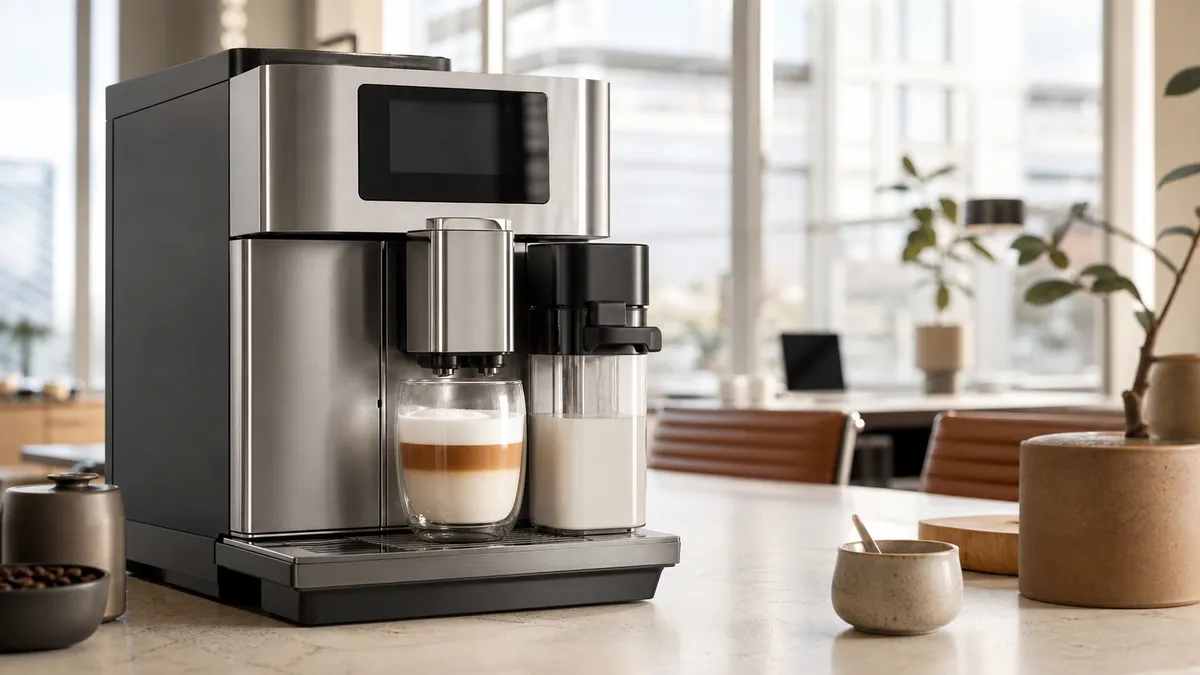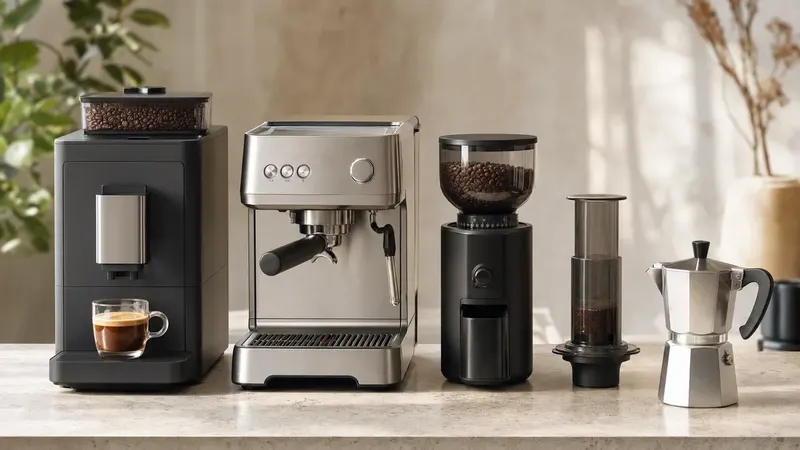
Coffee machines and equipment range from a simple cafetière to an automatic office system that grinds beans, brews coffee and prepares milk drinks. Choose by the drinks you want, how much hands-on work you enjoy and how many people need serving, then consider the grinder, water and cleaning routine alongside the brewer.
In short
- Choose the brewing family before comparing brands: filter coffee, espresso and automatic milk drinks require different equipment.
- For freshly ground coffee, prioritise a grinder suited to your brewing method rather than treating it as an afterthought.
- Start with useful accessories: scales, the correct filters and appropriate cleaning tools.
- Check local water hardness and follow the machine’s own water-treatment and descaling instructions.
- For work, assess busy-period demand, cleaning responsibility and service support, not just the drinks menu.
Explore the topics
Start here if you are new
Begin with coffee machines to identify the kind of brewer that suits your drinks. Next, read coffee grinders if you want to use whole beans, then brewing accessories to complete the setup without collecting equipment you do not need.
The paths below organise that choice by goal and purchasing priority, without assuming that a more elaborate machine is automatically the right answer.
Keep the setup minimal
For someone happy to brew manually, start by comparing a cafetière with a filter dripper. Choose the brewer, establish how you will obtain appropriately ground coffee and add scales before considering specialist accessories.
If you already own a suitable kettle, include it in the setup rather than replacing it automatically. A pouring kettle becomes worth considering when controlled pouring is part of the method you choose.
Learn espresso properly
Read Coffee Machines, then Coffee Grinders, before choosing either appliance. Treat the espresso machine and grinder as a pair: the machine’s controls are of limited use if you cannot adjust the grounds appropriately.
Start with the equipment needed to measure coffee and prepare the basket consistently. Leave advanced accessories until you can identify the problem they would solve.
Make drinks with less intervention
Compare bean-to-cup and capsule systems in Coffee Machines. Decide whether you want to choose whole beans and adjust recipes, or use a compatible pre-portioned capsule.
Then read Coffee Equipment Care and Repairs. Convenience should include the work after the drink, not only the button you press before it.
Equip a shared workplace
Start with Coffee Machines, followed by Coffee Equipment Care and Repairs and Coffee Machine Brands. Write down the drinks required, likely demand, available space and who will clean the equipment before approaching suppliers.
Request itemised written quotations covering the complete installation and ongoing support, not an appliance on its own.
Find the right equipment guide
These six hubs organise the subject. Use the table to find the decision you need to make now, then return for the next part of the setup.
| Hub | Read it when you need to… | Main decision |
|---|---|---|
| coffee machines | Compare automatic machines, espresso equipment and manual brewers | Which brewing family fits your drinks and routine? |
| coffee grinders | Choose or improve grinding for filter or espresso | Which adjustment range and workflow do you need? |
| brewing accessories | Build a useful supporting kit | Which tools improve measurement, preparation or serving? |
| coffee machine brands | Investigate manufacturers and UK support | Which maker offers the right equipment and ownership arrangements? |
| coffee equipment care and repairs | Understand cleaning, water treatment or a developing fault | What can you maintain, and what needs a technician? |
| coffee and technology | Understand controls, automation and connected equipment | Which features solve a practical problem? |
Coffee machines: understand the brewing families
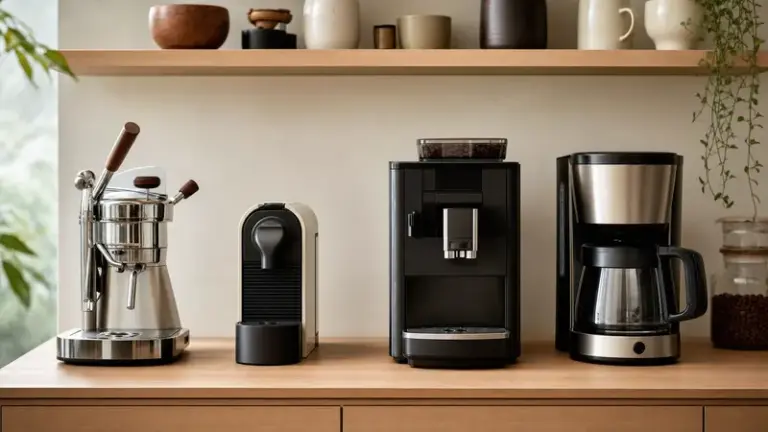
Start by separating the drink from the appliance. A large mug of filter coffee and a small espresso are different brewing goals, even when a machine’s menu uses similar names.
Filter machines and manual drippers
Filter brewers pass water through a bed of ground coffee. An electric filter machine manages water delivery; a manual dripper leaves pouring to you.
Choose this family when you want brewed black coffee rather than an espresso base. For electric brewers, the Specialty Coffee Association’s certified-equipment register provides evidence that listed equipment has undergone its specified performance assessment. Certification is useful evidence about a particular model, not an endorsement of every product from that brand.
Immersion and combined brewers
Immersion means leaving coffee grounds in contact with water before separating the drink. A cafetière uses this approach, while switchable immersion drippers combine steeping with drainage through a filter.
These are useful families to compare when you want manual brewing without making every stage depend on pouring technique. Check the brewer’s working capacity and how easily you can empty and wash it.
Espresso machines
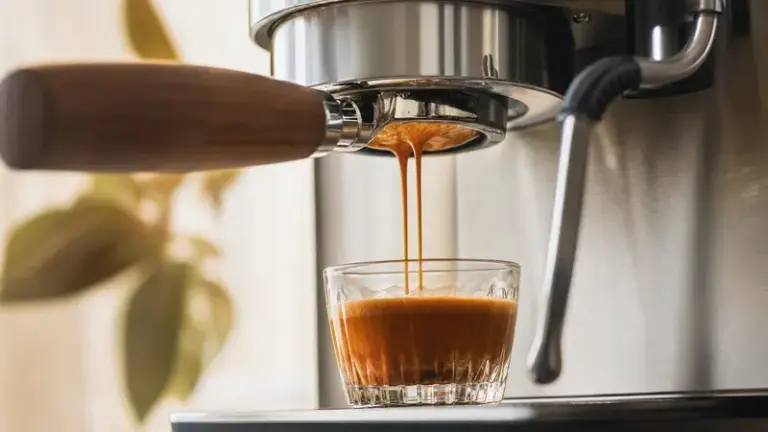
An espresso machine forces hot water through a prepared bed of finely ground coffee. On a conventional portafilter machine, the portafilter is the removable handle holding the coffee basket.
This family suits people who want espresso or espresso-based milk drinks and are willing to learn preparation. Compare control of brewing, milk steaming and cleaning access rather than judging the machine by the largest pressure figure on its packaging.
Bean-to-cup machines
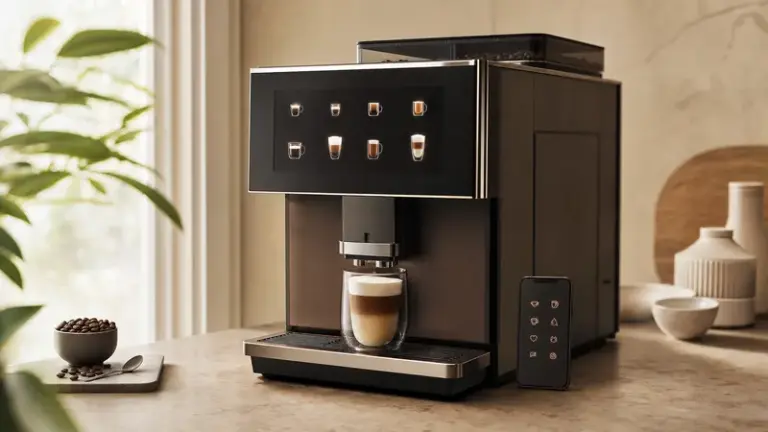
Bean-to-cup machines combine grinding and brewing in an automatic appliance. Depending on the model, milk preparation may be manual, partly automated or integrated into a drink programme.
They deserve consideration where repeatable operation matters more than hands-on preparation. Compare access to the water tank, grounds container and milk components as carefully as the screen.
Capsule machines
Capsule systems use compatible, pre-portioned coffee containers. Compatibility is system-specific: Nespresso’s Original and Vertuo ranges, for example, use different capsules and brewing technologies.
This is a route to straightforward individual preparation, but it ties your coffee choices to the selected format. Identify the system first, then examine drink options and the manufacturer’s cleaning instructions.
Stovetop and specialist brewers
A moka pot uses pressure generated during heating to move water through coffee into an upper chamber. It makes concentrated coffee, but should not be mistaken for a conventional espresso machine.
Cold-brew equipment, siphons and other specialist brewers belong in the comparison when their particular method interests you. There is no need to make them a beginner’s starting point.
Use the machine guide to narrow these families before investigating individual products.
Coffee grinders: why they often matter most
For a setup using whole beans, our recommendation is to prioritise a suitable grinder before adding more brewer features. That is an equipment-selection judgement, not a claim that grinding can compensate for unsuitable water, poor coffee or an incorrectly operated machine.
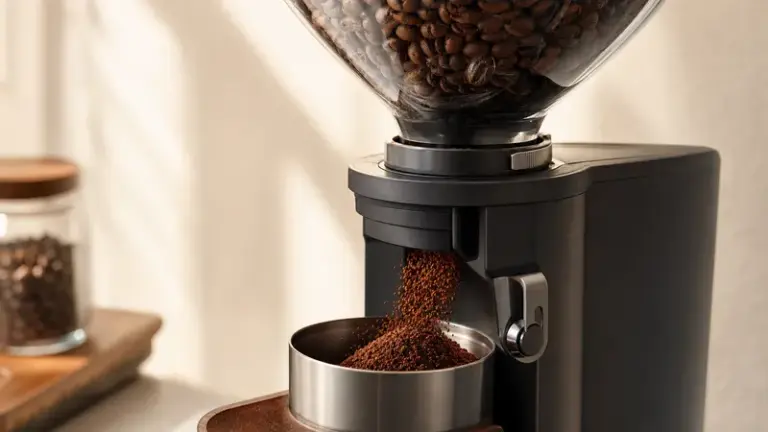
Grinding determines the particles presented to the water. Their size distribution influences how water moves through a coffee bed and how extraction proceeds, which is why a change in grind can alter both brewing behaviour and flavour.
Match the adjustment to the method
An espresso grinder needs useful adjustment within its fine-grinding range. A filter-focused grinder needs appropriate settings for the brewers you actually use.
Do not assume that a long list of settings proves suitability. Baratza’s published Encore ESP specification, for example, explicitly distinguishes its espresso adjustment range from its coarser range for other methods. That distinction tells you more than the setting count alone.
Look beyond the burr label
Burrs are the grinding surfaces inside a burr grinder. Flat and conical designs describe their geometry, but the label alone is not enough to establish how a complete grinder will perform.
Consider adjustment, ease of cleaning, access to replacement parts and the handling of grounds. If you regularly change between coffees or methods, ask to see that workflow demonstrated.
Hand grinding is worth considering if you accept the physical work involved; electric grinding is worth considering when that work would discourage use. The useful question is which arrangement you will operate consistently.
Read the grinder guide when you know your brewing method, especially before pairing a separate grinder with an espresso machine.
Brewing accessories: buy for a task
A useful accessory should improve measurement, make preparation easier or help keep equipment clean. Start by naming its job.
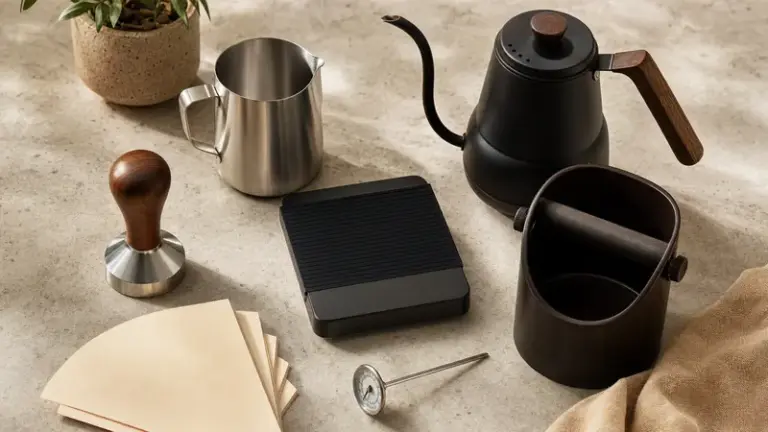
Scales let you measure coffee and water rather than relying on an approximate scoop. A built-in timer can also help record a manual brew, although it need not be part of the scales themselves.
Correctly fitting filters belong with the brewer, not in an afterthought order. Check the specified shape, size and material.
A controlled-pouring kettle is relevant to manual pour-over brewing. It is not a prerequisite for every brewing family.
For portafilter espresso, consider a suitable tamper, scales that fit the working space and a milk jug if you will steam milk. Check dimensions against the machine and basket rather than assuming that accessories are interchangeable.
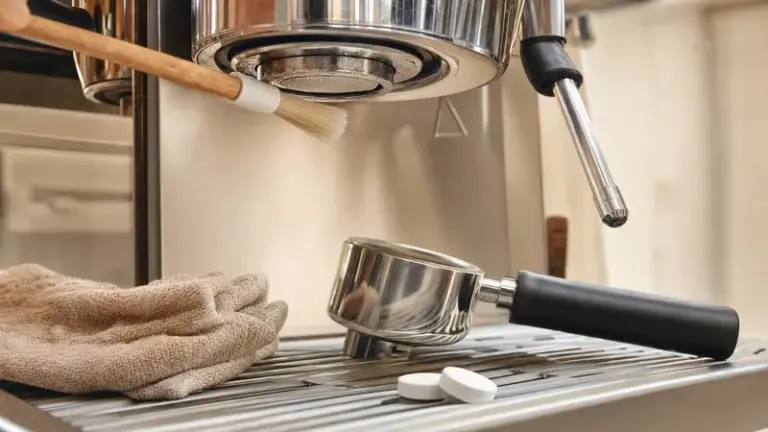
Cleaning tools and consumables should follow the equipment manual. Keep milk-system products, coffee-path cleaners and descalers identified by their intended use.
Finally, make serving practical. Choose cups, a server or a flask that suit how the coffee will be shared.
Use the accessories guide to build this kit in order of usefulness, rather than buying a collection before you have made a drink.
Coffee machine brands available in the UK
Compare brands against stated criteria: suitable equipment, accessible documentation, UK support, replacement parts and the terms of servicing. Brand familiarity is not a substitute for checking the exact model.
Examples verified on UK manufacturer or official brand sites include:
- Sage: portafilter espresso equipment, including machines with separate brewing and steaming boilers.
- JURA: automatic bean-to-cup equipment, with dedicated professional ranges alongside domestic products.
- Nespresso: capsule systems, including the distinct Original and Vertuo families.
- Baratza: separate coffee grinders.
- Hario: manual brewers, grinders, scales, kettles and supporting accessories.
These examples identify categories, not a performance ranking or a complete list of UK suppliers.
Before choosing, download the manual and find the service contact. For workplace equipment, ask who handles installation, operator training and faults, and whether the proposed support covers your location and intended use.
Read the brand guide once you have narrowed the equipment family. It is the place to investigate the maker, rather than choosing a brewing method around a badge.
Equipment care and descaling in UK hard water
Cleaning and descaling are different jobs. Cleaning addresses residues in coffee and milk components; descaling addresses mineral deposits in the water system.
Your water supply and your machine both matter. Thames Water provides postcode-based water information, while SES Water explains that hardness varies within its supply area according to local sources. There is no single hardness figure suitable for every UK reader.
Establish the water requirements first
Find your local supplier’s hardness report, then compare it with the equipment manual. If the machine includes a hardness test, follow its instructions and enter the appropriate setting.
Check the units as well as the number. Reports may express hardness as calcium or as calcium carbonate, while appliances may use Clark or German degrees. These are not interchangeable labels.
A useful reference illustrates why precision matters: SCA Standard 310-2021 specifies brewer-test water with calcium hardness equivalent to 50 to 175 parts per million as calcium carbonate, alkalinity equivalent to 40 to 70 parts per million as calcium carbonate, and pH 6 to 8. These are stated testing conditions, not permission to disregard an espresso machine’s water specification.
Alkalinity describes water’s ability to neutralise acids. It is distinct from hardness, and the SCAE water report considers both taste and equipment protection.
Build a model-specific routine
- Read the cleaning and water-treatment sections before first use.
- Follow the instructions for removable components and milk parts.
- Use the specified cleaning or descaling programme and suitable products.
- Record filter changes, maintenance prompts and developing faults.
Do not assume that a filter removes every descaling requirement. Sage’s Dual Boiler manual, for example, still addresses descaling when scale develops despite use of its supplied filter.
For symptoms, cleaning methods and repair decisions, continue to equipment care and repairs.
Coffee and technology: separate control from convenience
Technology is most useful when you can explain what it changes. Separate features that control brewing from features that make the appliance easier to operate.
Temperature control and heating systems
Temperature control manages brewing heat. PID control is a feedback-based control system used in some espresso machines; Sage describes it in its Dual Boiler, which also has a separate steam boiler for simultaneous brewing and steaming.
That arrangement is worth investigating if you regularly make milk drinks in succession. It is less compelling as a selection criterion if you rarely use steam.
Programme control and measurement
Timed and volumetric controls are different ways to manage a shot. Sage’s published description offers both: one controls time, while volumetric operation controls a programmed delivered volume.
Neither label tells you everything about the resulting drink. Ask what the user can adjust, what the machine measures and what remains fixed.
For advanced equipment, apply the same questions to flow or pressure features: what changes, when does it change, and can you repeat the setting?
Connectivity and automation
Connected functions may support management rather than brewing itself. JURA describes central monitoring and management for connected professional machines through its workplace software.
For home, ask whether an app adds something you will actually use. For work, ask whether monitoring helps the person responsible for supplies and maintenance, and what happens when connectivity is unavailable.
Read coffee technology to understand these mechanisms before treating a feature name as a reason to buy.
Make the final choice for home or work
At home, describe an ordinary day rather than an idealised coffee session. Include the drinks you make, available preparation time, washing-up space and whether other people will use the equipment.
Measure the intended position, including room to refill water, add beans and remove containers. Check the manufacturer’s installation requirements before ordering.
At work, distinguish total daily demand from a queue during a break. A published daily recommendation does not establish how quickly a particular sequence of drinks will be completed.
For context, JURA states recommended maximum daily outputs of up to 50 cups for its W line, 100 cups for its X line and 200 cups for its GIGA X line. These are manufacturer recommendations, not independently verified guarantees for every workplace. Request a demonstration using the drinks and serving pattern you expect.
Compare the complete ownership arrangement: equipment, installation, water treatment, consumables, energy, cleaning labour, servicing and provision during breakdowns. Obtain itemised written quotations so that omissions are visible.
For UK personal purchases, the Consumer Rights Act 2015 framework covers faulty goods, and statutory rights are separate from a manufacturer’s guarantee. Do not assume those consumer protections apply unchanged to business procurement: the Act’s definition of a consumer concerns an individual acting wholly or mainly outside their trade or profession.
The final machines and equipment shortlist should therefore answer three questions clearly: will it make the drinks you want, will people use it properly, and can you look after it?
FAQ
Should I choose an all-in-one machine or separate equipment?
Choose according to the workflow you want rather than assuming either arrangement is superior. Integrated equipment brings grinding and brewing into one appliance; separate equipment lets you select those components individually. Compare the actual adjustment, cleaning access and support arrangements, then consider whether you want to operate one coordinated system or manage separate tools.
Can I begin with pre-ground coffee?
Yes, provided the grind is appropriate for your chosen brewer. It can be a practical way to start without choosing every component at once. Be cautious with conventional espresso equipment, where grind adjustment is part of controlling extraction. Before buying, establish whether the machine and basket arrangement are suitable for the coffee you intend to use.
Is SCA certification a guarantee that I will like the coffee?
No, certification indicates assessment against specified equipment requirements, not a guarantee of personal taste. It is useful evidence when comparing the particular certified models. Your coffee choice, preparation and preferences still matter, so combine certification with an understanding of the brewer’s operation rather than treating the mark as the whole buying decision.
What should I establish before buying second-hand equipment?
Establish its identity, condition and support options before committing. Ask for the exact model, manual, maintenance history and a demonstration, and check replacement-part availability. For a complex machine, consider an inspection by a suitable technician. Do not treat an appliance that powers on as proof that every brewing, heating and milk function works properly.
Where to go next
Read Coffee Machines to choose a brewing family, then Coffee Grinders to match grinding to that method. Brewing Accessories helps complete the setup with purposeful tools, while Coffee Equipment Care and Repairs explains the ownership routine to understand before bringing equipment home or into work.
Sources
-
Specialty Coffee Association, Certified Home Equipment, undated live register, retrieved November 2026.
URL: https://sca.coffee/certified-home-brewer -
Specialty Coffee Association, Home Coffee Brewers: Specifications and Test Methods, SCA Standard 310-2021, 2021, retrieved copy hosted by CoffeeGeek.
URL: https://coffeegeek.com/wp-content/uploads/2023/10/SCAGoldCupStandard.pdf -
Speciality Coffee Association of Europe, The SCAE Water Chart, 2016.
URL: -
Sage, The Dual Boiler, UK product specifications, undated live page, retrieved November 2026.
URL: https://www.sageappliances.com/en-gb/product/bes920 -
Sage, The Dual Boiler Instruction Book, SES920 UK, 2021 file edition.
URL: https://assets.sageappliances.com/BES920/SES920_UK_IB_2021.pdf -
Baratza, Encore ESP, UK product specifications, undated live page, retrieved November 2026.
URL: https://www.baratza.com/en-gb/product/encore-esp-zcg495 -
Baratza, Hario V60 Brew Guide, undated live guide, retrieved November 2026.
URL: https://www.baratza.com/en-us/blog/brew-guides/hario-v60-brew-guide -
Baratza, Dialing in Espresso: Burr Types, Adjustments, and Troubleshooting, undated live guide, retrieved November 2026.
URL: https://www.baratza.com/en-us/blog/product-guides/dialing-in-espresso -
Hario UK, equipment catalogue and V60 Immersion Drippers, undated live pages, retrieved November 2026.
URLs: https://www.hario.co.uk/ and https://www.hario.co.uk/collections/hario-v60-immersion-drippers -
Nespresso UK, Choose Your Nespresso System, undated live guide, retrieved November 2026.
URL: https://www.nespresso.com/uk/en/choose-your-nespresso-system -
Lavazza, How to Prepare an Espresso Perfectly with a Moka Pot, undated live brewing guide, retrieved November 2026. Used for the distinction between moka and espresso preparation.
URL: https://www.lavazzausa.com/en/recipes-and-coffee-hacks/making-espresso-at-home -
Thames Water, Water Quality, and SES Water, Water Hardness and Scale, undated guidance retrieved November 2026.
URLs: https://www.thameswater.co.uk/help/water-and-waste-help/water-quality and https://www.seswater.co.uk/household/your-water/water-quality/water-in-your-home -
JURA UK, Professional Coffee Machine for the Workplace and Office, undated live specifications and management-software description, retrieved November 2026.
URL: https://uk.jura.com/en/professional/coffee-solutions-for-the-workplace -
GOV.UK, Consumer Rights Act 2015, 2015, and Accepting Returns and Giving Refunds: The Law, undated live guidance retrieved November 2026.
URLs: https://www.gov.uk/government/publications/consumer-rights-act-2015/consumer-rights-act-2015 and https://www.gov.uk/accepting-returns-and-giving-refunds -
UK Parliament, Consumer Rights Act 2015, section 2, current retrieved text checked November 2026.
URL: https://www.legislation.gov.uk/ukpga/2015/15/section/2
This page was researched from manufacturer documentation, SCA publications, water-supplier guidance and official UK consumer-law sources; equipment specifications are manufacturer claims, not results of first-hand testing.
Last checked: November 2026