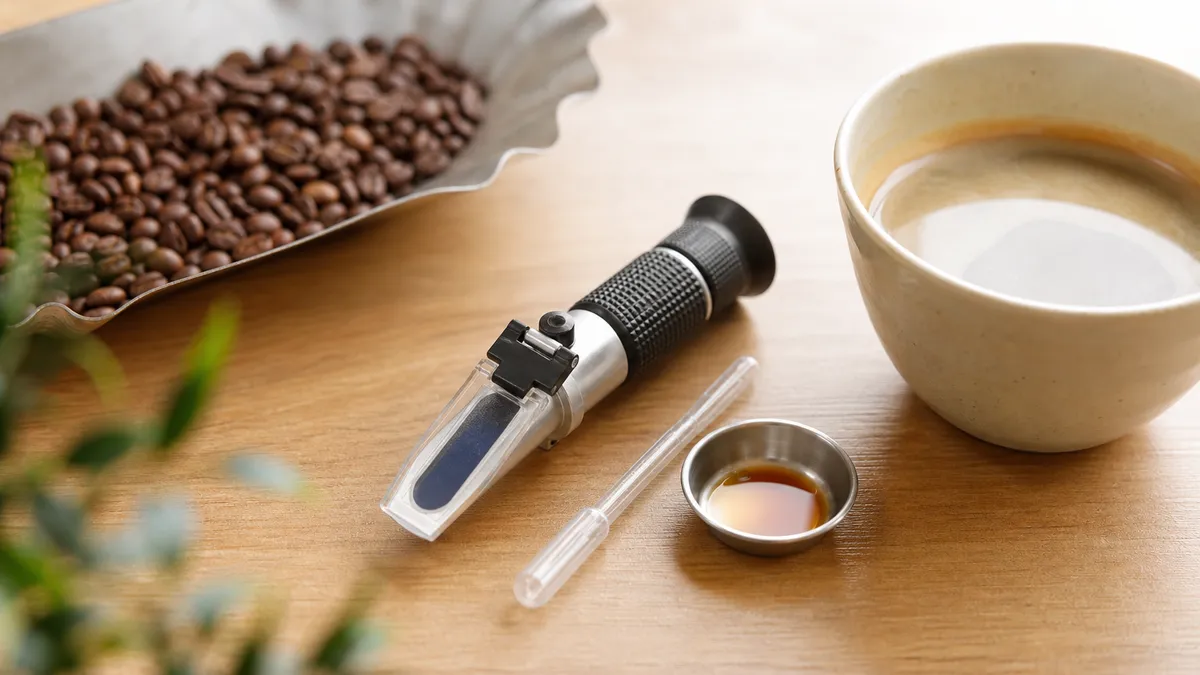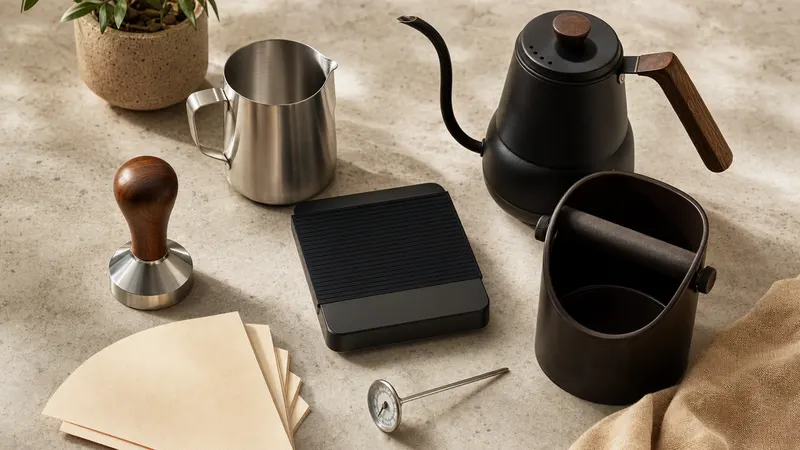
The brewing accessories that make a real difference help you measure consistently, control a brewing step or keep equipment working properly. Start with scales, the correct filter and water suited to your machine, then add tools for the drinks you actually make rather than collecting accessories without a clear job.
In short
- Choose accessories for your brewing method: a pour-over kettle and an espresso tamper solve different problems.
- For scales, check response, capacity and physical fit as well as the smallest displayed increment.
- Treat coffee filters and water filters separately: one separates grounds from the drink; the other changes the incoming water.
- Match espresso tools to the basket and milk tools to the way you heat and texture milk.
- Leave refractometers until you have a repeatable routine and a specific measurement question.
Guides in Brewing Accessories
 Coffee Cups, Glassware and Travel MugsMatch coffee cups, glassware and travel mugs to your drink, with practical guidance on sizes, ceramic, double walls, preheating, lids and reuse.Read the guide
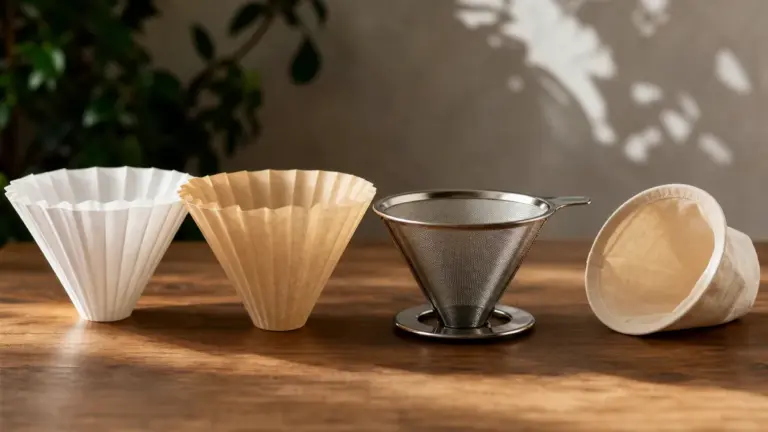 Coffee Filters: Paper, Metal and Cloth ComparedChoose coffee filters that fit your brewer. Compare paper, metal and cloth for flavour, body, cleaning, sizes and waste, with practical fitting advice.Read the guide
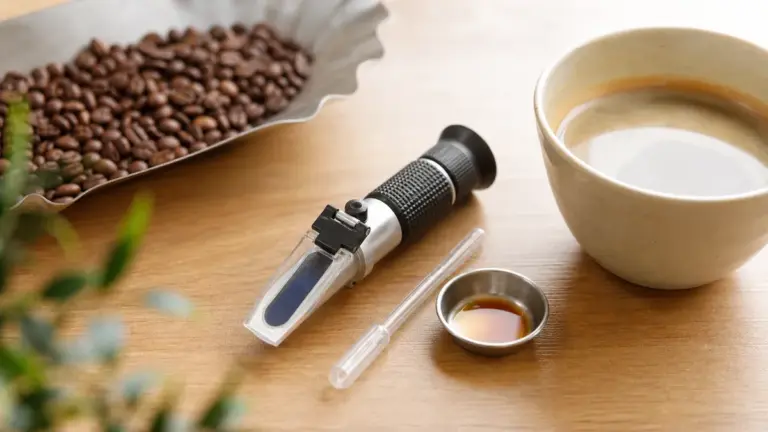 Coffee RefractometersLearn what coffee refractometers measure, how to calibrate and filter samples, and calculate extraction yield with a worked example. Do you need one?Read the guide
 Coffee Scales: Choosing for Espresso and Filter BrewingChoose coffee scales by readability, response time, timer, capacity and fit. Understand why weighing beats scoops and what water resistance means.Read the guide
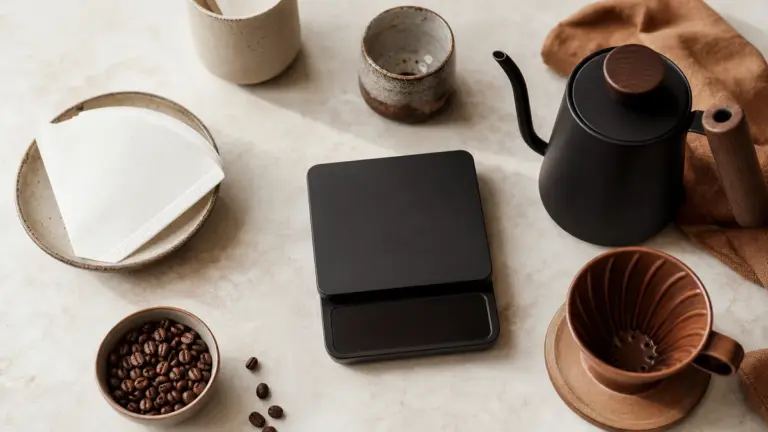 Essential Brewing AccessoriesChoose essential brewing accessories for your method, from scales and grinders to filters, water and espresso tools, without buying unnecessary extras.Read the guide
 Gooseneck KettlesDo you need a gooseneck kettle for coffee? Compare stovetop and electric designs, temperature control, practical capacity and everyday pouring needs.Read the guide
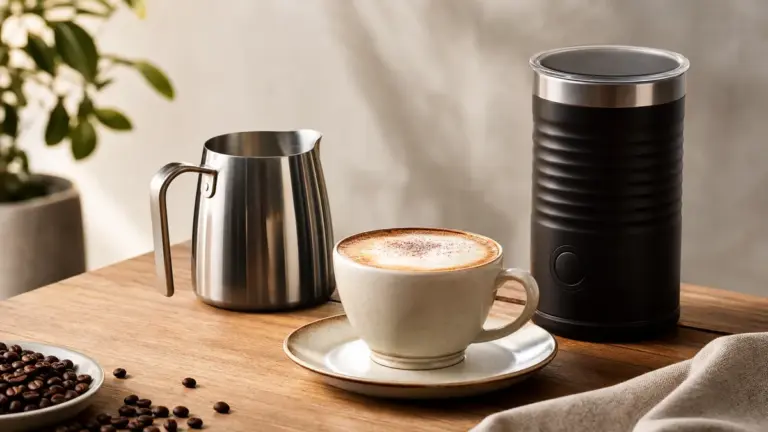 Milk Frothers and Milk PitchersChoose a milk frother and pitcher for home coffee. Compare steam wands, electric jugs and handheld whisks, plus jug sizes, plant milk and cleaning.Read the guide
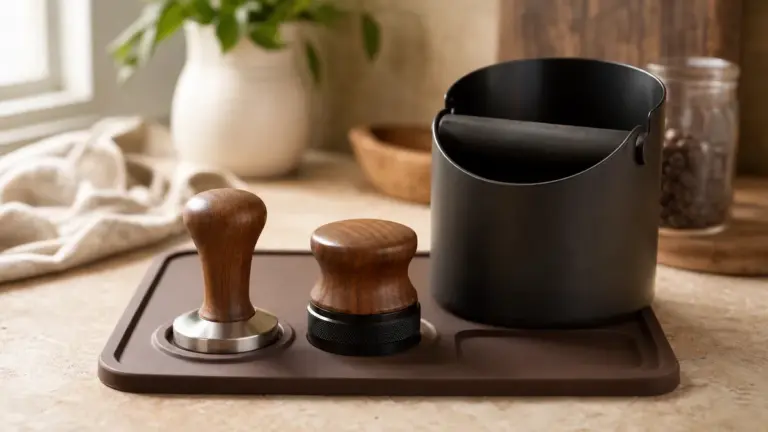 Tampers, Distribution Tools and Knock BoxesChoose espresso tools that help: understand tamper fit, calibrated designs, WDT needles, knock boxes and tamping mats, without unnecessary extras.Read the guide
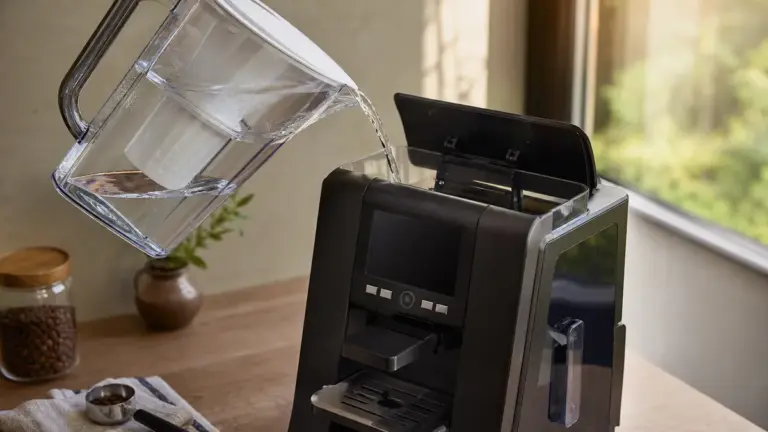 Water Filters for Coffee MachinesDo you need a coffee machine water filter? Check UK hardness, compare jugs, tank cartridges and in-line systems, and understand scale protection.Read the guide
Start here if you are new
- Read essential brewing accessories to build a short list around the brewer you already own. Use it before choosing specialist tools.
- Move to scales when you want to repeat a recipe rather than estimate each dose. This is the useful next step if your coffee changes despite apparently following the same method.
- Read water filters for coffee machines before choosing a cartridge or changing your machine’s water supply. Start with your local water information and the machine manual, not a generic recommendation.
For the wider relationship between brewers, grinders and supporting equipment, return to machines and equipment. This hub concentrates on the tools around the brewer, with detailed selection and technique covered in the linked guides.
Brewing accessories at a glance
The criteria here are purpose, compatibility, repeatability and cleaning. “Useful” means useful for a particular task, not essential for every coffee drinker.
| Accessory | Main job | Who it suits | Check before choosing |
|---|---|---|---|
| Scales | Measure coffee, brewing water or espresso yield | Anyone following a repeatable recipe | Capacity, response, dimensions and auto-off |
| Coffee filters | Separate grounds and influence the drink’s texture | Filter and immersion brewers | Exact brewer fit, material and cleaning |
| Gooseneck kettle | Make directed pouring easier to control | Manual pour-over users | Handling, usable capacity and temperature controls |
| Espresso tools | Support dosing, preparation and disposal of grounds | Manual espresso users | Basket compatibility and the problem being addressed |
| Milk tools | Heat, aerate, measure or pour milk | Milk-drink makers | Frothing method, working fill and cleaning access |
| Cups and travel mugs | Hold and serve the finished drink | All drinkers | Usable volume, clearance, lid and care instructions |
| Water filters | Treat particular characteristics of incoming water | Users whose water or machine requires treatment | Water report, treatment type and replacement schedule |
| Refractometers | Estimate dissolved coffee concentration | Advanced learners and quality-control users | Coffee suitability, calibration and sampling protocol |
Measuring and filtering the brew
Scales: repeat the recipe before adding complexity
Scales let you distinguish the amount of coffee used from the amount of water added or espresso collected. That distinction matters because a repeatable recipe needs measurable inputs, not simply the same-looking scoop or a familiar level in a cup.
Look for a display that remains visible beneath your brewer and controls you can operate without shifting the load. For espresso, check the space between the drip tray and spouts with both the scale and cup in position. For a larger filter brew, check that the scale can support the brewer, receiving vessel and water together.
A displayed increment of 0.1 g is a useful selection criterion for espresso work, but it is not proof of accuracy. Acaia defines resolution as the smallest displayed change in weight: it tells you how finely the reading is divided, not whether every reading is correct.
Read coffee scales when comparing response, repeatability and everyday usability. It is particularly useful if your existing kitchen scale switches off during brewing or hides its display beneath the server.
Filters: choose fit before material
A filter must match the brewer’s intended shape and size. Check the manufacturer’s compatibility information rather than assuming that two cone-shaped papers are interchangeable.
Material is then a choice about the drink and the work afterwards. Paper and metal are not simply disposable and reusable versions of the same result: Hario’s published descriptions, for example, distinguish the coffee oils passed by its metal filters from those retained by paper and cloth.
Do not treat “metal filter” as a single specification either. Mesh construction varies, so use the maker’s instructions for cleaning and the particular brewer’s guidance for preparation.
Read coffee filters when choosing between paper, cloth and metal, or when replacing an unfamiliar filter. That guide is the place for material comparisons and brewer compatibility rather than a universal winner.
Controlling the pour
A gooseneck kettle gives you a narrow spout for directing water during manual brewing. Its value is the control it offers your particular technique, not the shape of the kettle by itself.
Before choosing one, identify the difficulty. If you cannot comfortably direct a small stream, handling and spout behaviour deserve attention. If you want repeatable kettle settings, temperature selection may matter more. Fellow’s Stagg EKG instructions illustrate the distinction between selecting a temperature and using a separate holding function.
Try to assess balance with water inside, not just how an empty kettle feels. Check whether the lid stays secure during normal pouring, whether the handle suits your grip and whether the usable capacity fits your routine without exceeding the maker’s fill limits.
Read gooseneck kettles when manual pouring is something you want to improve. If your brewer distributes its own water, put this accessory behind the items that affect your actual workflow.
Preparing espresso and handling milk
Espresso tools: give each one a defined job
An espresso tamper compresses the grounds in the filter basket held by the portafilter, the removable handle that locks into the machine. Begin with the tool intended for your basket and a consistent preparation routine before adding more equipment.
Distribution means spreading the grounds before tamping. Different tools address this in different ways, so ask what you need to change: awkward dosing, uneven preparation or simply a messy work surface. Do not assume that a more elaborate sequence is automatically a better one.
Sage’s Barista Pro manual instructs users to distribute grounds before tamping and emphasises consistent tamping pressure. It also shows a knock box being used to catch removed grounds. That is a useful distinction: preparation tools act on the coffee before brewing, while a knock box mainly improves disposal and tidiness afterwards.
Read tampers, distribution tools and knock boxes when matching tools to a manual espresso setup. Use it to separate necessary compatibility checks from optional additions to the routine.
Milk tools: match the tool to the process
A milk pitcher is a working vessel for steaming and pouring; a frother is a device for introducing air, sometimes with a heating function. Establish which operation you need before comparing shapes or accessories.
For steam-wand use, check the machine’s recommended starting fill and leave the space required by its instructions. Breville’s published steaming method combines introducing air with circulating the milk, then calls for wiping and purging the wand afterwards. A suitable jug should make that process manageable rather than force an awkward grip or wand position.
Temperature measurement is useful when learning to repeat a result. Breville gives 60 to 65 degrees Celsius in one published steaming method, but this is method guidance, not a universal specification for every milk or plant-based drink.
Read milk frothers and milk pitchers when deciding between separate frothing and steaming, or when choosing a pitcher for your machine. Cleaning access belongs on the shortlist alongside pouring control.
Serving the drink
Choose cups around the drink you intend to serve and the equipment they must fit beneath. Check usable volume rather than relying on a product photograph, and measure machine clearance before choosing tall glassware or a travel mug.
For travel mugs, distinguish a sealed carrying lid from a lid intended for sipping with some spill resistance. Fellow’s published lid descriptions make this distinction within a single mug system, so the word “travel” alone is not enough to establish how a vessel should be carried.
Follow the care instructions for the complete product, including its lid and seals. A mug’s materials and construction can bring restrictions that do not apply to an ordinary ceramic cup.
Read coffee cups, glassware and travel mugs when choosing for desk use, serving or commuting. It is the useful next read when size, handling and cleaning matter more than adding another brewing control.
Water treatment: begin with the supply
Water filtration should answer an identified need. The Drinking Water Inspectorate distinguishes activated-carbon treatment for taste and odour from treatments that remove hardness or dissolved minerals; a filter that improves taste is not automatically a scale-control system.
Start with your water supplier’s published report. Thames Water, for example, provides a postcode-based water-quality lookup. Use the equivalent service from your own supplier rather than applying another area’s result to your home or workplace.
Hardness describes dissolved calcium and magnesium; alkalinity describes water’s capacity to neutralise acid. These are separate properties, even when both are reported in mg/L as calcium carbonate, a common basis for expressing and comparing results.
The SCAE Water Chart, a predecessor resource to today’s SCA material, considers hardness and alkalinity together. Use brewing-water guidance to understand the variables, but follow the machine manufacturer’s requirements when selecting treatment for equipment protection.
Read water filters for coffee machines when deciding whether you need taste treatment, hardness reduction or a machine-specific cartridge. Record cartridge changes and follow the replacement instructions: treatment is an ongoing task, not a permanent property of the filter housing.
Advanced measurement and sensible buying
Refractometers: answer a question, not just produce a number
A coffee refractometer measures refractive index, an optical property, and uses a coffee-specific relationship to estimate total dissolved solids, usually abbreviated to TDS. In this context, TDS means the concentration of dissolved coffee in the drink.
This is different from measuring the dissolved minerals in incoming water. The shared abbreviation does not make the instruments or their readings interchangeable.
The measurement is useful only when sample preparation is controlled. VST’s instructions require suitable filtration for espresso samples because suspended material can interfere with readings, alongside cooling and time for gas to leave the sample. A casual drop taken from a fresh shot is not the same as a prepared measurement sample.
Read coffee refractometers when you can already repeat your brewing routine and want to investigate strength or extraction. Treat the result as information to interpret alongside tasting, not an automatic verdict on quality.
Read specifications and rights carefully
Separate a manufacturer’s claimed feature from independent evidence of performance. A temperature setting, fine display increment or stated holding time tells you what the maker specifies; it does not establish comparative reliability.
Likewise, the SCA’s home-equipment certification programme evaluates submitted equipment against defined requirements. Do not extend a brewer’s certification to an unrelated kettle, scale or accessory beside it.
For UK personal purchases from a trader, faulty-goods rights are separate from the manufacturer’s warranty. GOV.UK explains that a warranty expiring does not by itself remove the retailer’s obligations. Workplace buyers should establish whether they are purchasing as a business and obtain written terms, compatibility confirmation and itemised quotations.
The most useful brewing accessories are those you can explain in one sentence: what they measure, what they control or what task they make easier.
FAQ
Can I keep using ordinary kitchen scales?
Yes, if they let you follow your recipe reliably and remain usable throughout brewing. Check capacity, display visibility, response and auto-off before replacing them. A dedicated coffee scale is worth considering when an identifiable limitation interrupts your method, not simply because the existing scale was sold for general kitchen use.
Should I change several accessories at once?
Prefer changing one part of the routine at a time when your aim is to understand the result. Breville’s preparation guidance recommends adjusting brewing factors individually, and the same experimental approach is useful here. Keep a brief note of what changed and what you noticed before deciding whether another accessory is needed.
How should a shared office choose accessories?
Choose around the people who will use and maintain them. As an editorial priority, favour straightforward controls, clear compatibility and cleaning instructions that can be assigned to someone. Before ordering, ask for written confirmation of intended workplace use, replacement-part availability and the applicable business terms rather than assuming a domestic product’s arrangements will suit.
Where to go next
Start with Essential Brewing Accessories to turn this overview into a method-specific shortlist, then read Scales to assess your measuring setup. Choose Water Filters for Coffee Machines before changing treatment, or Tampers, Distribution Tools and Knock Boxes if your next task is organising a manual espresso station.
Sources
- Acaia, Weighing Resolution, 2015. Explains displayed resolution and its meaning. Manufacturer guidance.
- Hario, English Catalogue, 2022, stainless-steel dripper section. Manufacturer description of filter materials and coffee oils. Catalogue.
- Fellow, Stagg EKG Electric Kettle Safety, Troubleshooting and Instructions, undated. Temperature selection, holding function and operating precautions. Manufacturer instructions.
- Sage, The Barista Pro Instruction Book, UK document SES878_UK_UG1_F22. Dosing, distribution, tamping and grounds disposal. Instruction book.
- Breville, The Dynamic Duo Instruction Book, document BEP920, undated. Milk texturing, cleaning and changing brewing factors individually. Instruction book.
- Fellow, Carter 3-in-1 Lid System, undated product page. Manufacturer descriptions of lid functions and care requirements. Product information.
- Drinking Water Inspectorate, Domestic water filters and softeners, undated. Treatment types, local water reports and cartridge maintenance. Official guidance.
- Thames Water, Water quality, undated. Postcode-based water-quality information and hardness explanation. Supplier information.
- Speciality Coffee Association of Europe, The SCAE Water Chart, undated retrieved edition. Hardness, alkalinity and treatment framework. Technical report.
- VST, Coffee and VST Refractometers, version 3, and Syringe Filter Safety and Operating Instructions, retrieved edition undated. Measurement principles and sample preparation. Technical paper; filter instructions.
- Specialty Coffee Association, Certified Home Equipment and Standards, current web pages, undated. Certification scope and published standards framework. Certification programme; standards directory.
- GOV.UK, Accepting returns and giving refunds: the law, current web guidance, undated. Faulty goods, retailer obligations and warranties. Official guidance.
Researched using retrieved manufacturer instructions, coffee-industry technical resources, official consumer guidance and water-supply information; no first-hand product testing is claimed.
Last checked: November 2026