Southern Africa’s coffee, as grouped on this website, includes the robusta-led industries of Angola and Madagascar and the mainly arabica origins of Zambia and Zimbabwe. These countries offer very different coffees, from full-bodied robusta to bright, fruit-led arabica, so the country, producer and processing method matter more than a single regional flavour description.
In short
- This is an editorial grouping, not the United Nations geographical subregion called Southern Africa.
- Angola and Madagascar grow both arabica and robusta; Zambia and Zimbabwe are principally arabica origins.
- Published growing examples range from Madagascar’s lowland robusta at 10 to 600 metres to highland arabica at 1,000 to 1,800 metres.
- Recovery takes different forms: restoring estates, supporting smallholders, improving processing and breeding better-adapted planting material.
- For UK buyers, start with a traceable lot rather than a promise of “Southern African flavour”.
Guides in Southern Africa
 Angolan Coffee: Origins, Flavour and ProductionDiscover what Angolan coffee tastes like, where robusta and arabica grow, how production declined, and what to check when buying beans in the UK.Read the guide
 Madagascar Coffee: Robusta and Wild SpeciesDiscover Madagascar coffee, its robusta-led flavour, naturally caffeine-free wild relatives, conservation research and what to check before buying.Read the guide
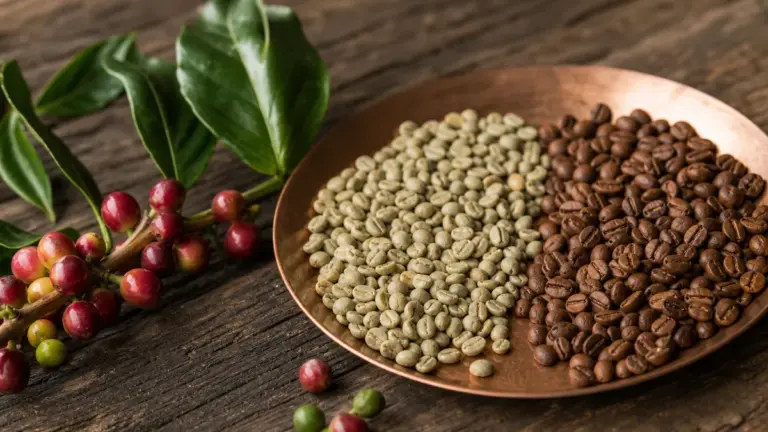 Zambia CoffeeWhat does Zambian coffee taste like? Explore its estate farms, growing regions, arabica varieties, processing methods and sourced production figures.Read the guide
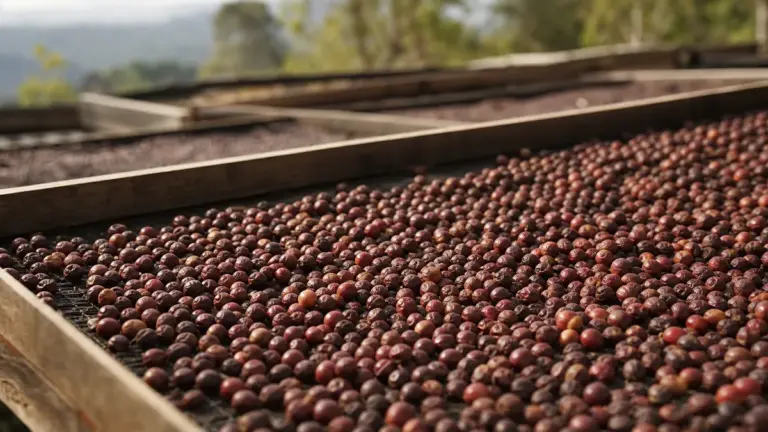 Zimbabwe Coffee: Flavour, Growing Regions and RevivalDiscover Zimbabwean coffee, from Honde Valley to Chimanimani: its berry-led flavours, washed processing, varieties and carefully documented revival.Read the guide
Start here if you are new
Begin with beans and origins if species, varieties and processing are unfamiliar. Then read Zambia for an introduction to the group’s estate-grown arabica, followed by Angola to understand its contrasting robusta tradition.
A note on geography: “Southern Africa” here is a website navigation category covering Angola, Zambia, Zimbabwe and Madagascar. It is not the UN M49 subregion, which comprises Botswana, Eswatini, Lesotho, Namibia and South Africa. The UN places Angola in Middle Africa and the other three countries in Eastern Africa.
The grouping is useful for exploring these particular origins together, but it should not imply that they share one climate, production system or coffee culture. Nor is it an exhaustive list of coffee-producing countries in the southern part of Africa.
Southern Africa coffee fact panel
The following figures describe documented locations and examples, not uniform limits across all four countries.
- Altitude: Madagascar’s agricultural research centre, FOFIFA, maps robusta cultivation at 10 to 600 metres, medium-altitude arabica at 700 to 1,000 metres and highland arabica at 1,000 to 1,800 metres. An Olam estate sheet gives 1,300 to 1,550 metres for its northern Zambian estates.
- Species and varieties: the main commercial species are Coffea arabica and Coffea canephora, the latter traded as robusta. Documented Zambian plantings include Catimor 129, Java, Marsellesa and Starmaya. These are not regional species names.
- Processing: dry processing is established in Angola and Madagascar. Washed processing is associated with Zimbabwe and Zambia, while Zambian producers also offer natural and honey-processed lots.
- Harvest: published guides give June to October for Angola and July to October for Zimbabwe. Algrano gives May to September for Zambia. A field study gives June to August for south-eastern Madagascar, not the whole island.
- Cup profile: there is no dependable regional template. Published Zambian estate notes include lemon, berries, milk chocolate and caramel; Nespresso describes eastern Zimbabwe arabica through lively acidity and berry notes. Madagascar’s exporter descriptions distinguish powerful-bodied robusta from softer, more aromatic highland arabica.
Harvest guides are planning aids rather than delivery promises. Ask for the actual picking period and harvest year of the lot being offered.
Four countries, different starting points
| Country | Main commercial coffee | Documented growing areas | What to investigate first |
|---|---|---|---|
| Angola | Predominantly robusta, with arabica also grown | Robusta in the north and Cuanza Sul; arabica on central and southern highlands | Species, producer and whether the coffee is whole-cherry dried |
| Zambia | Mainly arabica | Northern Province, including the Kasama and Mbala areas | Estate, variety and washed versus natural processing |
| Zimbabwe | Arabica | Eastern growing areas along the Mozambique border | Producer, processing and the current harvest |
| Madagascar | Predominantly robusta, with a smaller arabica sector | Eastern and northern lowlands; arabica on the highlands | Species first, then locality and processing |
Angola: look beyond its former scale
Angola’s coffee identity is closely tied to robusta. USDA identifies Uíge, Cuanza Norte and Cuanza Sul as important producing provinces, while agronomic research also documents arabica cultivation in Huambo, Bié, Huíla and Benguela.
The distinction matters when buying. “Angolan coffee” does not automatically mean robusta, and an arabica from a highland farm should not be judged against expectations formed by the country’s better-known lowland crop.
Read Angola when you want to follow the connection between its historical industry, present-day producers and attempts to restore production. For choosing a bag, request the species and processing information before relying on the national name.
Zambia: estate identity is particularly useful
Zambia offers a clear route into traceable estate coffee. Olam’s published estate material names Catimor 129 alongside Java and Marsellesa, while Algrano’s Mount Sunzu information includes Starmaya and Marsellesa.
Those names describe planting material, not processing methods or quality grades. World Coffee Research identifies Starmaya as an F1 hybrid, meaning the first generation from a deliberate cross between selected parents.
The Zambia guide is the useful next read when comparing estates, varieties and processing styles. A washed Starmaya and a natural Catimor lot are more informative buying descriptions than “Zambian arabica” alone.
Zimbabwe: follow the producer and recovery story
Zimbabwe’s coffee is associated with the country’s eastern growing areas. TechnoServe describes an industry that peaked in the late 1980s before suffering a sharp decline in the early 2000s through economic hardship and climate shocks.
Its recovery work with Nespresso focuses on smallholder training in cultivation, processing and quality. That is a different model from rebuilding production primarily through large estates.
Use Zimbabwe to explore those farming communities and the coffees reaching buyers from them. A recovery programme explains how a coffee reaches market; the particular lot still needs its own flavour description.
Madagascar: establish the species first
Madagascar has a robusta-dominated commercial crop and a smaller highland arabica sector. In its November 2022 project announcement, FOFIFA put arabica at only 5% of national production, a dated estimate rather than a permanent proportion.
Exporter EKL describes the main robusta areas as the eastern and northern lowlands, with arabica grown on the highlands, including Itasy. It also distinguishes the dominant dry-processing tradition from wet processing used for some arabica.
Read Madagascar when you want to separate the island’s commercial coffees from its wider botanical story. For a purchase, “Madagascar” is the beginning of the description, not enough information to predict the cup.
History and production: read the dates and units
These origins do not share a simple rise-and-recovery story. Angola’s industry was disrupted by war, Zimbabwe’s by economic and climatic shocks, and Zambia’s recovery has involved substantial estate renewal.
A short timeline
- 1973: AFD’s historical account records Angola exporting 220,000 tonnes of robusta, illustrating the scale of its former industry.
- Late 1980s: TechnoServe places Zimbabwe’s production peak in this period.
- 2018: Nespresso announced its Zimbabwe revival initiative, working with TechnoServe on farmer support.
- 2022: FOFIFA launched its RATELO arabica research project in Madagascar.
- 2026: FOFIFA reported a national workshop on 28 and 29 September to develop Madagascar’s coffee recovery programme for 2026 to 2036.
Production figures need especially careful handling. USDA’s 2021 Angola report distinguishes 8,718 tonnes of dried coffee fruit, locally called mabuba, from 4,369 tonnes of green coffee beans in 2019. Quoting the larger number as green-bean production would substantially misrepresent the crop.
For Zambia, the ICO’s April 2023 report recorded production of 64,000 bags of 60 kg in coffee year 2021/22. It linked the recovery to consolidation and rejuvenation of estates under Olam Food Ingredients and Northern Coffee Corporation Limited.
These are dated production benchmarks, not November 2026 estimates or a current ranking. Likewise, an export figure is not interchangeable with production: the FAO’s country profiles explicitly note that exports can include stocks from an earlier season.
What recovery projects actually change
Recovery means more than planting additional trees. The documented projects address different weaknesses between the farm and the buyer.
In Angola, AFD describes support for producer organisations, technical assistance, processing and coordination across the coffee sector. Its account also identifies ageing plantations and farmers as constraints. Restoring output therefore involves both the crop itself and the organisations needed to handle and market it.
Zambia’s ICO-documented recovery centres on estate consolidation and rejuvenation. Published estate information also shows the role of irrigation and a wider processing offer, including washed, natural and honey coffees.
In Zimbabwe, TechnoServe’s partnership with Nespresso concentrates on smallholder knowledge and access to quality-focused markets. Training covers cultivation and processing rather than treating production volume as the only objective.
Madagascar adds a breeding and adaptation strand. FOFIFA’s RATELO project, launched in November 2022, was designed to create and assess planting material across different ecological zones. Its September 2026 national workshop concerned a broader recovery programme. These are documented research and planning activities, not proof that future production targets have already been achieved.
For readers following these projects, keep three questions separate: what was announced, what was implemented and what measurable results followed.
Cup profiles: useful clues, not national guarantees
The strongest flavour descriptions here belong to identifiable suppliers or lots.
Olam’s Zambian estate sheet describes lemon, berries, milk chocolate and light caramel. Algrano describes Mount Sunzu coffees through cocoa and caramel. Those descriptions offer a useful starting point for readers seeking sweetness with fruit or chocolate notes, but they do not define every Zambian coffee.
Nespresso describes eastern Zimbabwe arabica as having lively acidity and pronounced berry notes. Here, acidity means the bright, tart impression in the drink, not a claim about its measured pH.
For Madagascar, EKL describes robusta as full-bodied with marked bitterness and highland arabica as softer and more aromatic. These are exporter descriptions, not independent evaluations of the national crop.
For Angola, the sources used here establish species, growing areas and processing more securely than a single sensory signature. It is better to ask for a producer’s sample notes than attach an unsupported chocolate, spice or fruit description to the entire country.
A practical comparison is to taste coffees with similar roast intentions first, recording sweetness, acidity, bitterness, body and aftertaste. Treat an origin name as context and the actual cup as the evidence.
Finding these coffees in the UK
Zambian coffee has a directly verifiable UK retail presence: Garage Coffee Roasters listed Starmaya AA, Zambia when checked in November 2026. Its stated notes were guava, blackberry and lavender, illustrating how one retail lot can differ from broader estate descriptions.
Zimbabwean coffee has also reached UK consumers through Nespresso’s Reviving Origins programme, whose UK launch was announced in May 2019. That historical release is not confirmation of present stock.
For Angola and Madagascar, the research established production or export activity but did not establish dependable year-round UK retail availability. Ask a specialist roaster whether they have a current lot or an expected arrival rather than assuming that an origin guide is a stock list.
Before ordering, request:
- Country and producer, with the estate, cooperative or locality where available.
- Species and variety, keeping arabica or robusta separate from names such as Starmaya.
- Processing method, with clarification if the description is unfamiliar.
- Harvest year and roast date, recorded as different dates.
- Lot-specific tasting notes and intended brewing use, rather than a generic national profile.
For Southern Africa, a well-described available coffee is a better starting point than chasing all four origins at once.
FAQ
Is coffee grown in South Africa itself?
This page does not attempt to catalogue South Africa’s coffee production. Its title is an editorial navigation label for Angola, Zambia, Zimbabwe and Madagascar, rather than a claim that these are the only coffee-growing countries in the wider southern part of the continent. The geographical distinction is explained near the beginning.
Does a coffee grown at higher altitude automatically taste better?
No, altitude alone is not a sufficient buying rule. CIRAD explains that arabica generally favours cooler conditions and robusta warmer, humid conditions, so an altitude figure needs to be interpreted alongside species and location. Ask for the producer, processing method and sample description rather than ranking unrelated coffees by metres alone.
Does “natural” mean the coffee was grown organically?
No, natural describes processing, not organic cultivation. In this context it means drying the whole coffee cherry before removing the dried fruit layers. A natural coffee can therefore tell you something about post-harvest handling without establishing how the farm managed fertilisers, pests or certification.
Where to go next
Read Angola and Madagascar to explore the group’s robusta-led industries and their smaller arabica sectors. Choose Zambia for estate and variety detail, or Zimbabwe for the relationship between eastern growing communities, processing and coffee recovery.
Sources
Publication dates are given where the retrieved documents identify them. Undated commercial descriptions are treated as supplier claims, not independent sensory testing.
-
United Nations Statistics Division, Standard country or area codes for statistical use, M49, live classification, accessed 2026.
https://unstats.un.org/unsd/methodology/m49/
Supports the distinction between this editorial grouping and UN geographical subregions. -
CIRAD, Coffee: Plant and uses, live reference page, accessed 2026.
https://www.cirad.fr/en/our-activities-our-impact/tropical-value-chains/coffee/plant-and-uses
Supports the species distinction and their different growing conditions. -
FOFIFA, Présentation du projet Café RATELO ARABICA, 2022.
https://www.fofifa.mg/wp-content/uploads/2022/11/Presentation-du-cafe-RATELO-ARABICA.pdf
Supplies Madagascar’s mapped altitude bands. -
Olam Specialty Coffee, Zambia Estates, sheet containing 2019 harvest material.
https://www.covoyacoffee.com/mwdownloads/download/link/id/87
Supplies estate altitude, planting material, processing and supplier tasting descriptions. -
FAO, Annex 4: Africa Coffee Producing Countries Profiles, historical profiles containing 1999 data, undated webpage.
https://www.fao.org/4/x6939e/X6939e10.htm
Used for historical harvest guidance, processing and the distinction between exports and production. -
USDA Foreign Agricultural Service, Angola Coffee, 25 March 2021.
https://apps.fas.usda.gov/newgainapi/api/Report/DownloadReportByFileName?fileName=Angola+Coffee_Luanda_Angola_03-25-2021.pdf
Supplies producing provinces, processing and the separate 2019 dried-fruit and green-bean figures. -
Pesquisa Agropecuária Tropical, Agroclimatic zoning for coffee crop in Angola, 2018.
https://new.scielo.br/j/pat/a/hgxsyHSM4V9sVQfHJyQxCnF/?ilang=pt_BR&lang=en
Used for documented Angolan arabica-growing provinces. -
International Coffee Organization, Coffee Report and Outlook, April 2023.
https://ico.org/resources/public-market-information/
Supplies Zambia’s 2021/22 production benchmark and its explanation of estate recovery. -
Agence Française de Développement, Improving the performance and growth of the Angolan coffee value chain, undated project page.
https://botswana.afd.fr/en/projects/improving-performance-and-growth-angolan-coffee-value-chain
Used for historical exports, war-related disruption and recovery activities. -
TechnoServe, Reviving Coffee in Zimbabwe, undated project page.
https://www.technoserve.org/fight-poverty/projects/reviving-coffee-in-zimbabwe/
Supplies the historical production trajectory and partnership activities. -
Nespresso, Nespresso revives Zimbabwe’s coffee production, 6 September 2018; and Nestlé UK, Nespresso reveals “Reviving Origins” programme at London launch, 10 May 2019.
https://www.nestle.com/sites/default/files/asset-library/documents/media/news-feed/nestle-nespresso-revives-zimbabwe-coffee-production-6sept2018.pdf
https://www.nestle.co.uk/en-gb/media/newsfeatures/nespresso-reveals-reviving-origins-programme-at-london-launch
Establishes the announcement and historical UK launch dates. -
FOFIFA, Cérémonie de lancement officiel du projet Café RATELO ARABICA, 14 November 2022; and Atelier national sur le développement de la filière café, 1 October 2026.
https://www.fofifa.mg/ceremonie-de-lancement-officiel-du-projet-cafe-ratelo-arabica/
https://www.fofifa.mg/atelier-national-sur-le-developpement-de-la-filiere-cafe/
Supplies the dated arabica share, research activities and national recovery planning. -
Algrano, Source Green Coffee from Zambia, undated origin page.
https://algrano.com/pt-br/origins/zambia
Supplies producer-reported geography, harvest timing, varieties and Mount Sunzu descriptions. -
World Coffee Research, Arabica Varieties Catalog: Starmaya, live catalogue, accessed 2026.
https://varieties.worldcoffeeresearch.org/varieties/starmaya
Used for Starmaya’s classification as an F1 hybrid. -
EKL Export, Café vert de Madagascar: Robusta et Arabica, ce que les torréfacteurs doivent savoir, 2 October 2026.
https://ekl-export.mg/cafe-vert-de-madagascar-robusta-et-arabica-ce-que-les-torrefacteurs-doivent-savoir/
Supplies exporter descriptions of growing areas, processing and cup characteristics. -
Nespresso Professional Canada, Sustainable Source, undated live page; and Garage Coffee Roasters, Single Origins, live catalogue checked November 2026.
https://www.nespresso.com/pro/ca/en/caring-for-communities
https://www.garageroasted.co.uk/collections/single-origins
Used respectively for the attributed Zimbabwe sensory description and a UK Zambian coffee listing.
Research combined retrieved institutional statistics, agricultural research, project documentation and clearly attributed supplier descriptions; no first-hand tasting or farm visits are claimed.
Last checked: November 2026