
Coffee can fit into a healthy diet for many adults, but caffeine, pregnancy, individual sensitivity and the limits of the research matter more than a simple “good” or “bad” verdict. Much of the evidence linking coffee with better long-term health is observational, so it does not prove that coffee prevents disease. This Health & Science guide connects the evidence with practical reading on caffeine, decaf, coffee chemistry and substitutes.
In short
- Separate coffee from caffeine. Research on the whole drink does not automatically establish what caffeine alone does.
- Count caffeine from every source, including tea, energy drinks and supplements, rather than counting coffee alone.
- Pregnancy needs different guidance: the NHS advises no more than 200 mg of caffeine a day from all sources.
- Decaf is not necessarily caffeine-free, although it contains less caffeine than regular coffee.
- Choose the right reading route: health outcomes, caffeine management, flavour science or alternatives to coffee.
Explore the topics



Start here if you are new
Begin with these three routes in order, stopping when you have answered your own question:
- Put the health headlines in context. Start with coffee and health if you want to understand benefits, possible harms and the difference between a promising association and a demonstrated effect.
- Make sense of your own drinking habits. Continue to caffeine and decaf for questions about intake, timing, sensitivity and reducing caffeine without necessarily giving up coffee.
- Understand what is happening in the cup. Read coffee science when you want the explanation behind aroma, bitterness, extraction and the measurements used to study them.
If your main aim is to replace coffee altogether, go directly to coffee substitutes. That is a different decision from choosing decaf: first decide whether you want less caffeine, no coffee, or simply another hot drink.
You do not need a chemistry background to use this section. Start with the decision you need to make, then follow the scientific detail as far as it remains useful.

Choose your route through Health & Science
The four hubs divide the subject by the question being asked, rather than treating every coffee question as a health question.
| Hub | Choose it when you want to… | Keep this distinction in mind |
|---|---|---|
| health evidence | Weigh claims about coffee and health | An association is not proof of prevention |
| caffeine and decaf | Understand intake, timing or lower-caffeine choices | Coffee intake and caffeine intake are not interchangeable |
| chemistry and sensory science | Explain what coffee contains and how it tastes | Measuring a compound is not the same as measuring a health effect |
| alternatives to coffee | Choose a replacement that meets your needs | Check the actual ingredients, not just the product name |
These are navigation rules, not a ranking of drinks. A useful answer to “Will this keep me awake?” may tell you little about “Why does this taste bitter?” Likewise, a flavour experiment cannot settle a claim about long-term disease risk.
For a focused reading session, write down one question before choosing a hub. “Should I change my afternoon drink?” is easier to investigate than “Is coffee healthy?”, because it identifies a decision rather than asking one beverage to account for your whole health.
Coffee and health: what the evidence can tell you
Use the health hub when a headline makes you wonder whether your usual drink is helping or harming you. It is the route for weighing health outcomes, not for diagnosing symptoms or prescribing a daily number of coffees.
A major umbrella review published in the BMJ found that coffee consumption was more often associated with benefit than harm across the outcomes examined. Its long-term findings drew heavily on observational research, including associations with lower risks of type 2 diabetes and several liver conditions. The authors called for robust randomised trials to establish whether observed associations were causal.
That distinction should shape the reading, not appear as a small-print qualification afterwards. “Coffee drinkers had a lower risk” describes a comparison between groups. “Coffee reduced the risk” makes the stronger claim that the drink caused the difference.
Why coffee studies can give different answers
Confounding occurs when another factor influences both an exposure and an outcome, making their relationship difficult to interpret. Randomisation helps address this by assigning the intervention through chance rather than allowing participants’ existing characteristics to determine their group. It does not remove every possible source of bias.
In coffee research, preparation and serving definitions also matter. The BMJ review identified variation in cup sizes, brewing methods and the composition of the drink as limitations when combining studies. A research category called “coffee consumption” is therefore less precise than a measured caffeine dose or a carefully specified brew.
The practical reading rule is straightforward: ask what was consumed, who consumed it, what happened and how the researchers measured it. Do not turn a population finding into a personal prescription to start drinking coffee or to drink more.
Caffeine and decaf: make the question specific
Choose caffeine guidance and decaf when your concern is stimulation, sleep, intake or cutting back. Here the useful questions are “How much?”, “When?” and “How do I respond?”, rather than whether coffee has a healthy reputation.
EFSA’s 2015 scientific assessment found no safety concerns for healthy non-pregnant adults from habitual caffeine intake up to 400 mg a day, spread across the day, or single doses up to 200 mg. These are population benchmarks, not targets or guarantees that everyone will feel comfortable at those amounts.
Timing matters too. EFSA concluded that 100 mg near bedtime can affect sleep in some adults. Its assessment did not cover people’s medical conditions or caffeine’s interactions with medicines, so the general adult figures cannot answer every personal safety question.
Count milligrams, not just mugs
For a practical intake check, list the drinks and products you use, their serving sizes and any available caffeine information. Include supplements: FSA guidance identifies products such as pre-workout supplements and guarana-containing supplements as potential caffeine sources.
Where the amount is unknown, record that uncertainty rather than giving it an invented value. Ask the maker or drink supplier for information if the answer affects an important decision.
The NHS gives approximate examples of 100 mg in a mug of instant coffee, 140 mg in a mug of filter coffee and 75 mg in a mug of tea. These are useful illustrations, not measurements of your own drink; do not apply the filter estimate to espresso or pod drinks.
Pregnancy and breastfeeding
During pregnancy, the NHS advises no more than 200 mg daily from all sources. Its current breastfeeding advice says that cutting caffeine out is sensible because it can make a baby restless; if you do consume it, try not to exceed 300 mg a day. Ask your midwife, health visitor or GP for advice appropriate to you and your baby.
What decaf changes
Decaf reduces caffeine exposure, but does not necessarily eliminate it. The FDA also advises reducing habitual caffeine intake gradually when cutting back, because withdrawal can be unpleasant.
Decaffeination is a separation process. Different methods use water, carbon dioxide or other solvents to dissolve caffeine; some also use adsorption, in which caffeine sticks to a material such as activated carbon. Water itself is a solvent, so “solvent-free” is an unhelpful shortcut for comparing methods.
Follow the decaf route to investigate the process and the product separately. A preference for one processing method is not, by itself, evidence that every coffee made that way tastes better or is healthier.
Coffee science: connect chemistry with what you taste
Read the science hub when you want to understand the drink itself. It connects the chemical changes in coffee with the physical processes of brewing and the sensory methods used to describe the result.
Coffee contains more than caffeine. A review in the Royal Society of Chemistry journal Food & Function describes aroma-producing volatile compounds, chlorogenic acids and melanoidins, among other constituents. Melanoidins are products of Maillard reactions, a family of reactions involved in the changes that occur during roasting.
This gives you several different questions to explore. Which compounds are present? Which reach the brewed drink? Which contribute to a recognisable smell or taste? Those questions need different measurements, even when they concern the same cup.
Strength, extraction and sensory description
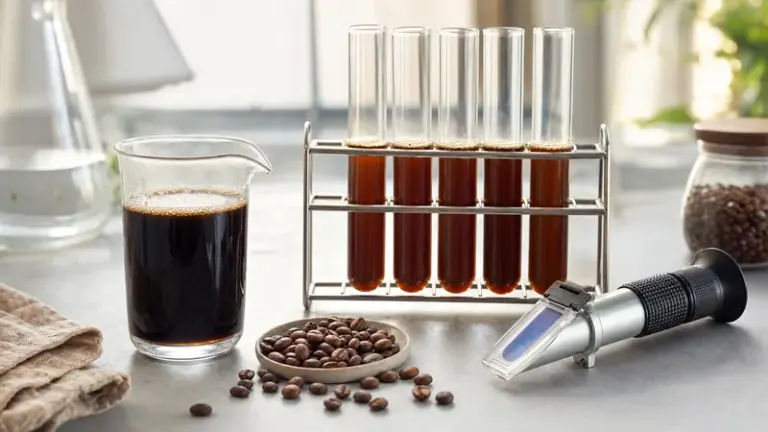
In brewing research, strength commonly means the concentration of dissolved coffee material in the drink, expressed as total dissolved solids, or TDS. Extraction yield describes the proportion of material removed from the grounds. They are related measurements, but they describe different things.
A controlled sensory study published in the Journal of Food Science varied roast, strength and extraction yield and found changes in attributes including sourness, bitterness, sweetness and thickness. Such work helps explain why a single description such as “strong” cannot capture the whole sensory character of coffee.
For your own comparisons, use the science hub to make the question testable. Compare one named attribute, such as bitterness or thickness, rather than asking only which sample is “better”. Record what you changed and keep preference separate from description: liking a sample and explaining it are different tasks.
Chemistry is not a health verdict
Identifying a substance is only the beginning of a health assessment. Acrylamide provides a useful example: EFSA identifies coffee and coffee substitutes among dietary sources and considers dietary exposure a concern on the basis of animal evidence, while describing the human cancer evidence as limited and inconsistent. Neither “it is present, therefore the drink causes cancer” nor “human evidence is inconclusive, therefore there is no concern” accurately represents that assessment.
This is where the science and health routes meet. Use chemistry to understand composition and mechanism, then ask for appropriate human evidence before accepting a claim about disease.
Coffee substitutes: choose for a reason, then check the ingredients
Use the substitutes hub when you want something other than coffee. Start by naming what the replacement must do: avoid caffeine, avoid coffee itself, suit a dietary requirement, or provide an enjoyable alternative.
Coffee substitutes can be made from roasted grains or roots, including barley, rye and chicory. Products may also combine several ingredients or be blended with coffee, so the category name alone does not establish whether a particular product contains caffeine.
For someone with coeliac disease, the grain choice matters: wheat, barley and rye contain gluten. A roasted-grain drink is not automatically a suitable alternative simply because it contains no coffee.
Use a short checklist when comparing products:
- Does the ingredient list match the reason you are switching?
- Is it a substitute alone, or a blend containing coffee?
- Is caffeine information available where you need it?
- Does it meet your dietary requirements?
- Do you actually enjoy drinking it?
Treat health claims as a separate question from suitability. “This meets my needs” is a sound reason to choose a drink; it does not require a claim that the drink prevents disease or is universally healthier.
At a workplace tea point, make the choice easy to understand. Keep original packaging available and distinguish regular coffee, decaf and substitutes clearly. Do not present a shared alternative as suitable for everyone without checking what it contains.
Read the evidence with the question in view
The final step is to match the evidence to the claim. You do not need to become a research specialist, but knowing what kind of study you are reading helps you see what its conclusion can support.
Observational research and controlled trials answer different questions
An observational association can identify a pattern worth investigating. A well-conducted randomised trial can provide stronger evidence about the effect of an assigned intervention, although its conduct and measurements still need scrutiny.
The CRAVE trial illustrates both the value and the limits of controlled coffee research. Researchers randomly instructed 100 adults to consume caffeinated coffee or avoid caffeine during a 14-day trial. Sleep duration was lower on coffee-assigned days, but the study could not establish what decades of drinking coffee would do to disease risk.
That is not a failure of the trial. It is a reminder to keep the conclusion within the question, population and timescale studied.
Reviews help, but pooling does not remove every weakness
A meta-analysis statistically combines results from separate studies. Cochrane warns that the process can mislead if study design, bias and differences between studies are not properly considered. A more precise combined estimate is not automatically a more trustworthy answer to every question.
When reading a review, ask whether the included studies investigated sufficiently similar drinks, people and outcomes. Then look for the authors’ assessment of certainty, not just the headline result.
Use these questions before changing a habit:
- What exactly was studied? Coffee, caffeine, decaf or an isolated compound?
- Who was studied? Does that population resemble the person the advice is aimed at?
- What was measured? A sensory response, a short-term physiological measurement or a health outcome?
- What remains uncertain? Does the conclusion acknowledge the limits of the method?
This approach leaves room for genuine enthusiasm about coffee without asking it to be medicine.
A note on personal medical advice
This section provides general information, not diagnosis or individual treatment advice. Speak to a GP, pharmacist or midwife about caffeine if you have a relevant condition, take medicines, are pregnant or need help interpreting symptoms.
Individual sensitivity, medicines and health conditions can affect how much caffeine is too much for a particular person. Do not use a general intake benchmark to dismiss a reaction you are experiencing, or stop prescribed treatment because of a coffee claim.
FAQ
Do I need to start drinking coffee for its possible benefits?
No, this guide does not recommend starting coffee as a health intervention. Observational findings can be useful and reassuring, but they do not prove that taking up coffee will improve your health. Read the health evidence in context rather than treating a favourable association as a prescription.
Can I judge caffeine content by how intense a coffee tastes?
No, perceived intensity is not a dependable caffeine measurement. EFSA notes that caffeine concentrations vary with the beans, manufacturing and preparation method. Use product-specific information where available, and keep “strong-tasting” separate from “contains more caffeine” when choosing or recording drinks.
Does a study of caffeine tablets tell me everything about coffee?
No, caffeine research does not describe every effect of the whole coffee drink. Coffee contains multiple compounds, and the CRAVE researchers explicitly noted that their study could not separate caffeine’s effects from those of other ingredients in the coffee drinks consumed. Match the evidence to the substance actually studied.
Where to go next
Continue with Coffee and Health to weigh health claims, then Caffeine and Decaf to consider intake and lower-caffeine choices. Coffee and Science explains the mechanisms and measurements behind the cup, while Coffee Substitutes helps you choose a different drink for a clearly defined reason: together, these are the four routes through Health & Science.
Sources
-
European Food Safety Authority, Caffeine, live topic page summarising the 2015 Scientific Opinion, accessed 2026.
https://www.efsa.europa.eu/en/topics/topic/caffeine -
NHS, Foods to avoid in pregnancy, live guidance, accessed 2026.
https://www.nhs.uk/pregnancy/keeping-well/foods-to-avoid/ -
NHS, Food and drinks to avoid when breastfeeding, live guidance, accessed 2026.
https://www.nhs.uk/best-start-in-life/baby/feeding-your-baby/breastfeeding/healthy-diet-when-breastfeeding/food-and-drinks-to-avoid-when-breastfeeding/ -
Poole and colleagues, BMJ, Coffee consumption and health: umbrella review of meta-analyses of multiple health outcomes, 2017, volume 359, j5024.
https://pmc.ncbi.nlm.nih.gov/articles/PMC5696634/ -
US Food and Drug Administration, Spilling the Beans: How Much Caffeine is Too Much?, live consumer guidance, accessed 2026.
https://www.fda.gov/consumers/consumer-updates/spilling-beans-how-much-caffeine-too-much -
Food Standards Agency, Guidance for food business operators on food supplements containing caffeine, live guidance, accessed 2026.
-
Specialty Coffee Association, Coffee Decoded: The Chemistry of Decaffeination, undated web article, accessed 2026.
https://sca.coffee/sca-news/coffee-decoded-21-chemistry-of-decaf -
Ludwig and colleagues, Royal Society of Chemistry, Food & Function, Coffee: biochemistry and potential impact on health, 2014, article abstract.
https://pubs.rsc.org/en/content/articlelanding/2014/fo/c4fo00042k -
Frost, Ristenpart and Guinard, Journal of Food Science, Effects of brew strength, brew yield, and roast on the sensory quality of drip brewed coffee, 2020, volume 85, pages 2530 to 2543, abstract retrieved through PubMed.
https://pubmed.ncbi.nlm.nih.gov/32652586/ -
European Food Safety Authority, Acrylamide, live topic page summarising the 2015 risk assessment, accessed 2026.
https://www.efsa.europa.eu/en/topics/topic/acrylamide -
European Commission, Guidance on the implementation of Commission Regulation (EU) 2017/2158, section on coffee substitutes, undated PDF, accessed 2026. Used for product descriptions, not as a statement of current UK law.
https://food.ec.europa.eu/system/files/2020-01/cs_contaminants_catalogue_acrylamide_guidance-doc_en.pdf -
NHS, Coeliac disease, live guidance, accessed 2026.
https://www.nhs.uk/conditions/coeliac-disease/ -
Cochrane, Handbook for Systematic Reviews of Interventions, version 6.5, 2024, Chapter 8, Assessing risk of bias in a randomized trial, chapter last updated October 2019.
https://www.cochrane.org/authors/handbooks-and-manuals/handbook/current/chapter-08 -
Marcus and colleagues, New England Journal of Medicine, Acute Effects of Coffee Consumption on Health among Ambulatory Adults, 2023, volume 388, pages 1092 to 1100.
https://pmc.ncbi.nlm.nih.gov/articles/PMC10167887/ -
Cochrane, Handbook for Systematic Reviews of Interventions, version 6.5, 2024, Chapter 10, Analysing data and undertaking meta-analyses, chapter last updated November 2024.
https://www.cochrane.org/authors/handbooks-and-manuals/handbook/current/chapter-10
Research combined live official health guidance, a peer-reviewed umbrella review, controlled human research, chemistry literature and methodological guidance, distinguishing observational associations from demonstrated effects.
Last checked: November 2026