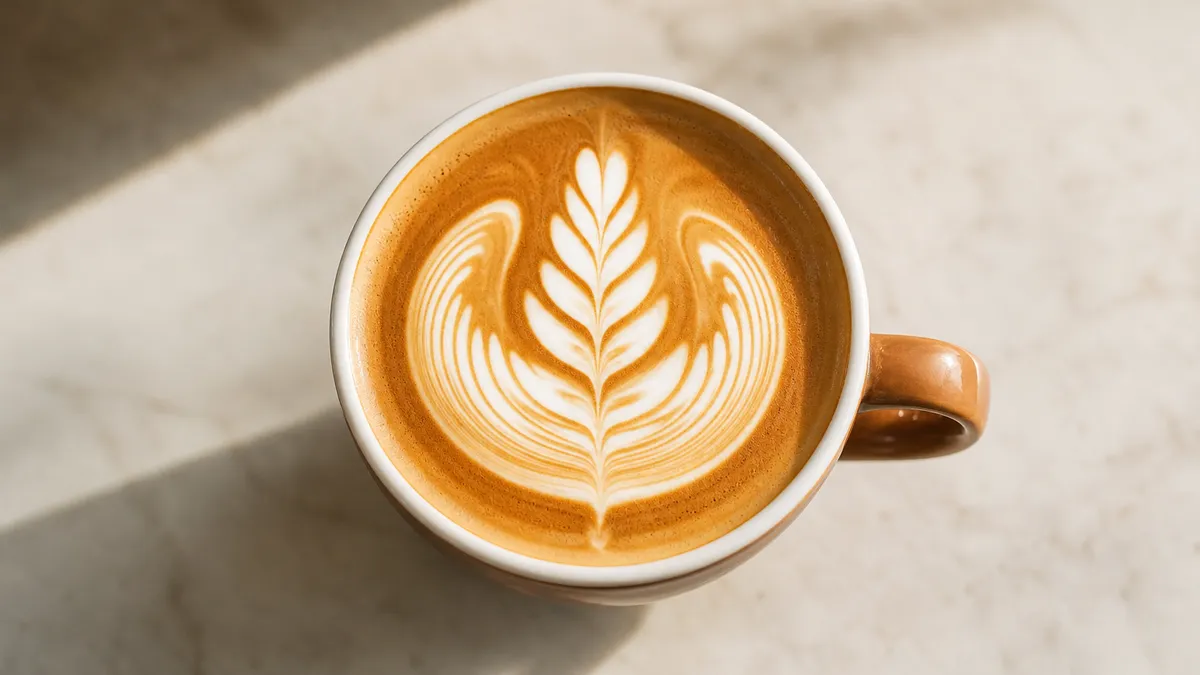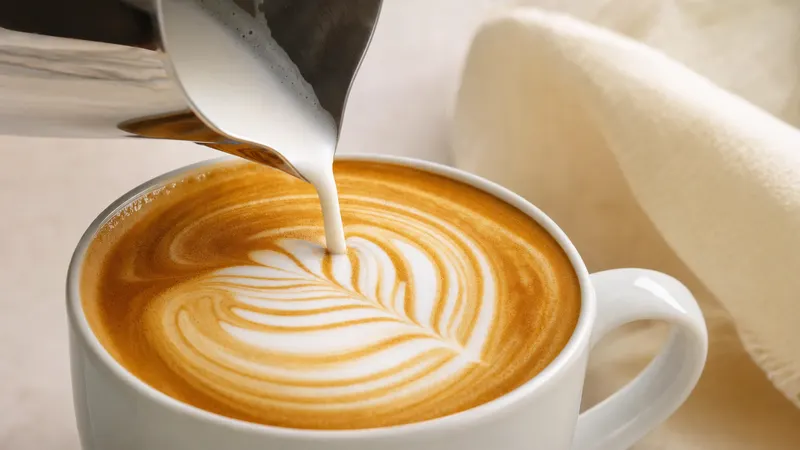
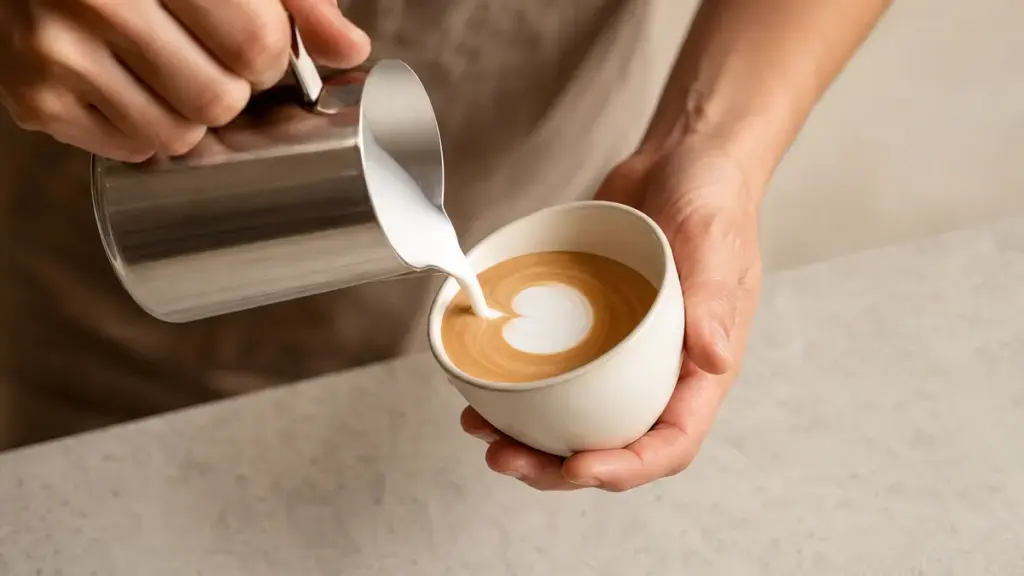
To make latte art, pour finely textured steamed milk into espresso, first mixing the milk beneath the surface, then bringing the jug close enough for white foam to form a pattern. Start with smooth microfoam and a simple heart before attempting tulips, rosettas or more elaborate designs.
In short
- Learn milk texture before patterns: the aim is glossy, flowing microfoam, not stiff foam sitting above thin milk.
- Use jug height deliberately: a higher, narrow stream mixes; a low spout lets the white pattern appear.
- Practise a heart first, then add the separate placements of a tulip and the rhythmic movement of a rosetta.
- Judge progress by contrast, placement, recognisable shape and repeatability, not complexity alone.
- Distinguish free-poured designs from etched decoration, and check each competition’s own rules before entering.
Guides in Coffee Art and Latte Art
 Coffee Art ExhibitionsFind coffee art in museums, galleries and festivals, with verified exhibition examples, collection highlights and a checklist for checking current events.Read the guide
 Coffee as an Art FormDiscover how coffee became an art form, from Italian and Seattle latte-art pioneers to free pouring, etching, coffee painting and social media.Read the guide
 Heart, Tulip and RosettaLearn to pour a heart, stack a tulip and wiggle a rosetta, with clear steps, pattern-specific fixes and a practice plan for better milk…Read the guide
 How to Pour Latte ArtLearn how to pour latte art with clear steps for the base fill, dropping in, wiggle and pull-through, plus practice drills and fixes for…Read the guide
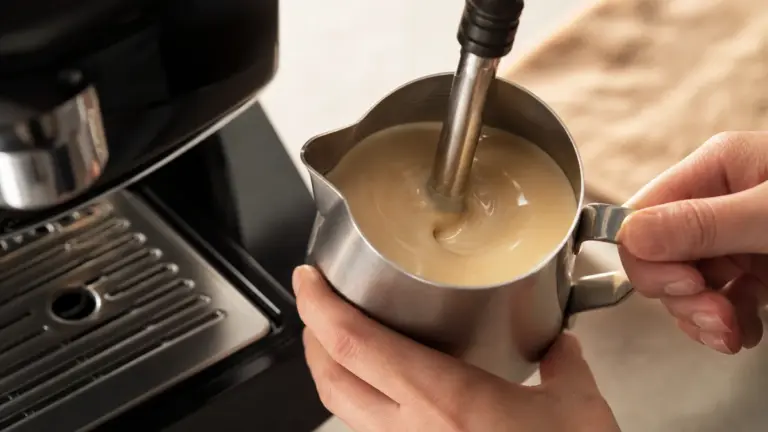 How to Steam Milk and Make MicrofoamLearn how to steam milk into glossy microfoam, with wand positioning, temperature guidance, plant-milk adjustments and fixes for common foaming problems.Read the guide
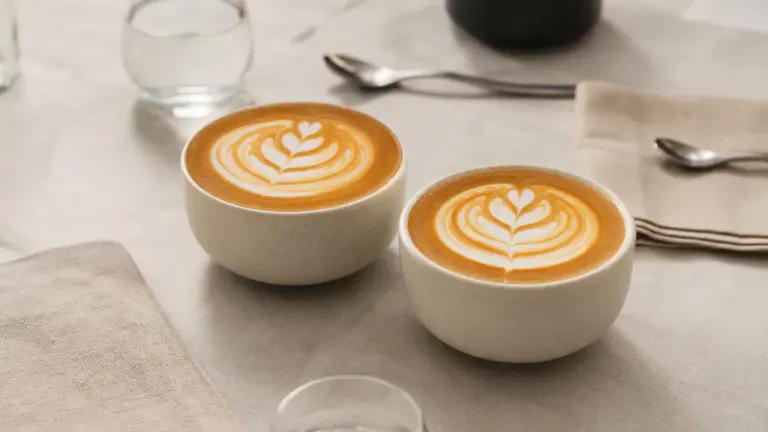 Latte Art CompetitionsLearn how latte art competitions work, what judges assess, how UK entry works and what to check before your first throwdown or national championship.Read the guide
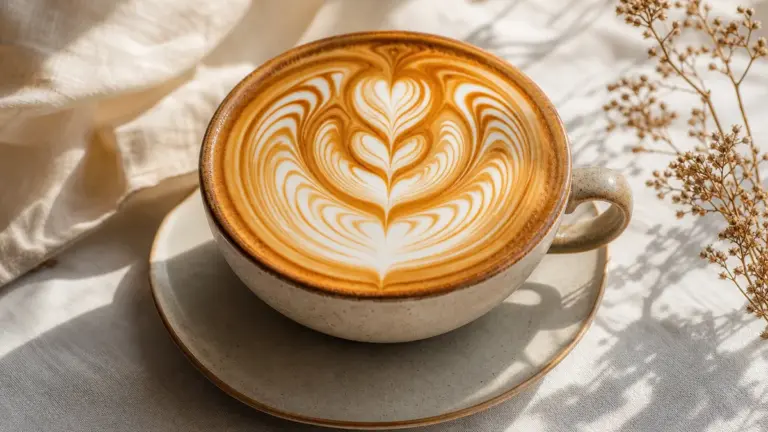 Latte Art MasterpiecesExplore remarkable latte art masterpieces, from intricate free-pour swans and championship animals to etched designs, colour accents and 3D foam art.Read the guide
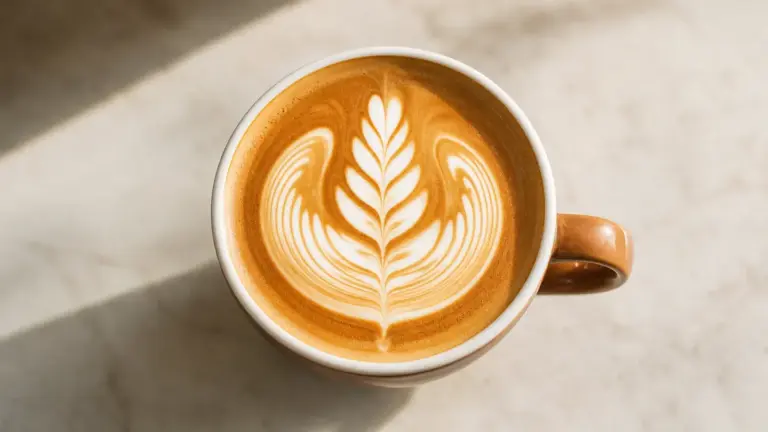 World Latte Art ChampionshipUnderstand the World Latte Art Championship, its rounds, judging and Art Bar, plus verified recent winners and the UK route to qualification.Read the guide
Start here if you are new
Follow this path rather than trying to copy a championship routine straight away:
- Learn milk steaming. Start here if your milk is bubbly, stiff or separating. A pouring tutorial cannot compensate for milk that will not flow as an integrated mixture.
- Understand the pour. Move here when your milk looks smooth but the white shape disappears, spreads uncontrollably or lands in the wrong place.
- Practise the core patterns. Use this once you can deliberately bring white foam to the surface. Work on one pattern at a time so that each attempt tests something specific.
If you are still exploring drinks and preparation methods, return to brewing and recipes for the wider context. This hub maps the artistic side of coffee, from the first controlled pour to interpreting exhibition work and competition performances.
Find your route through coffee art and latte art
Choose your next read by the skill or question you have now, rather than by the most impressive finished picture.
| Area | What to concentrate on | Read next |
|---|---|---|
| Artistic interpretation | Intention, composition and the relationship between appearance and drinking | Coffee as an Art Form |
| Milk preparation | Fine bubbles, fluid texture and controlled heating | How to Steam Milk and Make Microfoam |
| Pouring mechanics | Jug height, flow, cup angle and placement | How to Pour Latte Art |
| Foundation patterns | Hearts, stacked tulips and leaf-like rosettas | Heart, Tulip and Rosetta |
| Advanced work | How separate elements form a clear composition | Latte Art Masterpieces |
| Exhibitions | What is being displayed, how it was made and how to interpret it | Coffee Art Exhibitions |
| Competition | Rules, judging, repeatability and preparation | Latte Art Competitions |
| World championship | The official format and its particular demands | World Latte Art Championship |
The practical route runs from milk to pouring to patterns. The appreciation route starts with coffee as an artistic medium, then moves towards advanced work, exhibitions and competitive performance. You can follow either without needing to become a competition barista.
Coffee as an artistic medium
There are two useful ways to approach coffee as art. One concerns the drink itself: the arrangement of pale milk against brown espresso, the balance of shapes and the deliberate presentation of something made to be consumed. The other concerns coffee as a subject or material for creative work.
Our editorial view is that latte art is most rewarding when appearance supports the drink rather than displacing it. A carefully centred heart can be more satisfying than an elaborate picture squeezed against the rim. Complexity is a choice, not a requirement.
Read coffee as an art form if your interest is the boundary between craft, design and art. It is the useful starting point for thinking about intention and presentation, rather than learning where to put the steam wand.
Keep a distinction between free pouring, where the jug’s milk stream creates the design, and etching, where a tool draws or modifies details on the surface. The World Latte Art Championship treats these differently: free-pour categories prohibit the additional tools allowed in relevant designer work. Neither label alone tells you whether a composition is successful, but it tells you something about how it was made.
Microfoam comes before the picture
Microfoam is milk containing fine air bubbles distributed through the liquid. For latte art, it should flow as a coherent mixture rather than arrive as thin milk followed by a separate lump of froth.
The Specialty Coffee Association’s foam worksheet describes its highest-quality milk as smooth, shiny and moist, without visible bubbles. That is a more useful beginner’s reference than trying to copy an exact steaming time from someone else’s machine.
During steaming, you introduce air near the milk’s surface, then maintain circulation to distribute it through the jug. Those are related but distinct jobs. Adding air throughout the entire heating process is not the same as integrating a controlled amount of air.
Before concentrating on patterns, check whether the milk moves freely when you swirl the jug. If it looks dry and mounded, return to texturing. If it looks glossy but produces no visible design, pouring height or flow may be the more useful variable to investigate.
For temperature, Dennis Hew’s Everybody Latte Arts gives 55 to 60°C as its working guide. Treat that as the approach of a named teaching resource, not a universal latte-art standard; follow your equipment and milk manufacturer’s instructions, and use a suitable thermometer rather than assuming every steam wand heats at the same rate.
Dairy and plant-based milk
Plant-based drinks are not interchangeable foaming materials. In a controlled laboratory study published in Soft Matter, researchers compared animal and plant-based milks using frothing and gas-bubbling methods, finding different foam volumes, lifetimes and responses to heating.
That experiment did not establish a universal winner for hand-poured latte art. Foam volume and longevity do not, by themselves, describe how easily a barista can draw a clean pattern.
For practice, our recommendation is to keep the milk product consistent while learning a movement. If you change both the drink formulation and your technique, it becomes harder to identify why the result changed.
Keep preparation clean
Follow the milk’s storage instructions and use-by date, and return chilled milk promptly to the fridge. The Food Standards Agency recommends setting a business fridge at 5°C or below to allow for temperature fluctuations.
Keep the steam wand clean and purge it according to the machine’s instructions. Do not let attention to the picture distract you from handling milk and equipment properly.
Pouring: understand what each movement does
Think of pouring as a sequence of purposes, not a drawing gesture performed at one fixed height.
First, build the background. A relatively high, narrow stream integrates milk with the espresso. At this stage, you are preparing the drink’s base rather than trying to leave a white mark.
Next, bring the pattern to the surface. Lower the spout close to the liquid and adjust the flow so that the white foam becomes visible. La Marzocco’s pouring guide identifies this change in height and flow as central to making the design appear.
Finally, finish deliberately. For a heart, lifting the jug and drawing a finer stream through the white shape produces the finishing point. Leave yourself room in the cup to complete that movement.
Cup tilt helps bring the surface within reach of the spout; the cup then returns towards level as it fills. The useful principle is changing the distance between spout and liquid, not simply holding the jug “low” relative to the worktop.
When practising, choose one observation to record: when the white first appeared, where it landed, or whether the finish dragged through cleanly. A note such as “pattern appeared too late” gives the next attempt a clearer purpose than “poor heart”.
For detailed instruction, use How to Pour Latte Art rather than treating this overview as a complete pouring method.
Hearts, tulips and rosettas
These foundation patterns develop related skills, but they ask for different movements.
Heart: placement and a clean finish
A heart begins with a controlled white shape and ends with a fine cut-through. It brings together milk texture, positioning, flow and the transition between low and high pouring.
Make the heart your reference exercise. Our suggested test is not whether you have produced one attractive example, but whether you can explain what you changed between attempts.
Tulip: separate placements
A tulip builds its form through successive placements of white foam, followed by a finishing movement through the stack. It introduces another challenge: stopping and restarting intentionally without losing the overall composition.
Before adding more layers, look at their spacing and alignment. For practice, choose fewer, clearer elements rather than filling every available part of the cup.
Rosetta: rhythm and travel
The rosetta’s leaf-like structure combines side-to-side movement with controlled travel across the surface, followed by a cut-through. It requires coordination between movement and milk flow, not simply a faster wrist.
Use Heart, Tulip and Rosetta when you are ready for pattern-specific instruction and diagnosis. These shapes are foundations to revisit, not milestones that become irrelevant once you can pour something more elaborate.
Looking at masterpieces and exhibitions
Advanced work is easier to appreciate when you separate execution from composition.
Execution concerns how clearly the milk has been placed: distinct edges, readable elements and control over the relationship between white foam and the coffee-coloured background. Composition concerns how those elements occupy the cup and relate to one another.
The SCA latte-art worksheet provides useful viewing criteria: contrast, size and position, appropriate symmetry, foam quality and identification of the pattern. It also recognises the value of leaving a surrounding frame rather than letting the design crowd the cup’s edge.
Read latte art masterpieces to develop your eye for advanced work. Instead of asking only how many details a design contains, ask which detail makes it recognisable, where your attention lands first and whether the overall shape remains clear.
Use coffee art exhibitions when your interest extends beyond learning to pour. When viewing displayed work, look for an explanation of the medium and process: are you seeing a drink, a photograph of a drink, a live demonstration or another kind of coffee-related artwork?
That distinction helps you interpret the object in front of you without assuming everything labelled “coffee art” was produced by the same technique.
Competitions: creativity under repeatable conditions
Read latte art competitions before choosing an event. Use it to understand what questions to ask about categories, permitted techniques, judging and preparation, then confirm the answers with that organiser’s current documents.
Our suggested preparation order is straightforward: understand the rules, establish a repeatable design, then rehearse presenting it within the required format. Do not build a routine around assumptions taken from a different contest.
The world latte art championship is the next read for the international competition specifically. Under its 2026 rules, competitors present matching beverages against submitted reference images; free-pour work excludes etching tools.
The same rules make Art Bar participation compulsory but keep its separate award outside the stage scores that determine the world champion. This is why a striking Art Bar image should not automatically be described as the title-winning stage performance.
For your own practice, borrow the principle of repeatability without adopting the whole competitive routine. Put photographs of successive attempts side by side and assess one criterion at a time. Coffee art and latte art become more useful learning subjects when you can identify what worked, not merely admire the finished cup.
FAQ
Does attractive latte art prove that the coffee tastes good?
No, appearance alone does not establish flavour quality. The SCA latte-art worksheet assesses visual and foam characteristics, including contrast, positioning and recognisable shape; those are not a complete assessment of the drink’s taste. Treat the pattern as one part of presentation, then judge the coffee and milk by drinking them.
Should I learn with my left hand if most tutorials show right-handed pouring?
No, there is no reason to change your dominant hand simply to match a demonstration. Our practical suggestion is to mirror the arrangement while keeping the same relationships between spout, cup and intended pattern. Pay particular attention to which direction the finished design should face, rather than copying the demonstrator’s screen position.
How long should I expect learning to take?
There is no useful universal deadline. We recommend judging progress by controllable outcomes: making consistent milk, bringing white foam to the surface deliberately and repeating a recognisable pattern. Give each practice session one purpose, and compare attempts made with the same equipment and ingredients before deciding that a technique is not working.
Where to go next
Start with How to Steam Milk and Make Microfoam, then use How to Pour Latte Art to connect texture with jug control. Continue to Heart, Tulip and Rosetta for structured pattern practice, or read World Latte Art Championship to understand how those skills develop into formal competition.
Sources
-
Specialty Coffee Association, Barista Latte Art Standard Worksheet, July 2017, version 1.0. Criteria for contrast, composition, symmetry, foam and pattern recognition.
https://static1.squarespace.com/static/587af1d4db29d69a1a226b95/t/607470a48eccc83bd18ca8bc/1618243748483/SCA%2BBarista%2BLatte%2BArt%2BStandard%2BWorksheet%2BEN%2BUS-Letter.pdf -
Specialty Coffee Association, Barista Foam Standards Worksheet, undated, Version2 file. Descriptions of acceptable and excellent milk texture.
https://static1.squarespace.com/static/587af1d4db29d69a1a226b95/t/607471dbed0f3f1b97ebf045/1618244060190/SCA_Barista_Foam_Standards_US-Letter%2BVersion2.pdf -
La Marzocco Home, Pouring Latte Art, 2022. Jug height, flow and heart-pouring mechanics.
https://home.lamarzoccousa.com/pouring-latte-art/ -
La Marzocco Home, The Essential Guide to Mastering Espresso at Home, undated. Air incorporation, milk circulation and steam-wand preparation.
https://home.lamarzoccousa.com/the-essential-guide-to-mastering-espresso-at-home/ -
Dennis Hew, Everybody Latte Arts, Decent Espresso edition, 2024. Temperature guidance and foundation-pattern teaching.
https://decentespresso.com/doc/everybody_latte_arts/everybody_latte_arts.pdf -
Hassan and colleagues, The bubbly life and death of animal and plant milk foams, Soft Matter, 2024. Controlled experimental comparison of milk-foam formation and stability.
https://pubmed.ncbi.nlm.nih.gov/39370983/ -
Food Standards Agency, Chilling food correctly in your business, undated live guidance. Refrigeration and chilled-food handling.
-
World Coffee Championships, 2026 World Latte Art Championship Rules and Regulations, 2026 competition edition. Reference images, matching drinks, free pouring and Art Bar provisions.
https://static1.squarespace.com/static/65fb773fac2112270b71798a/t/68e6b8f6143df370b6695c96/1759951094843/2026%2BWorld%2BLatte%2BArt%2BChampionship%2BRules%2Band%2BRegulations.pdf
This hub was researched using retrieved SCA teaching worksheets, manufacturer instruction, controlled experimental research, FSA guidance and official competition rules; no first-hand equipment testing is claimed.
Last checked: November 2026