Grind size and extraction affect how much flavour reaches your cup and how evenly it gets there. Finer grounds usually extract more readily, but they can also restrict water flow, so better coffee comes from matching the grind to the brewing method rather than simply grinding finer.
In short
- Use a grind chart as a starting point, then adjust for your coffee, equipment and recipe.
- Keep coffee dose, water quantity and pouring technique steady while testing a grind change.
- Separate strength, how concentrated coffee is, from extraction, how much material has dissolved from the grounds.
- Treat sourness, bitterness and drying sensations as clues, not proof of one particular brewing fault.
- Check your water before assuming the grinder is responsible for every disappointing cup.
Guides in Grind Size and Extraction
 Brewing Ratios and TemperatureChoose coffee-to-water ratios and brewing temperatures for filter, cafetière and espresso, with clear weighing rules and practical roast-level adjustments.Read the guide
 Coffee Grind Size and Consistency: The Complete GuideUnderstand how coffee grind size, fines and burr design affect extraction, then use a controlled taste test to adjust your grinder with confidence.Read the guide
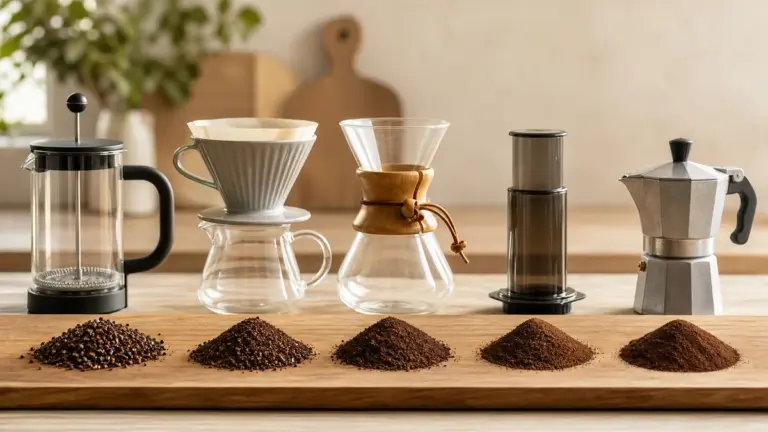 Coffee Grind Size ChartFind the right coffee grind size for espresso, cafetière, pour-over and more, with everyday texture comparisons and clear steps for adjusting your grinder.Read the guide
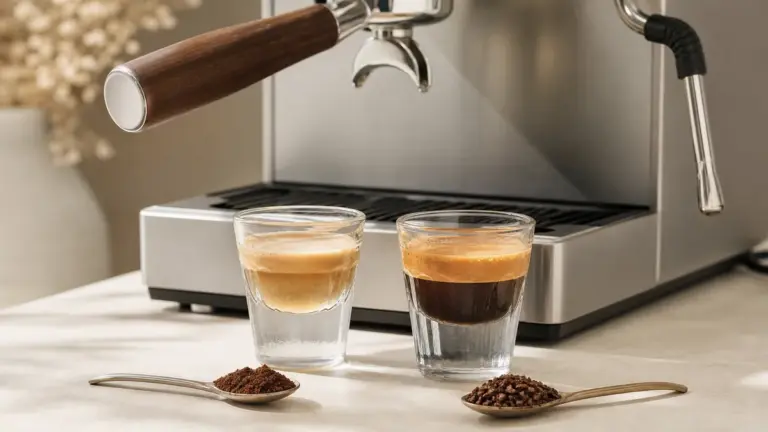 Extraction Time and Grind SizeLearn how grind size changes extraction time in espresso, pour-over and cafetière coffee, and how to adjust without chasing a universal target time.Read the guide
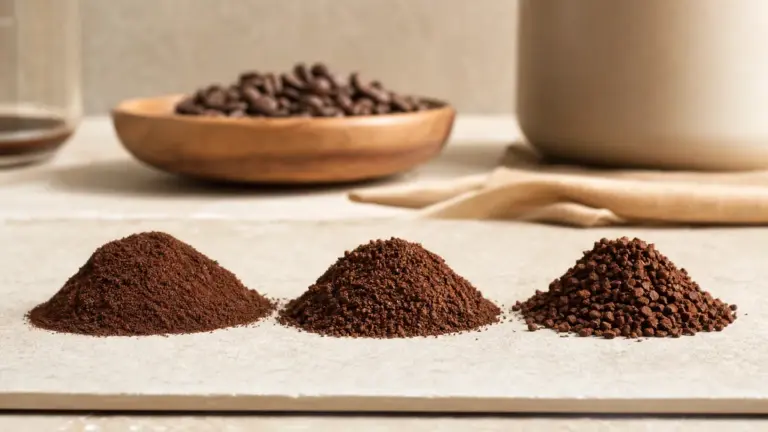 Grind Consistency and TasteHow fines, boulders and grind consistency affect coffee taste, extraction and flow, plus what burr quality and sifting can really tell you about a…Read the guide
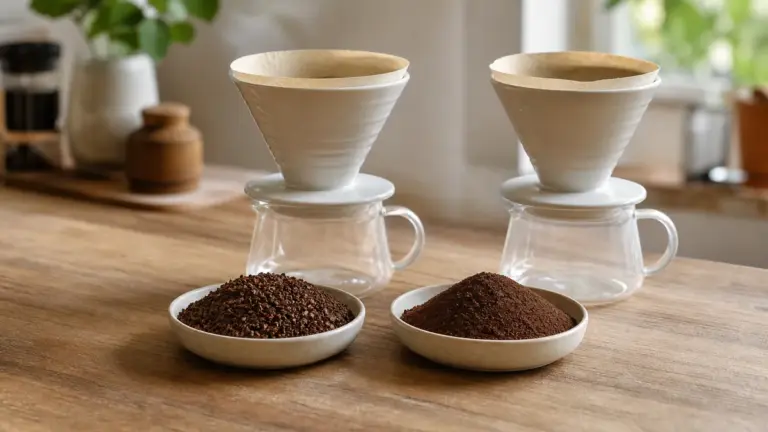 How Grind Size Affects Coffee BrewingLearn how grind size changes coffee extraction, pour-over drainage and espresso resistance, plus a simple comparison to improve your next brew.Read the guide
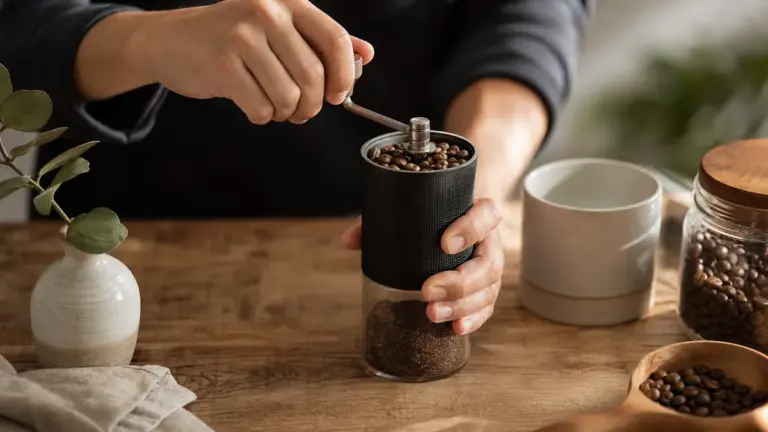 How to Grind CoffeeLearn how to grind coffee with manual and electric grinders, weigh each dose, manage static and retention, use RDT safely, and clean your grinder.Read the guide
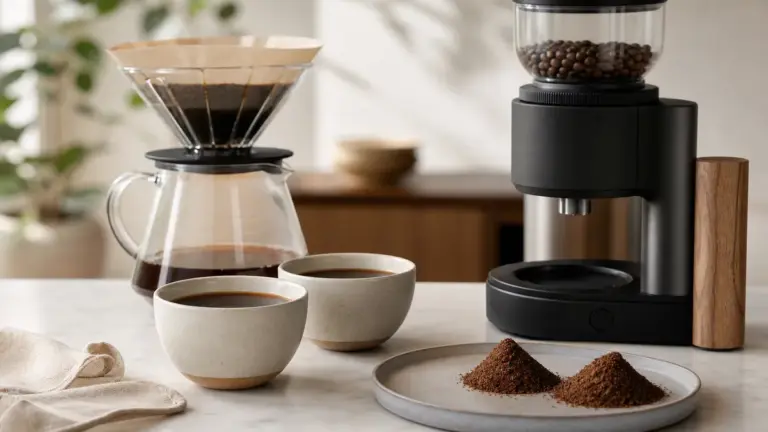 Over-Extraction vs Under-ExtractionLearn how over-extraction and under-extraction taste, what SCA reference ranges mean, and how to adjust filter coffee, espresso and cafetière brews.Read the guide
 Water for Coffee: Hardness, Alkalinity and TDSChoose better water for coffee: understand hardness, alkalinity and TDS, compare SCA targets, check your UK supply and separate flavour from scale.Read the guide
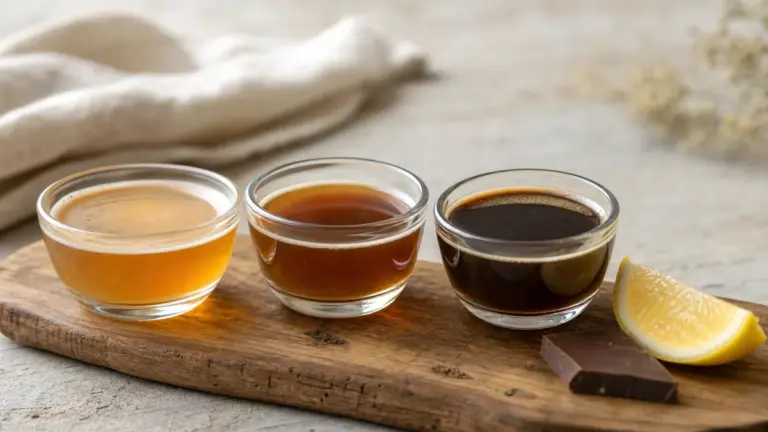 Why Does My Coffee Taste Bitter or Sour?Diagnose bitter, sour, weak or flat coffee with taste-led fixes, a repeatable brewing test and practical advice for filter, espresso and cafetière.Read the guide
Start here if you are new
Follow this short route rather than trying to change everything at once:
- Read the grind size chart to find a sensible starting point for your brewing method.
- Follow how to grind coffee to make that starting point repeatable.
- Use the bitter or sour troubleshooting guide when you have a cup to assess and a specific problem to solve.
This hub connects the variables behind a brew. For the wider choice of methods and drinks, return to brewing and recipes.
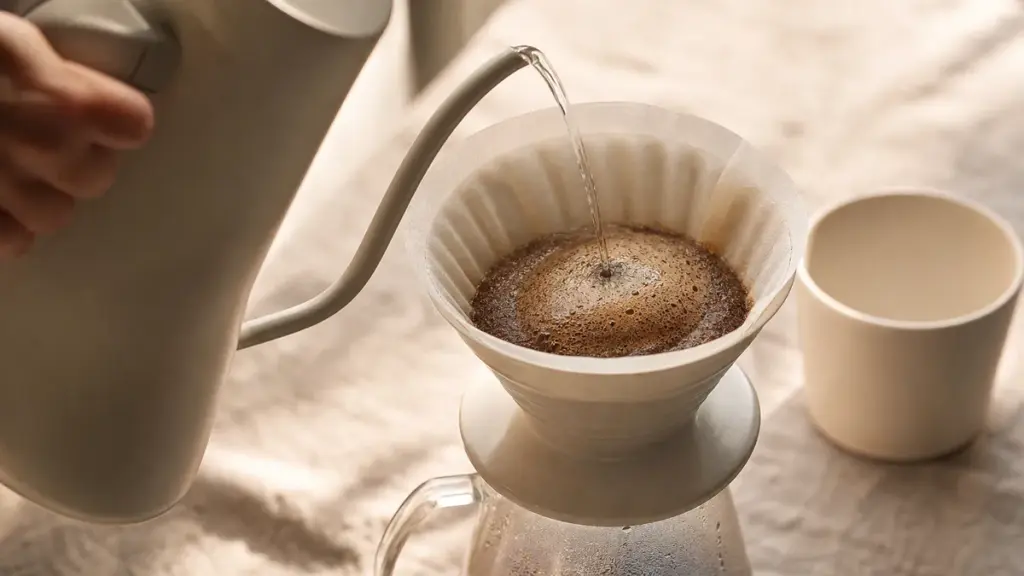
Grind size and extraction at a glance
Choose your next read by the question you need to answer. These are connected subjects, but each guide has a different job.
| Area | Main question | What to observe | Useful next read |
|---|---|---|---|
| Grinding | Can I reproduce the same starting point? | Dose, adjustment setting and handling | How to Grind Coffee |
| Grind chart | Where should I begin? | Relative fineness for the recipe | Coffee Grind Size Chart |
| Brewing behaviour | Why did the water move differently? | Flow, resistance and drainage | Impact on Brewing |
| Extraction and time | What does a longer brew tell me? | Taste alongside elapsed time | Extraction Time and Grind Size |
| Consistency | Why do apparently identical brews differ? | Particle distribution and repeatability | Grind Consistency and Taste |
| Ratios and temperature | Is the recipe itself suitable? | Coffee and water weights, temperature | Brewing Ratios and Temperature |
| Water | Could the water be changing the result? | Hardness, alkalinity and treatment | Water for Coffee: Hardness, Alkalinity and TDS |
| Taste diagnosis | Which adjustment should I try? | Sourness, bitterness, dryness and strength | Why Does My Coffee Taste Bitter or Sour? |
Use the table to pick one investigation. A useful brewing note ends with a decision, such as “keep this setting” or “test a slightly coarser grind”, rather than a list of everything that might be wrong.
Grinding: establish a repeatable starting point
A grinder produces a distribution of particle sizes, not identical little pieces. The setting influences that distribution, while the way the grounds are handled and brewed determines how water reaches them.
The complete guide to grind size and consistency is the broad reference for understanding these relationships. Read it when you want to connect grinder behaviour with brewing results rather than troubleshoot a single cup.
For the practical task, use how to grind coffee. It is the better starting point when you need a reliable routine for weighing coffee, choosing a setting and making adjustments.
What a grind chart can and cannot do
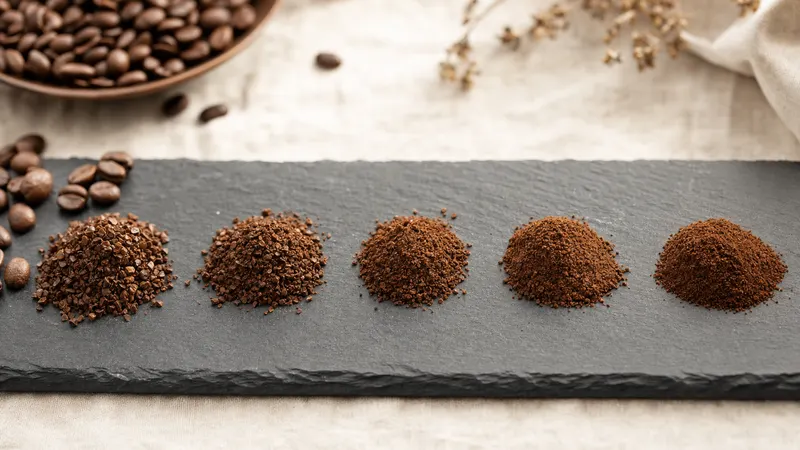
“Fine”, “medium” and “coarse” are useful relative descriptions, not universal measurements. Even a manufacturer's suggested setting is a starting point: the coffee, filter and brewing technique can require something different.
Keep the grind size chart beside your recipe when changing methods. Do not assume that a number from somebody else's grinder transfers directly to yours.
A photograph also leaves something out. Two samples can look broadly similar while containing different proportions of small particles, known as fines, and larger fragments. That distinction matters when a brew behaves differently despite an apparently familiar grind.
Adjust the grinder according to its instructions
Adjustment procedures are equipment-specific. Baratza, for example, advises running its grinders during significant moves finer when beans are present, to avoid compressing coffee between the burrs.
Follow your own manufacturer's instructions rather than applying that procedure to every grinder. Also account for retained grounds, meaning coffee left inside the grinding chamber or chute, when assessing the first dose after an adjustment.
Extraction: distinguish flavour balance from strength
Extraction is the transfer of soluble material from ground coffee into water. Strength describes the concentration of dissolved coffee material in the finished drink.
These are different questions: “How concentrated is it?” and “How much did the water take from the coffee?” Calling every unsatisfying cup “weak” hides that distinction.
Use over-extraction and under-extraction when you need to understand the terminology before changing a recipe. It is particularly useful if you have been treating stronger coffee and more thoroughly extracted coffee as the same thing.
A simple diagnostic comparison is to dilute a small portion of the finished drink with water. Dilution reduces concentration; it does not return dissolved material to the grounds. Use that comparison to ask whether excessive intensity, rather than the extraction process alone, is bothering you.
Why finer is not always better
Smaller particles offer more surface area relative to their mass. In a packed coffee bed, however, grinding finer also changes resistance to water flow.
Laboratory espresso experiments combined with mathematical modelling found that extraction yield fell again at very fine settings. The researchers interpreted this as evidence of uneven flow through the bed, rather than every particle receiving equally effective contact.
The practical lesson is limited but useful: a finer setting is not a guarantee of higher or more even extraction. Read the impact on brewing when you need to understand why an adjustment changes both flavour potential and the movement of water.
Time and consistency: read the whole brew
Brew time is an observation, not a complete diagnosis. A long drainage time might accompany restricted flow, while a different pouring pattern can change the time without any grinder adjustment.
Use extraction time and grind size when a recipe finishes earlier or later than expected. It helps frame the useful question: did the change improve the cup, or merely move the timer towards a target?
For pour-over, record total time alongside the pouring pattern. For espresso, record beverage yield alongside shot time. Otherwise, you risk comparing brews that did not actually follow the same recipe.
Consistency means predictability, not identical particles
No grinder produces perfectly uniform grounds. The useful aim is a predictable particle distribution and a repeatable brewing routine, not the elimination of every fine particle.
Read grind consistency and taste when yesterday's setting gives a different result today, or when repeated brews vary more than your adjustments explain. This is the place to investigate repeatability before chasing a supposedly perfect setting.
Separate two questions in your notes:
- Between brews: did the dose, grind setting, water and technique remain comparable?
- Within the brew: did water contact the bed evenly, or was flow restricted or uneven?
This distinction keeps “inconsistent coffee” from becoming a catch-all explanation.
Ratios and temperature: keep the recipe readable
Write filter and immersion ratios as coffee to water by weight. A ratio of 1:16 means 20 g of coffee with 320 g of brewing water, not 320 g of finished drink.
For espresso, use dry dose to beverage yield by weight. As an arithmetic example, 18 g in and 36 g out is a 1:2 ratio, not a statement about how much water entered the machine.
Read brewing ratios and temperature when you need to choose or scale a recipe. It is also the useful next step when grind adjustments have become a substitute for deciding how concentrated you want the drink.
Temperature is part of the system
Temperature affects extraction, but a kettle setting does not describe the entire brew. Grind, contact time and flow still matter.
A controlled drip-coffee sensory study compared brewing at 87, 90 and 93 degrees Celsius, adjusting other variables to hold strength and extraction comparable. It found little sensory effect attributable to brewing temperature within those conditions.
That does not mean temperature never matters. It means this experiment separated temperature from changes in extraction, something an ordinary kettle-temperature comparison may not do.
Water: check the ingredient behind every adjustment
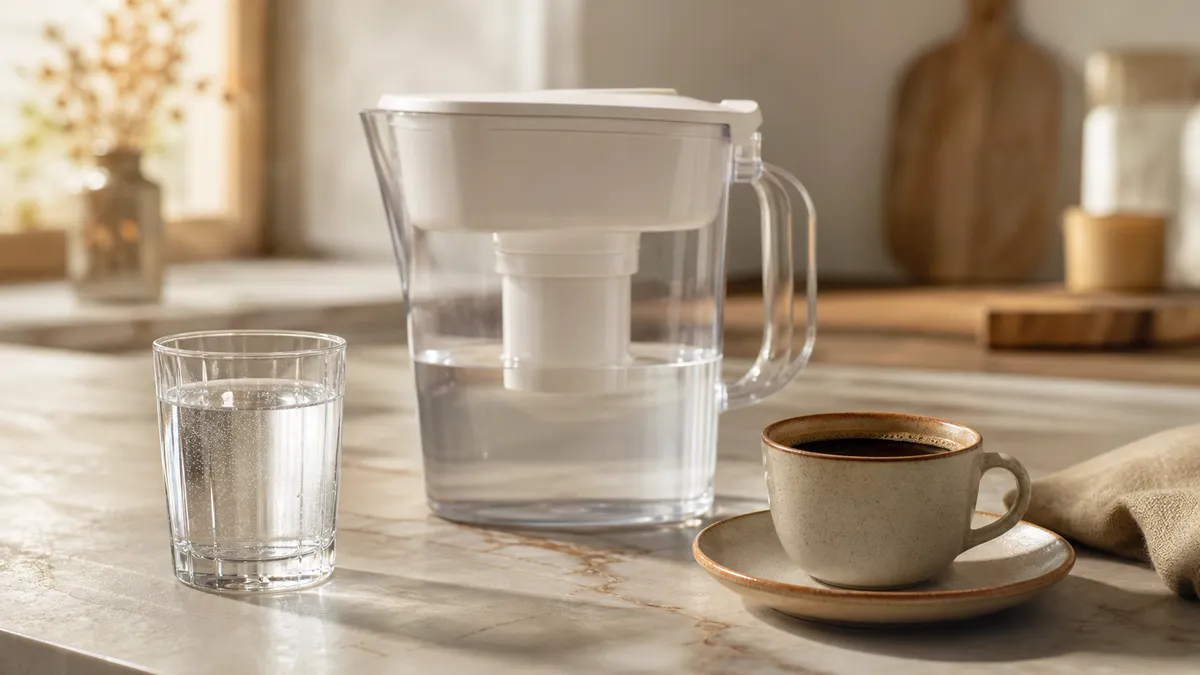
Water hardness and alkalinity are different properties. Hardness concerns dissolved calcium and magnesium; alkalinity describes acid-neutralising capacity and influences how coffee acidity is expressed.
TDS, total dissolved solids, is another measurement again. A handheld water TDS meter estimates a value from electrical conductivity, so its reading does not identify the individual minerals present.
Start with your local water supplier's published report rather than a UK-wide hardness assumption. The Drinking Water Inspectorate advises checking with the water company because local variation can make broad maps misleading.
Use water hardness, alkalinity and TDS when the same recipe tastes different in another building, or when you need to understand filtration and machine-water requirements.
Put water standards in context
SCA Standard 102-2024, for coffee sample preparation and tasting, specifies cupping water with:
- Calcium hardness of 50 to 175 ppm as calcium carbonate.
- Alkalinity at or near 40 to 70 ppm as calcium carbonate.
- No chlorine and a pH of 6 to 8.
These are cupping specifications, not universal instructions for filling every machine. In dilute water, ppm is approximately equivalent to mg/L; “as calcium carbonate” identifies the reporting basis, not necessarily the substance dissolved in the water.
For an office machine, use the manufacturer's water requirements alongside the local report. Taste requirements and equipment protection should be considered together.
Troubleshooting taste: make one informative change
Describe the problem before choosing a fix. “Sharp and thin”, “intensely bitter” and “drying after swallowing” give you more to investigate than “bad”.
Use why coffee tastes bitter or sour for the diagnostic route. Return to over-extraction versus under-extraction if the terminology is getting in the way.
The following are starting hypotheses, not fault codes:
| Symptom | Possible explanation | First controlled test |
|---|---|---|
| Sharp, sour cup | Extraction may be insufficient for the intended profile | Test a slightly finer grind while holding the recipe steady |
| Bitter, overpowering cup | Concentration may be contributing | Dilute a small sample before changing the brew |
| Slow, stalled pour-over | Fines and agitation may be restricting the filter | Repeat with gentler pouring |
| Variable espresso flow | Uneven bed preparation or restricted flow may be involved | Standardise preparation before another grind change |
| Unexpected flavour after changing settings | Retained grounds may mix old and new grind sizes | Follow the manufacturer's transition procedure |
A repeatable comparison routine
- Choose an established recipe. For example, Baratza's published V60 guide uses 20 g coffee, 320 g water at 98 degrees Celsius and a medium to medium-coarse grind, aiming to finish in under three minutes. These are that guide's starting conditions, not universal targets.
- Record the baseline. Note dose, water weight, temperature, grind setting, pouring pattern, total time and taste.
- Change the grind only. Keep your handling and recipe as similar as practical.
- Compare the result. Record whether the original problem improved, worsened or remained.
- Keep or reverse the change. Investigate another variable only after deciding what this comparison taught you.
The purpose of learning grind size and extraction is not to make every brew match a number. It is to make your next adjustment explainable.
FAQ
Do I need a refractometer to improve my coffee?
No, a refractometer is not necessary for the comparison routine above. Coffee refractometers estimate dissolved-solids concentration and can support extraction calculations, but they do not directly measure flavour or tell you whether you will enjoy the drink. Begin with a scale, a consistent recipe and useful tasting notes before adding measurement equipment.
Should I put coffee through the grinder again if it is too coarse?
Do not assume your grinder is suitable for regrinding. Baratza specifically warns that regrinding coarse coffee can cause clumping, compaction and strain in its grinders. Check the instructions for your equipment rather than trying it as a general remedy. For the next dose, adjust the setting and grind fresh whole beans.
Can I use an ordinary water TDS meter to measure coffee strength?
No, a handheld conductivity-based water TDS meter is not a substitute for a coffee refractometer. The devices use different measurement principles and interpretations. A water meter can help monitor changes in a water supply or treatment system, but its reading does not provide the coffee-strength measurement used in brewing-control calculations.
Where to go next
Choose Coffee Grind Size and Consistency: The Complete Guide for the broad reference, or How to Grind Coffee to establish your routine. Continue with Brewing Ratios and Temperature when choosing a recipe, and Water for Coffee: Hardness, Alkalinity and TDS when grind size and extraction no longer explain the result.
Sources
- Baratza, Hario V60 Brew Guide, undated. Manufacturer guidance on recipe conditions, pouring, grind adjustments and filter restriction. Retrieved guide.
- Baratza, Switching Grind Settings with Confidence, undated. Manufacturer guidance on adjustment procedures, retained grounds and brewing records. Retrieved guide.
- Baratza, Common Grinding Myths, undated. Manufacturer guidance on particle distributions and regrinding. Retrieved guide.
- Cameron and colleagues, Systematically Improving Espresso: Insights from Mathematical Modeling and Experiment, Matter, 2020. Peer-reviewed experimental and modelling research on grind, flow and extraction. Retrieved manuscript.
- Batali, Ristenpart and Guinard, Brew temperature, at fixed brew strength and extraction, has little impact on the sensory profile of drip brew coffee, Scientific Reports, 2020. Controlled brewing and descriptive sensory research. Retrieved paper.
- Specialty Coffee Association, Coffee Value Assessment: Sample Preparation and Tasting Mechanics, SCA Standard 102-2024, 2024. Section 7.4 and Table 2, water for cupping. Retrieved standard.
- Specialty Coffee Association, Scott Manley, Addressing Water Quality Issues: The TDS Meter, undated. Technical explanation of conductivity-based water meters and interpretation. Retrieved article.
- Drinking Water Inspectorate, Water Hardness / Hard Water, undated. Official explanation of hardness, reporting units and local variation. Retrieved guidance.
- Speciality Coffee Association of Europe and Zurich University of Applied Sciences, water research report, undated. Exploratory sensory research on water composition and coffee acidity. Retrieved report.
This hub was researched from retrieved standards, peer-reviewed experiments, official water guidance and manufacturer instructions; practical comparisons are editorial synthesis, not first-hand testing.
Last checked: November 2026