Coffee science explores what coffee contains, how roasting and brewing change it, and how we experience the finished drink. This guide maps the main areas you can explore, from reading research critically to understanding chemistry, aroma, acids and sensory assessment.
In short
- Start with the question you want answered: a chemical measurement, a tasting description and a health outcome need different kinds of evidence.
- A compound detected in coffee is not automatically important to its aroma.
- Measured acidity and perceived sourness are related, but they are not interchangeable.
- The flavour wheel helps organise descriptions; it does not tell you what you must enjoy.
- Use the linked guides for depth, rather than treating one study or one tasting note as the whole explanation.
Guides in Coffee and Science
 Coffee Acids, Oils and SugarsDiscover how coffee acids, oils and sugars shape brightness, body, crema and sweetness, and why roasting and paper filters change what reaches your cup.Read the guide
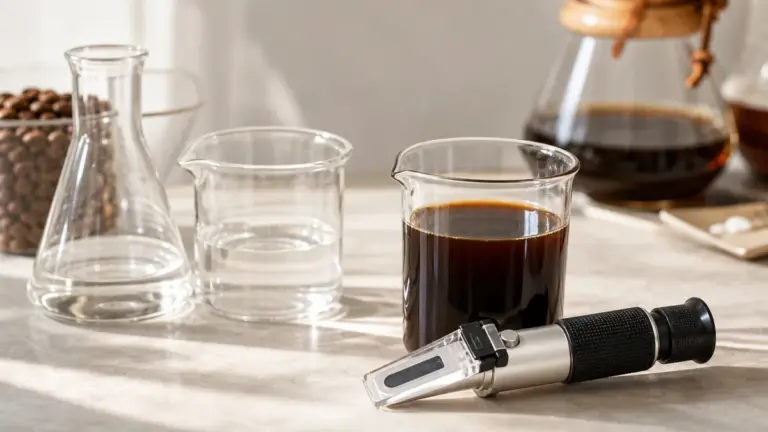 Coffee and ScienceWhat is coffee science? Explore plant biology, roasting chemistry, extraction physics, sensory testing and how to interpret coffee health research.Read the guide
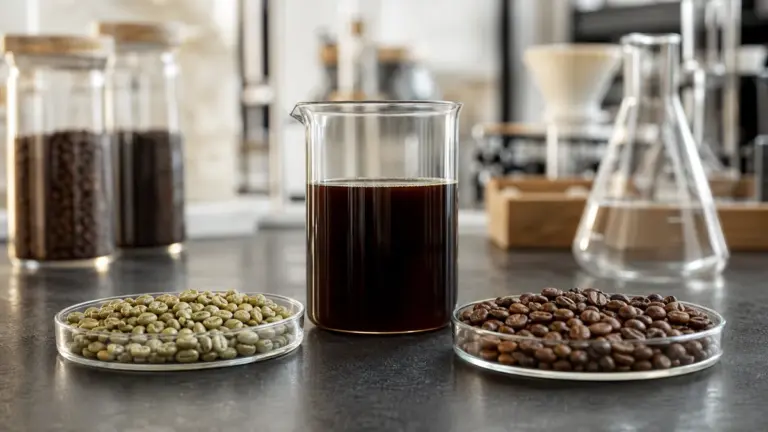 Coffee ChemistryUnderstand coffee chemistry, from caffeine, sugars and oils in green beans to roasting reactions, brown melanoidins and the compounds that enter your cup.Read the guide
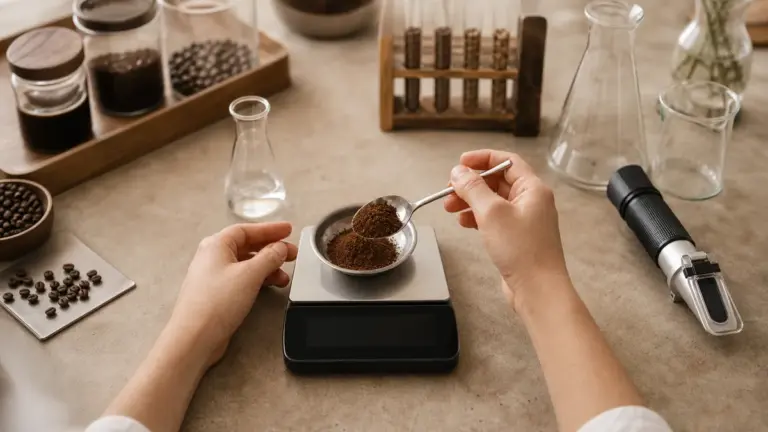 Coffee Research and StudiesExplore recent coffee studies on health, genetics and extraction, with dated findings, evidence limits and a practical checklist for reading research.Read the guide
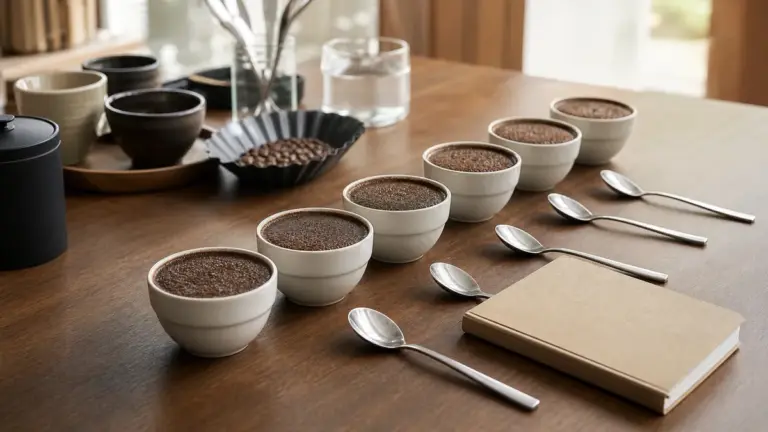 Coffee Sensory Science and the Flavour WheelUnderstand the coffee flavour wheel, WCR Sensory Lexicon and current SCA assessment, with a simple home exercise for clearer, more useful tasting notes.Read the guide
 The Science of Coffee Aroma and FlavourDiscover what creates coffee aroma and flavour, how retronasal smell works, and why roasting, brewing and cooling change what you notice in the cup.Read the guide
Start here if you are new
Follow this short route before choosing a specialist topic:
- Coffee chemistry introduces the substances and transformations behind the drink. Start here if scientific terminology is the main obstacle.
- Aroma and flavour connects those chemical changes with what you smell and taste. Read this next if you want to understand descriptions such as floral, nutty or caramel-like.
- Sensory science and the flavour wheel turns that understanding into a more organised way of tasting. It is the practical next step when you can recognise differences but struggle to describe them.
If your starting point is a striking news headline rather than a cup of coffee, begin with coffee research and studies instead. That guide is the place to examine how a study was designed and how far its conclusions can reasonably travel.
This hub sits within health and science. Its particular job is to help you navigate explanations and evidence, not to prescribe a caffeine intake, diagnose symptoms or provide a brewing recipe.

Coffee science at a glance
The subject becomes easier to navigate when you separate the questions researchers are asking. Measuring what is present, investigating what people perceive and testing an effect on health are connected activities, but they are not substitutes for one another.
| Area | Main question | What to look for | Best next read |
|---|---|---|---|
| Research methods | How convincing is the claim? | Study design, comparisons, limitations and replication | Research and studies |
| Chemistry | What changes between bean and drink? | Identified compounds and controlled processing conditions | Coffee chemistry |
| Aroma and flavour | Which substances matter to perception? | Chemical analysis combined with smelling or tasting | Aroma and flavour |
| Acids, oils and sugars | How do these groups contribute? | Composition, transfer into the brew and sensory evidence | Acids, oils and sugars |
| Sensory science | How can people describe coffee consistently? | Defined attributes, references and suitable tasting methods | Sensory science |
Use the table as a route finder. If a coffee tastes unexpectedly sour, the acids guide is a better starting point than a general health review; if a headline claims coffee prevents disease, a flavour analysis cannot establish whether that is true.
Research: understanding what a study can tell you
Choose coffee research and studies when you want to investigate the evidence behind a claim. It is especially useful for separating a promising finding from a result that applies directly to everyday coffee drinking.
Begin by identifying what the researchers actually studied. Was it a brewed drink, an isolated substance, a trained tasting panel or people reporting their usual consumption? These are different research questions, even when an article summarising them uses the same word, “coffee”.
Health research needs particular care. An observational study records associations without assigning people to drink coffee. A randomised controlled trial assigns an intervention and a comparison, making it better suited to testing a causal effect under its particular conditions.
A systematic review brings together research using an explicit method. A meta-analysis statistically combines compatible results, while an umbrella review examines existing reviews. Combining studies does not remove weaknesses shared by the underlying evidence.
For example, the BMJ’s 2017 umbrella review of coffee and health brought together observational and intervention evidence, but called for robust randomised trials to establish whether observed associations were causal. That is a reason to read beyond a favourable headline, not a reason to dismiss research altogether.
Before accepting a conclusion, ask:
- What was compared? Different roast levels, different drinks or different groups of people?
- What was measured? A chemical concentration, a sensory response or a health outcome?
- How closely does it match my question? Findings from a particular coffee and preparation method need not describe every cup.
- What remains uncertain? Look for limitations and alternative explanations, not just the authors’ preferred interpretation.
For personal health decisions, use current guidance rather than converting a research association into a drinking target. EFSA’s caffeine assessment distinguishes healthy adults from other groups, and the NHS gives specific advice for pregnancy. Speak to a GP, pharmacist or midwife about individual medical concerns.
Chemistry: following the changes from bean to cup
Read coffee chemistry when you want the underlying explanation for roasting and brewing changes. It provides the foundations needed before exploring individual acids, aroma compounds or laboratory measurements.
Coffee is a mixture, not a single active ingredient. Its components include carbohydrates, acids, proteins, lipids and caffeine, and roasting changes that mixture by breaking down some substances and forming others.
One important process is the Maillard reaction, a family of reactions involving sugars and amino compounds. During roasting, these reactions help produce colour and flavour molecules. Roasting is therefore more than drying or darkening a bean.
Brewing presents a different question: which substances move from the grounds into the drink? The composition of the bean and the composition of the finished beverage are not identical. Some components transfer more readily than others, and some lipids enter the drink as dispersed droplets rather than simply dissolving.
A useful reading habit is to distinguish presence, concentration and effect. Finding a substance establishes its presence; measuring its concentration tells you how much was detected; demonstrating a sensory effect requires evidence about perception. Keeping those steps separate prevents a chemical name from becoming an explanation before the necessary work has been done.
Aroma and flavour: connecting molecules with experience
Choose the science of coffee aroma and flavour if your question begins with “Why does this smell like…?” It is the most useful route into the relationship between laboratory analysis and the experience of drinking coffee.
Aroma concerns smell. Flavour brings taste and smell together, so a description such as lemon-like can involve both sourness and a recognisable aromatic character. It need not mean that the drink tastes like lemon juice.
A chemical inventory alone cannot explain the whole aroma. Researchers can use gas chromatography to separate volatile substances, mass spectrometry to help identify them, and olfactometry, involving human smelling, to investigate which separated substances have noticeable odours.
An experimental roasting study published in 2024 illustrates the distinction. The researchers identified 74 compounds, of which 25 were classified as aroma-active in their analysis. Those figures describe that experiment, not a universal count for coffee.
The useful lesson is methodological: detectable does not mean equally influential. Ask whether a claim rests on an instrument finding a compound, on people perceiving it, or on both.
This also makes tasting language less intimidating. You do not need to identify a molecule to notice a floral aroma, and recognising a familiar smell does not establish its exact chemical cause.
Acids, oils and sugars: three different questions
Read coffee acids, oils and sugars when a broad explanation such as “the chemistry changed” is no longer enough. It is the next stop for understanding sourness, texture and perceived sweetness without treating them as the same phenomenon.
Acids and perceived sourness
Acidity can refer to a chemical measurement or a sensory description. pH measures one aspect of a solution’s acid-base condition; titratable acidity measures the amount of alkali needed to reach a specified endpoint.
Neither term should be used as shorthand for everything a drinker experiences as sour. In an experimental study of drip-brewed coffee, perceived sourness correlated more strongly with titratable acidity than with pH under the tested conditions.
Preference is another question again. A measurement can help explain differences between samples without deciding whether you will enjoy them.
Oils and texture
Coffee oils belong to the broader chemical group called lipids. They can contribute to the drink’s texture and interact with aroma compounds.
An emulsion is a dispersion of droplets of one liquid in another, such as oil droplets in water. That distinction matters because describing everything in coffee as “dissolved” overlooks part of the drink’s physical structure.
Follow the component guide for this detail rather than assuming that a fuller-feeling coffee simply contains more of every flavour substance.
Sugars and perceived sweetness
A sweet impression is not a direct measurement of sugar. In a controlled study of successive drip-brew fractions, later fractions were perceived as sweeter even though the measured monosaccharides, simple sugars, were below perceptible concentrations in the samples.
The authors proposed masking effects and sweet-associated aromas or flavours as possible explanations. This supports a careful conclusion: perceived coffee sweetness cannot always be explained by the measured simple sugars alone. It does not prove that sugar never contributes to any coffee drink.
Sensory science: describing before judging
Choose coffee sensory science and the flavour wheel when you want a repeatable vocabulary for what you notice. It is also the right guide for distinguishing a description of coffee from a judgement about its quality.
Sensory science uses people as assessors within organised methods. Shared definitions and reference materials help a panel use terms more consistently, rather than relying entirely on private associations.
World Coffee Research’s Sensory Lexicon identifies 110 attributes covering flavour, aroma and texture, with references for assessing intensity. Its second edition was published in 2017, and the lexicon underpins the revised Coffee Taster’s Flavor Wheel.
The wheel organises descriptors from broad categories towards more specific ones. Start with “fruity”, for example, before deciding whether a narrower description genuinely fits. Stopping at the broader term is more useful than forcing a confident-sounding detail.
Keep description separate from liking. The Specialty Coffee Association’s Coffee Value Assessment distinguishes descriptive assessment, recording sensory attributes, from affective assessment, recording an evaluator’s impression of quality. A coffee can be intensely fruity without being your favourite.
For a simple learning session:
- Smell the coffee before tasting and note a broad impression.
- Taste it and record basic observations before searching for elaborate comparisons.
- Consult the wheel, moving from a general category towards a specific descriptor only when it fits.
- Keep “what I notice” separate from “how much I like it”.
- Use the lexicon’s definitions and references when a term is unclear.
Treat this as guided practice, not a laboratory result or a professional qualification. The purpose of Coffee and Science is to help you ask a clearer next question, then choose the guide that can answer it.
FAQ
Do I need chemistry knowledge to use these guides?
No, start with the question that interests you rather than a list of scientific terms. The chemistry guide is the foundation route, while aroma and sensory science provide a more experience-led entry point. You can move between them as unfamiliar terms become relevant, without studying every branch in a fixed order.
Is a flavour wheel a scoring system?
No, the flavour wheel organises sensory descriptors rather than awarding a quality score. It helps you move from broad impressions towards more specific language. A descriptor’s presence or intensity does not automatically establish whether a coffee is good, and the SCA’s assessment framework distinguishes description from an evaluator’s quality judgement.
Can a single experiment settle a coffee question?
Usually not beyond the conditions it actually tested. A carefully controlled experiment can provide strong evidence about its samples and methods, while leaving questions about other coffees, preparations or populations unanswered. Read its limitations, then look for replication and related research before treating its conclusion as a universal rule.
Where to go next
Read Coffee Research and Studies to assess evidence, or Coffee Chemistry for the foundations behind the drink. Continue with The Science of Coffee Aroma and Flavour to connect chemistry with perception, then Coffee Sensory Science and the Flavour Wheel to organise your own observations.
Sources
-
The BMJ, Poole and colleagues, Coffee consumption and health: umbrella review of meta-analyses of multiple health outcomes, 2017.
https://www.bmj.com/content/bmj/359/bmj.j5024.full.pdf -
American Chemical Society, Gail Kay Haines, Brain Booster to Go?, ChemMatters, December 2008. Used for basic roasting chemistry, not health conclusions.
https://www.acs.org/content/dam/acsorg/education/resources/highschool/chemmatters/articlesbytopic/organicchemistry/chemmatters-dec2008-coffee.pdf -
Molecules, Obando and Figueroa, Effect of Roasting Level on the Development of Key Aroma-Active Compounds in Coffee, 2024. Retrieved abstract and bibliographic record.
https://pubmed.ncbi.nlm.nih.gov/39407651/ -
ACS Food Science & Technology, Titratable Acidity, Perceived Sourness, and Liking of Acidity in Drip Brewed Coffee, 2021. Retrieved abstract.
https://pubs.acs.org/doi/full/10.1021/acsfoodscitech.0c00078 -
Food Science & Nutrition, Senila, Kovacs and Senila, Essential and Nonessential Elements, Lipids and Volatile Compounds in Coffee and Transfer to Coffee Brews: Assessment of the Benefits and Potential Risks for Human Health, 2025 issue; first published December 2024.
https://onlinelibrary.wiley.com/doi/10.1002/fsn3.4640 -
Society of Chemical Industry, Batali and colleagues, Sensory and monosaccharide analysis of drip brew coffee fractions versus brewing time, Journal of the Science of Food and Agriculture, 2020.
https://scijournals.onlinelibrary.wiley.com/doi/10.1002/jsfa.10323 -
World Coffee Research, Sensory Lexicon, edition 2.0, October 2017; accompanying resource page.
https://worldcoffeeresearch.org/resources/sensory-lexicon -
Specialty Coffee Association, How to Use the Coffee Taster’s Flavor Wheel in Eight Steps, undated retrieved page.
https://sca.coffee/sca-news/how-to-use-the-flavor-wheel-in-eight-steps-ab2hy -
Specialty Coffee Association, Coffee Value Assessment, current framework overview, undated.
https://sca.coffee/value-assessment -
European Food Safety Authority, Caffeine, current topic page summarising its 2015 scientific opinion.
https://www.efsa.europa.eu/en/topics/topic/caffeine -
NHS, Foods to avoid in pregnancy, current guidance page, undated retrieved version.
https://www.nhs.uk/pregnancy/keeping-well/foods-to-avoid/
Researched through live retrieval of original research records, a published umbrella review, professional sensory resources and official health guidance, with findings limited to what the retrieved material supports.
Last checked: November 2026