West and Central Africa grows mainly robusta coffee, alongside liberica in its West African homeland and arabica in the highlands of eastern Democratic Republic of the Congo and Cameroon. The region is both a source of commercial coffee and an important home of wild coffee diversity, so the species, growing area and processing method tell you more than a country name alone.
In short
- Look for robusta from Côte d'Ivoire, Ghana, Cameroon and the Democratic Republic of the Congo, but do not assume these origins taste alike.
- Liberia is part of liberica's native range, yet Liberian coffee is not automatically liberica: robusta is also cultivated.
- For highland arabica, explore eastern Congo and western Cameroon's coffee-growing areas.
- There is no single regional harvest season. Ghana's harvest starts in September; one documented South Kivu arabica origin harvests from April to July.
- Excelsa is treated here as Coffea dewevrei, following the 2025 genomic study, rather than as a variety of liberica.
Guides in West and Central Africa
 Cameroon Coffee: Origins, Flavours and VarietiesDiscover Cameroon's highland arabica and lower-grown robusta, including Boyo, Java's breeding history, harvest seasons and what to look for on a bag.Read the guide
 Côte d’Ivoire and GhanaExplore coffee from Côte d'Ivoire and Ghana: robusta flavours, production history, natural processing and the evidence behind specialty coffee efforts.Read the guide
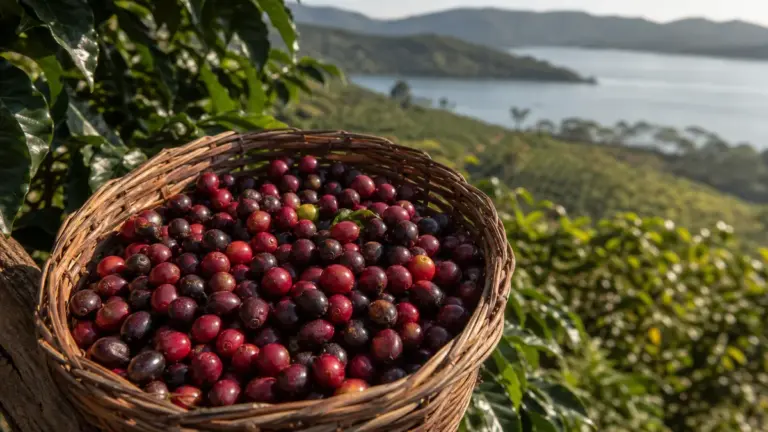 Democratic Republic of the Congo CoffeeDiscover DR Congo coffee, from fruit-led Lake Kivu arabica to robusta, with verified growing details, co-operative context and practical buying checks.Read the guide
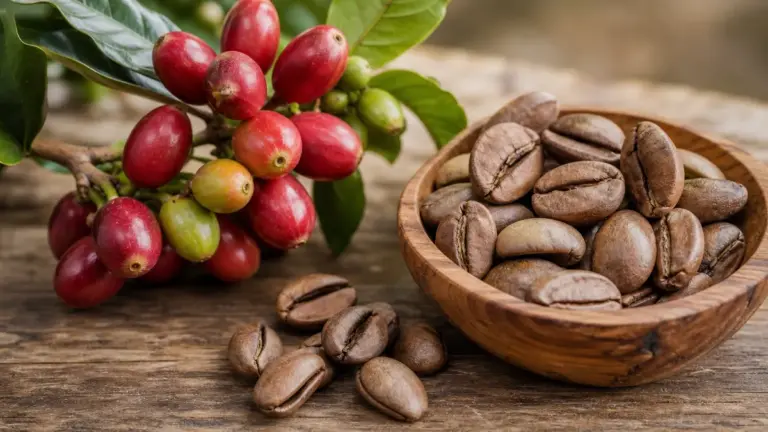 Liberia CoffeeExplore Liberia’s link to liberica coffee, its possible flavours, documented revival efforts and the provenance details to check before buying beans.Read the guide
Start here if you are new
Begin with beans and origins if you need help separating a coffee's species, variety, origin and processing method. These describe different things, even when they appear together on a packet.
Next, read Côte d'Ivoire and Ghana for an introduction to West African robusta. Follow it with the Democratic Republic of the Congo to explore a country whose coffee spans Congo Basin robusta and eastern highland arabica.
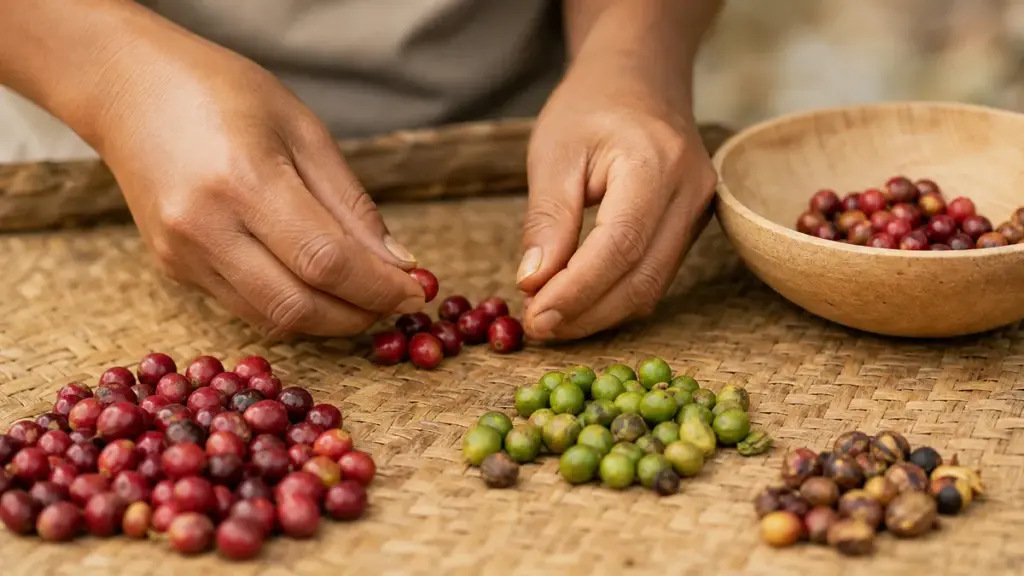
The region at a glance
This guide focuses on Liberia, Côte d'Ivoire, Ghana, the Democratic Republic of the Congo, abbreviated here to DRC, and Cameroon. It is a route into their individual guides, not an attempt to give every coffee-growing country in West and Central Africa the same identity.
Origin fact panel
- Altitude: documented growing sites in the sources include robusta at Yangambi, DRC, at 485 metres, and arabica supplied to Changwe washing station in South Kivu at 1,600 metres. This 485 to 1,600 metre span describes those examples, not the region's complete growing limits.
- Main species and named planting material: robusta, Coffea canephora; arabica, Coffea arabica; and liberica, Coffea liberica. Documented examples include Bourbon arabica at Changwe and Lula and Petit-Kwilu material in Congolese robusta research collections.
- Main processing methods: dry processing for much of Cameroon's robusta and wet processing for its arabica, according to the ICO country profile. Fully washed arabica is also documented at Changwe. “Natural” means drying the fruit around the seed; “washed” involves removing the fruit before the final drying stage.
- Harvest months: Ghana's harvest starts in September, according to COCOBOD. Changwe's published window is April to July. Ask for the individual origin's harvest dates rather than applying either calendar across the region.
- Cup profile: documented examples range from nutty and cocoa-like Congolese robusta to floral, fruity washed South Kivu arabica. Liberia's agricultural research institute describes liberica using woody, earthy, floral, chocolate and fruit descriptors. These are starting points, not guaranteed flavours.
Which country should you explore?
| Origin | Coffee to look for | Geography to distinguish | Read the country guide when |
|---|---|---|---|
| Liberia | Robusta and liberica | Named farms and producing counties, rather than the species name alone | You want to understand liberica's homeland and the country's coffee revival |
| Côte d'Ivoire | Principally robusta | Western forest regions, including Tonkpi, Haut-Sassandra and Guémon | You want production context for a significant West African robusta origin |
| Ghana | Principally robusta | Coffee-growing areas including Ashanti, Eastern, Volta and the western regions | You want to investigate Ghanaian coffee beyond its better-known cocoa |
| DRC | Robusta and arabica | Congo Basin growing areas versus eastern Kivu and Ituri | You want to compare lowland robusta with highland arabica |
| Cameroon | Robusta and arabica | Robusta areas including Littoral versus western highland arabica areas | You want to understand both species within one origin |
The table is a navigation aid, not a quality ranking. Choose the country guide that answers your question, then narrow the search to a producer, cooperative or washing station.
Robusta and liberica heartlands
Robusta is not an Asian species that later arrived in Africa. World Coffee Research places its origins in central and western sub-Saharan Africa, where wild populations occur mainly beneath humid forest canopies. Commercial cultivation elsewhere should not obscure that African botanical history.
Liberica needs a more careful geographical explanation. The 2025 study by Davis and colleagues distinguishes West African Coffea liberica, Central African excelsa, Coffea dewevrei, and the related West-Central African species Coffea klainei. Older references often grouped these plants under a broader liberica classification.
Here, “liberica” means Coffea liberica in that narrower sense, while “excelsa” means Coffea dewevrei. Kew's current research project also uses those separate species names. This matters when buying: an old botanical label and a modern species identification may not mean exactly the same thing.
Liberia: botanical identity is not a crop breakdown
Liberia's association with liberica is genuine, but it is not a reliable shortcut for identifying every coffee grown there. The country's Central Agricultural Research Institute reports work with both liberica and robusta, including seedling distribution and the establishment of coffee genetic collections.
For a buyer, the useful question is therefore not simply “Is this Liberian coffee?” Ask which species it contains and where it was grown. Read Liberia when you want the fuller account of the country's coffee identity and revival, rather than treating the country's name as a species guarantee.
Côte d'Ivoire and Ghana: separate robusta origins
Côte d'Ivoire and Ghana belong in the same regional conversation, but not in one anonymous flavour category. Côte d'Ivoire's official regional production data place much of its coffee in the western forest belt. Ghana's COCOBOD identifies robusta cultivation across several southern and middle-belt growing regions.
COCOBOD also describes improved clonal and hybrid planting material developed through the Cocoa Research Institute of Ghana. A clone is propagated from selected plant material; a hybrid combines different parents. Neither term, by itself, tells you what the roasted coffee will taste like.
Use Côte d'Ivoire and Ghana to investigate those national differences. When comparing actual coffees, ask for processing and tasting information rather than transferring a description from one country to the other.
The arabica highlands of eastern Congo and Cameroon
The region's robusta reputation can hide its arabica-growing areas. In DRC, the coffee-sector guide prepared for USAID INVEST identifies arabica in North Kivu, South Kivu and eastern Ituri, while robusta is grown across lower-lying areas of the northeast, centre and west.
Changwe washing station provides a concrete South Kivu example. Its importer lists Bourbon arabica, fully washed processing, an altitude of 1,600 metres and floral, fruity flavours with lively acidity. Those are the importer's details for that coffee, not a national tasting specification.
Cameroon also needs to be read by growing area and species. The ICO country profile identifies highland arabica in the West, North-West and South-West, alongside a wider robusta-growing area that includes Littoral and other regions. It describes washed processing as the main arabica approach and dry processing as the main robusta approach at the time of publication.
For the next level of detail, read Cameroon to understand that internal geography. Choose the Democratic Republic of the Congo when you need help distinguishing eastern arabica origins from the country's robusta traditions.
A short history and a dated production picture
The region's coffee history contains two different stories: the long existence and use of African coffee plants, and the later development of documented commercial cultivation and international trade. A date in an export history is not necessarily the beginning of local knowledge.
A short timeline helps keep those stories in proportion:
- Mid-eighteenth century: COCOBOD dates coffee's introduction into Ghana by missionaries to this period.
- Around 1870: World Coffee Research dates the first documented robusta cultivation in Congo to approximately this time, while acknowledging likely earlier small-scale cultivation.
- Around 1900: Congolese robusta planting material spread through European botanical and commercial networks to Java, helping establish cultivation beyond Africa.
- 2025: genomic, morphological and distribution evidence supported separating liberica, excelsa and Coffea klainei.
- 2026: Liberia's agricultural research institute reported continuing coffee improvement work through Seeds4Liberia.
What the production figures actually show
For a dated regional comparison, the ICO's April 2023 report recorded 1.5 million 60 kg bags of robusta production in Côte d'Ivoire in coffee year 2021/22. It recorded 165,000 bags of robusta for Cameroon in the same coffee year. These are historical figures, not estimates of production in November 2026.
More recent publication does not always mean more recent harvest data. Côte d'Ivoire's official open-data portal, updated in July 2026, reports national coffee production of 95,520 tonnes in 2022 and 46,932 tonnes in 2023.
Keep those series separate. Calendar-year production, coffee-year production, marketed production and exports answer different questions. Before comparing numbers, check the period, unit and definition; converting bags into tonnes does not fix a mismatch between what the figures measure.
What the coffees can taste like
There is no useful single “West African taste”. Species and origin help frame expectations, but an identifiable lot and a clear tasting description are better buying tools.
For robusta, World Coffee Research describes a general tendency towards lower perceived acidity, greater bitterness and fuller body than arabica. That does not require every robusta to taste harsh or earthy, nor does it establish the flavour of a particular Ghanaian or Ivorian lot.
Congolese research makes the variation especially clear. A peer-reviewed sensory study evaluated 70 robusta genotypes, meaning genetically distinct plant types, from the Yangambi collection. Nutty and cocoa descriptors were most frequent, but promising samples also showed fruity and sweet characteristics.
That was an evaluation of selected research material, not a survey of everything exported from DRC. Its practical lesson is narrower and more useful: robusta's genetic identity can matter, and the species name alone is not a complete quality description.
Liberica deserves the same restraint. CARI's woody, earthy, floral, chocolate and fruit descriptions indicate possible directions, not a compulsory checklist. Try a traceable example before deciding that an entire species is, or is not, for you.
Buying West and Central African coffee in the UK
Start with a question you can answer by tasting. Do you want to explore robusta, compare highland arabica origins, or understand liberica? Trying to do all three with an unspecified “African blend” makes the result difficult to interpret.
Ask the roaster or supplier for:
- Species and composition: arabica, robusta, liberica or a stated blend.
- Specific origin: a farm, cooperative, district or washing station where available.
- Processing method: ask what was actually done, rather than relying on an unfamiliar marketing name.
- Harvest information: distinguish the crop year from the roast date.
- Tasting basis: ask whether the description comes from the supplier's own assessment or an upstream specification.
For a useful comparison, choose coffees intended for the same brewing method and ask the roaster how to prepare each. Keep notes on sweetness, acidity, bitterness, aroma and texture. Your preference is the result you need; there is no obligation to prefer the rarer species.
For workplace purchasing, request a sample before committing to regular supply. Evaluate it in the drinks staff actually choose, and ask for written confirmation of composition, traceability and the procedure for approving replacement lots. Get itemised written quotations if moving from exploration to a supply agreement.
For the curious buyer: ask what the grade means
A grade is only useful when its rules are clear. Cameroon's ICO profile describes commercial classification involving defects and bean size; neither a letter nor a size designation should be read as a complete tasting report.
Likewise, the Yangambi research used Fine Robusta Standards and Protocols. If a supplier quotes a score, ask which protocol was used and who assessed the sample. For West and Central African coffee, a precise description of the coffee in front of you is more useful than a confident claim about an entire region.
FAQ
Does “Liberian coffee” mean liberica?
No. “Liberian” identifies the country, whereas “liberica” identifies a coffee species. Liberia's agricultural research institute documents work with robusta as well as liberica. Ask the seller to state the species and whether the packet contains a blend; a national name alone does not settle either question.
Can a robusta coffee taste fruity?
Yes. The peer-reviewed Yangambi study found fruity and sweet characteristics in some of the Congolese robusta material it evaluated. That does not guarantee fruit flavours in any packet labelled robusta. Ask for a description of the actual lot, and treat the species as useful context rather than a complete prediction.
Does “single-origin” give enough information to choose?
Not on its own. For this region, ask the seller to explain the origin more precisely and identify the species and processing method. A country-level description can leave substantial differences unresolved, particularly in DRC and Cameroon, where both arabica and robusta are grown. Choose the level of traceability that supports the comparison you want to make.
Where to go next
Read Liberia for the distinction between a country's coffee identity and its botanical names, then Côte d'Ivoire and Ghana for the West African robusta context. The Democratic Republic of the Congo and Cameroon are the useful next reads for exploring how robusta-growing areas and arabica highlands coexist within national borders.
Sources
-
World Coffee Research, Robusta, Varieties Catalog, undated live reference. Species origins and wild habitat.
https://varieties.worldcoffeeresearch.org/robusta -
World Coffee Research, History of Robusta, Varieties Catalog, undated live reference. Cultivation history, international dispersal and general cup characteristics.
https://varieties.worldcoffeeresearch.org/robusta-2/history-of-robusta -
Davis and colleagues, Royal Botanic Gardens, Kew and partner institutions, Genomic data define species delimitation in Liberica coffee with implications for crop development and conservation, Nature Plants, 2025. Revised species boundaries and distributions.
https://www.nature.com/articles/s41477-025-02073-y.pdf -
Royal Botanic Gardens, Kew, Excelsa and Liberica coffee development, undated live project page. Current use of separate liberica and excelsa species names.
https://www.kew.org/science/our-science/projects/excelsa-and-Liberica-coffee-development -
Ghana Cocoa Board, Coffee: Production, Consumption & Potential Health Benefits, 9 July 2022. Used only for cultivation, planting material, growing regions, harvest timing and history, not health claims.
https://cocobod.gh/news/coffee-production-consumption-potential-health-benefits -
International Coffee Organization and Cameroon's National Cocoa and Coffee Board, Country Coffee Profile: Cameroon, ICC-120-5, 2017. Growing areas, processing and commercial classification.
https://www.ico.org/documents/cy2016-17/icc-120-5e-profile-cameroon.pdf -
Chemonics International and CrossBoundary, prepared for USAID INVEST, An Introductory Guide to the Coffee Sector in the DRC, approved December 2022. Arabica and robusta geography.
-
Sucafina, Changwe Fully Washed, undated live origin specification. Importer's stated altitude, Bourbon variety, harvest, process and cup description.
https://sucafina.com/na/offerings/changwe-fully-washed -
International Coffee Organization, Coffee Report and Outlook, April 2023. Historical 2021/22 production figures.
https://ico.org/resources/public-market-information/ -
Côte d'Ivoire official open-data portal, data produced by Conseil Café-Cacao, Répartition de la production de café et cacao par région administrative (en tonnes), updated 1 July 2026. National and regional figures for 2022 and 2023.
https://data.gouv.ci/datasets/repartition-de-la-production-de-cafe-et-cacao-par-region-administrative-en-tonnes -
Bollen and colleagues, Sensory profiles of Robusta coffee (Coffea canephora) genetic resources from the Democratic Republic of the Congo, Frontiers in Sustainable Food Systems, 2 May 2024. Primary sensory research and Yangambi site information.
https://www.frontiersin.org/journals/sustainable-food-systems/articles/10.3389/fsufs.2024.1382976/full -
Central Agricultural Research Institute, Liberia, CARI Seeds4Liberia Project Reinforces Good Agronomic Practices, Climate-Smart and Agroforestry Systems for Sustainable Coffee Production in Liberia, 14 September 2026. Species, research activity, seedling distribution and institutional flavour descriptions.
https://mail.cari.gov.lr/media/press-releases/cari-seeds4liberia-project-reinforces-good-agronomic-practices-climate-smart
This guide was researched through live retrieval of botanical research, national agricultural sources, ICO publications and a clearly attributed importer specification; it does not report first-hand tasting or testing.
Last checked: November 2026