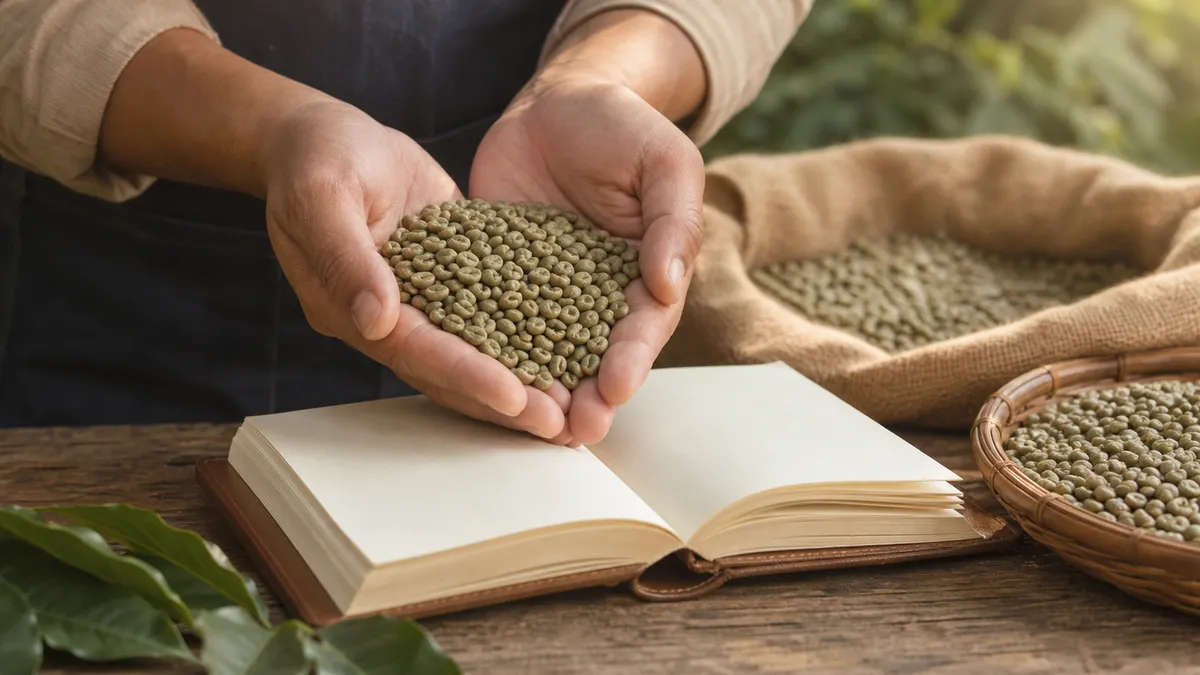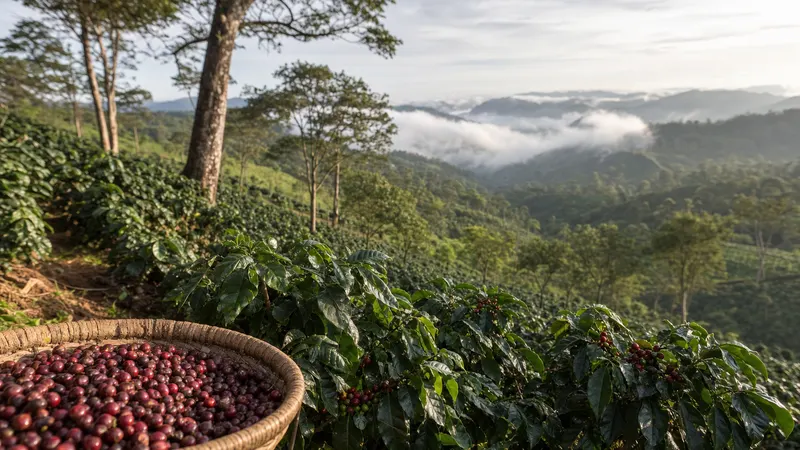
Coffee farming means growing coffee trees, caring for them through flowering and fruit development, and harvesting the fruits, known as cherries, for their seeds: the coffee beans. Farmers must match their plants and methods to local conditions while protecting their harvest and maintaining a viable livelihood. This hub maps those decisions, from plant biology to farming systems and economics.
In short
- Start with the plant: species and variety influence growing requirements, production and susceptibility to disease.
- Shade needs management: trees can protect coffee from excessive heat, but too much shade can reduce flowering and yield.
- Farming labels describe different things: shade concerns tree cover, organic concerns certified production rules, and regenerative approaches focus on restoring farm resources.
- Crop protection starts before spraying: observation, healthy plants and removal of pest reservoirs are important parts of management.
- Harvest volume is not the same as livelihood: labour, inputs, market access and household income all matter.
Guides in Coffee Farming
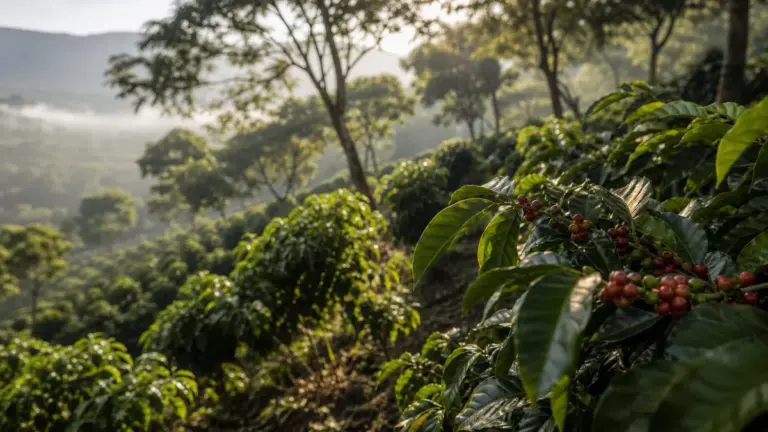 Coffee Farming: The Complete GuideFollow coffee farming from nursery to ripe cherry, with clear explanations of planting, shade, soil, pruning, labour, yields and the pressures farmers face.Read the guide
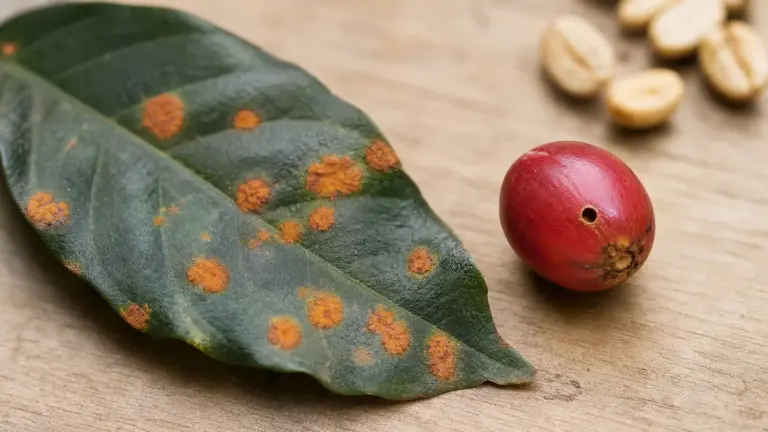 Coffee Leaf Rust and Coffee Berry BorerLearn how coffee leaf rust and coffee berry borer damage crops, what drove Central America’s epidemic, and how farmers manage these two major threats.Read the guide
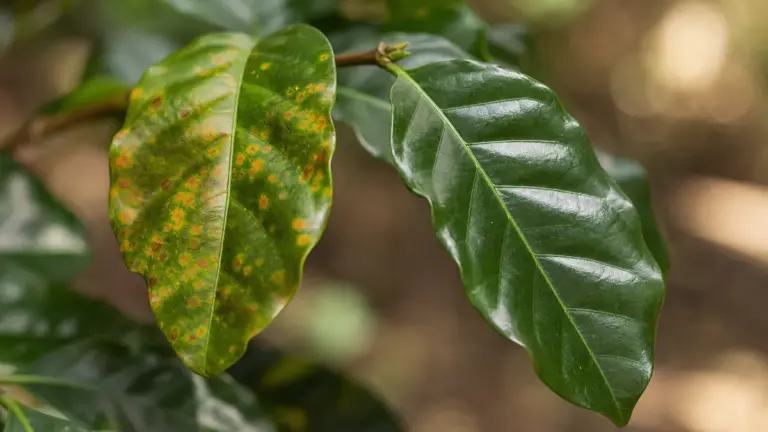 Coffee Pests and DiseasesLearn how rust, berry borer, berry disease, nematodes and wilt damage coffee plants, and how farmers combine prevention, monitoring and resistant varieties.Read the guide
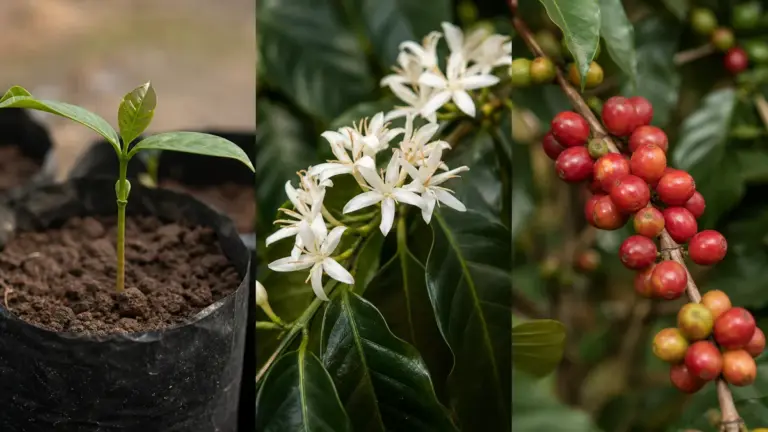 Coffee Plant Biology and Life CycleFollow the coffee plant from seed and seedling to flowers, ripe cherries and repeated harvests, with clear explanations of pollination and productive life.Read the guide
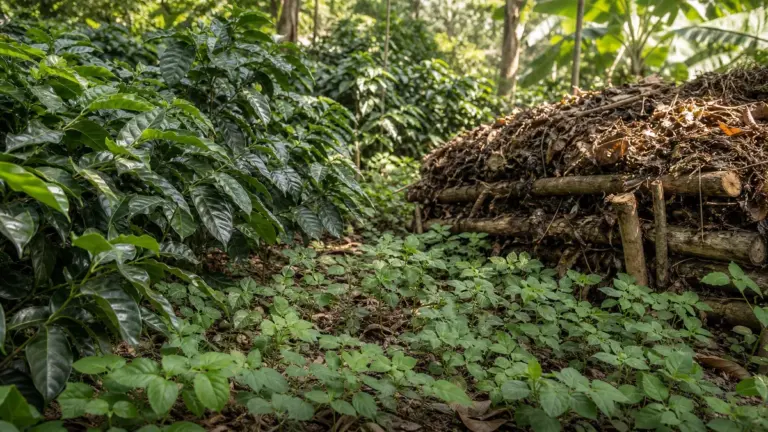 Organic Coffee FarmingWhat organic coffee farming guarantees, which inputs are allowed, how yields and premiums vary, and what to check on coffee labels sold in the…Read the guide
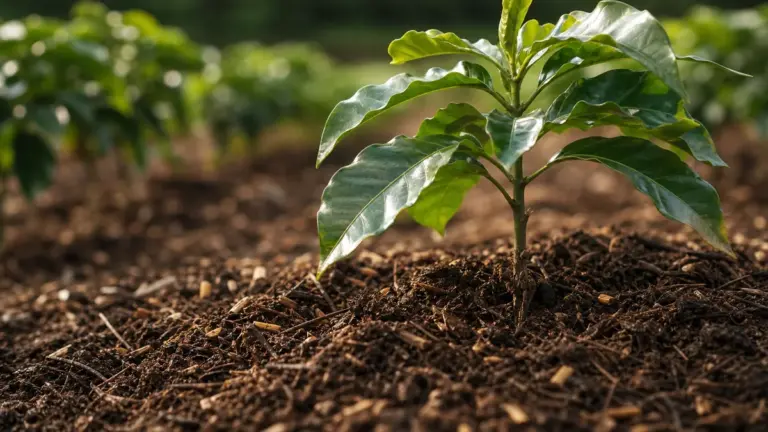 Regenerative Agriculture in CoffeeWhat regenerative agriculture means in coffee, how cover crops and compost work, and how to assess the evidence, certification and farming claims.Read the guide
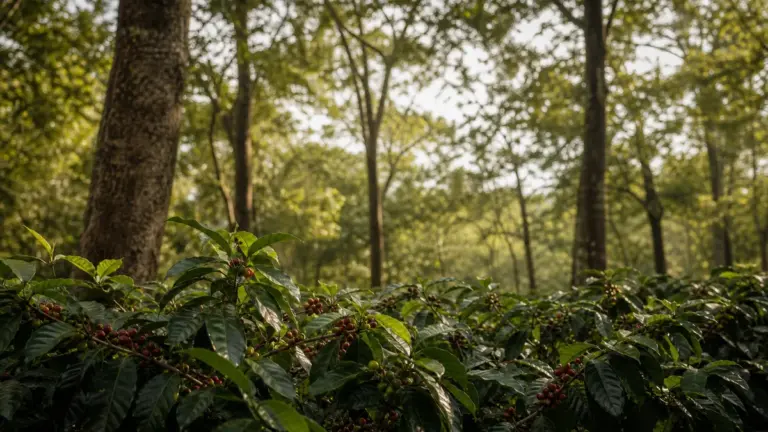 Shade-Grown CoffeeIs shade-grown coffee better? Compare farming systems, bird habitat evidence, yield and flavour trade-offs, plus Smithsonian Bird Friendly requirements.Read the guide
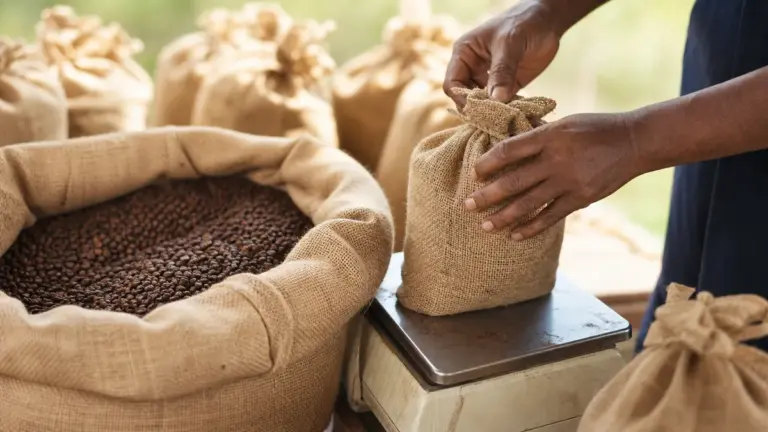 Smallholder Coffee Farms and Co-operatives ExplainedHow smallholder coffee farms and co-operatives work, from farm-size statistics and shared processing to selling, governance and women’s participation.Read the guide
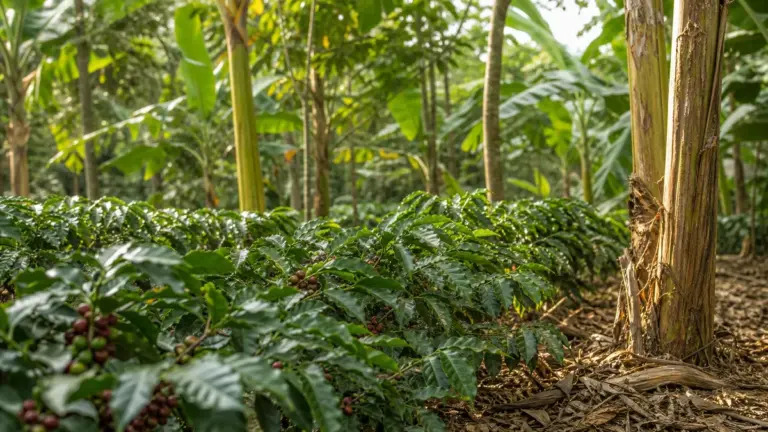 Sustainable Coffee Farming PracticesUnderstand sustainable coffee farming, from soil, shade and wastewater to farmer income, certification limits and evidence behind UK green claims.Read the guide
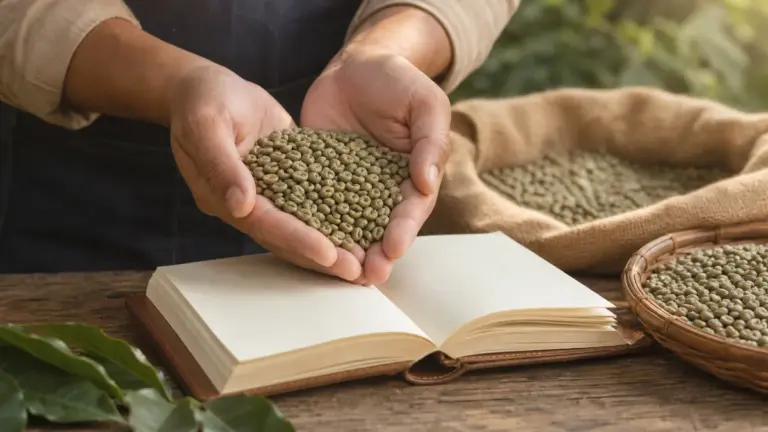 The Economics of Coffee FarmingUnderstand coffee farming economics: production costs, farmgate payments, labour, debt and the living income gap, plus questions buyers should ask.Read the guide
Start here if you are new
Take this reading path in order:
- the complete farming guide brings the whole growing process together. Choose it for a continuous explanation rather than separate topic guides.
- plant biology and life cycle provides the foundation for understanding flowering, fruiting and the decisions farmers make around them.
- sustainable farming practices helps you assess those decisions through environmental, social and economic questions.
For the wider context, return to beans and origins. Use the sections below when a particular question, such as shade management or farmer income, is your starting point.
Coffee farming at a glance
These are connected areas, not competing explanations. A farm’s planting decisions affect crop protection; its access to labour and buyers affects which growing practices it can maintain. World Coffee Research and the International Coffee Organization both treat farming decisions as dependent on circumstances rather than a single universal formula.
| Area | Main question | What to examine | Useful starting piece |
|---|---|---|---|
| Plant biology | What does the plant need? | Species, variety and development | Coffee Plant Biology and Life Cycle |
| Farming systems | How is the growing environment managed? | Shade, soil, water and inputs | Sustainable Farming Practices |
| Crop protection | What threatens the harvest? | Symptoms, monitoring and prevention | Coffee Pests and Diseases |
| Farm organisation | How do growers work and sell together? | Family labour, shared services and market access | Smallholder Farms and Co-operatives |
| Economics | Can farming support a livelihood? | Revenue, production requirements and risk | The Economics of Coffee Farming |
Use the table to choose a route, then follow the relevant linked guide below.
The plant behind the harvest
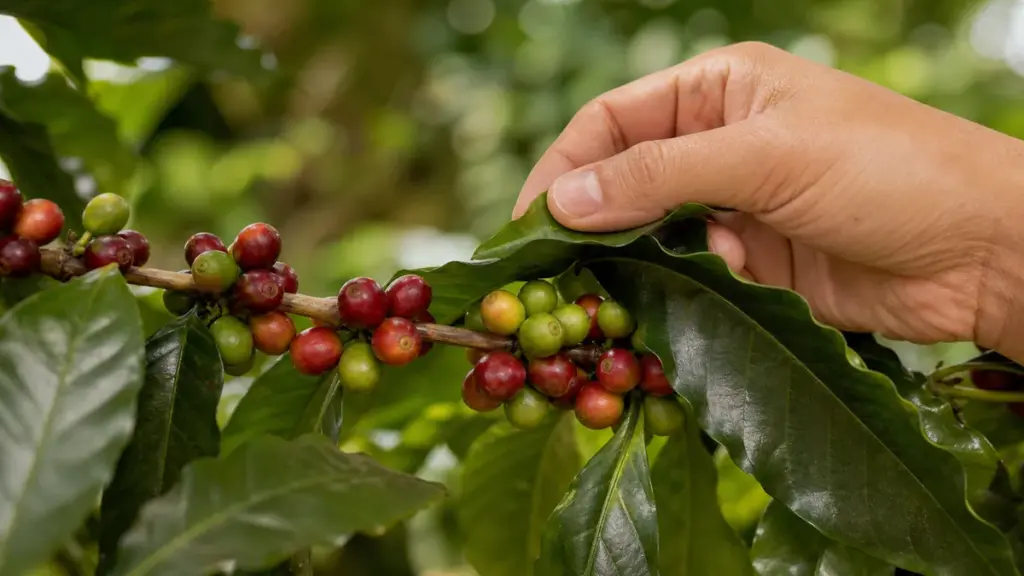
Coffee is a perennial crop: a woody plant that lives and produces across successive years, rather than being sown again for every harvest. The beans are seeds inside its fruit, usually two per cherry. That distinction helps separate growing the fruit from the processing that makes its seeds ready for roasting.
The principal cultivated species are Coffea arabica, which produces arabica coffee, and Coffea canephora, traded as robusta. Arabica generally suits cooler, frost-free conditions, while robusta generally suits warmer conditions. These are broad ecological differences, not instructions that every farm at a particular altitude should follow.
Within a species, varieties differ in expected yield, nutritional requirements, disease resistance and adaptation to growing conditions. A variety name on a coffee bag therefore describes more than a possible flavour association: it also points towards a planting decision made by a producer.
Read coffee plant biology when you want to understand how the plant grows and reproduces. It is the useful next step before interpreting claims about altitude, ripening or plant performance.
From planting material to ripe cherries
Farmers establish young plants in nurseries before planting them in the field. Propagation methods differ: arabica is commonly raised from seed, while cuttings are an established method for reproducing selected robusta plants. Pruning, weed management, nutrition and crop protection then form part of continuing farm care.
Flowering and fruit development respond to the growing environment, and cherries on the same branch need not ripen together. Selective hand-picking gathers ripe fruit over repeated visits; strip-picking removes cherries from a branch together. The distinction matters because selective harvesting demands more labour.
Use the full farming sequence for a closer account of establishment, annual care and harvesting. Here, the key point is that coffee production is a continuing cycle of plant management, not simply a picking season.
Sustainable, shade-grown, regenerative and organic farming
These terms answer different questions and can overlap. When reading a claim, separate what was done, which requirements were followed, and what outcome was measured. This is particularly useful for regenerative claims, which research has found may describe practices, intended outcomes or both.
Sustainable farming: look beyond a single practice
Assess sustainable farming through several questions together: is soil being protected, is water managed responsibly, are workers and households considered, and can producers keep farming? The ICO’s work on sustainability connects environmental resilience with inclusion and economic participation, rather than treating it as a purely environmental matter.
Our sustainable farming guide is the best route for comparing these objectives. Use it to structure questions about a farm or sourcing programme, rather than treating “sustainable” as a sufficient explanation on its own.
A useful reading habit is to ask for the actual practice and its purpose. “Maintaining soil cover to reduce erosion” tells you more than an unexplained claim that a farm is environmentally friendly.
Shade-grown coffee: managing trees alongside coffee
Shade-grown coffee is cultivated beneath other vegetation, commonly trees. Coffee agroforestry integrates coffee with trees that can provide shade, habitat and additional products. Tree cover and leaf litter can support biodiversity and soil protection, although the benefits depend on the system.
Shade is not a simple more-is-better decision. Trees can compete with coffee for water and nutrients; excessive shade can reduce flowering, while prolonged wet, cloudy conditions can increase some disease problems. Species choice, spacing and pruning therefore matter alongside the presence of trees.
Read shade-grown coffee to understand canopy management and its trade-offs. It is particularly useful when a label or supplier description mentions shade without explaining the growing system.
Regenerative agriculture: ask what is being restored
Regenerative approaches commonly seek improvements in soil health, biodiversity and the functioning of the farm ecosystem. Coffee guidance includes practices such as mulching, cover cropping and agroforestry, selected to suit local conditions. These are management choices, not interchangeable treatments for every farm.
A review of definitions found substantial variation in what “regenerative agriculture” meant. Coffee-sector guidance now provides more specific frameworks, including the Global Coffee Platform’s RegenCoffee guidance, but readers should still ask which framework a claim follows and what evidence supports it.
Use regenerative agriculture when you want to examine restoration claims more closely. Ask whether the evidence records an activity, such as planting trees, or an outcome, such as a measured change in soil condition.
Organic farming: a certified production system
Organic farming operates under defined production rules, with restrictions on fertilisers and plant-protection materials. It does not mean that farmers never intervene against pests. Defra’s guidance for Great Britain explicitly allows specified approved materials where needed and requires certification.
Keep that regulatory distinction separate from shade and restoration claims. When assessing coffee, check the organic certification rather than assuming that a description such as “naturally grown” establishes the same thing.
Read organic farming for the production principles and certification questions. It is the right next read when you want to understand what an organic claim establishes, rather than use it as shorthand for every aspect of farm performance.
Pests, diseases and environmental pressures
Coffee leaf rust and coffee berry borer illustrate two different threats. Leaf rust is a fungal disease caused by Hemileia vastatrix, associated with yellow-orange powdery lesions beneath leaves, premature leaf loss and reduced yield. Berry borer is a beetle, Hypothenemus hampei, whose females enter cherries and whose offspring feed within the seeds.
They require different responses. Rust management includes maintaining plant health and appropriate sanitation; berry borer management includes monitoring and removing residual fruit that can shelter the insect between harvests. Treatment decisions must follow local agronomic advice and applicable product authorisations.
Begin with coffee pests and diseases for the wider range of threats and the principles of integrated pest management, meaning a coordinated use of monitoring, prevention and suitable controls. Choose leaf rust and berry borer when you want to distinguish these two problems more precisely.
Environmental pressures also influence planting decisions. World Coffee Research identifies adaptation to changing climates, alongside pest and disease resistance, as a reason growers need reliable information about varieties. Read these challenges together: replacing a susceptible variety is a long-term farm decision, not merely a response to one damaged harvest.
Smallholders, co-operatives and farming livelihoods
Smallholder farming is not one uniform business model. For a useful picture of an individual farm, ask about its land, family and hired labour, other crops, processing arrangements and access to buyers. These are among the factors included in the ICO’s framework for assessing production and livelihoods.
Co-operatives and producer groups can help growers participate in markets through collective organisation. The ICO identifies potential benefits including stronger bargaining power, shared access to services and lower barriers to entering higher-value markets. These are possibilities to examine, not proof that membership alone produces a good outcome.
Read smallholders and co-operatives to understand the people and organisations behind a lot of coffee. Ask how a group is managed, which services members receive, and how sales and payments are explained to them.
Avoid two opposite shortcuts: assuming a small farm is automatically environmentally sound, or assuming that limited scale means limited skill. Judge the practices and arrangements described, rather than using farm size as the verdict.
The economics of coffee farming
A harvest must support more than the next round of picking. The ICO’s production indicators include planting material, paid labour, family labour, fertilisers, crop protection, energy, transport, equipment, finance and certification. Looking only at sales revenue leaves much of the farm business out of view.
Unpaid family work deserves particular attention. It may involve no immediate cash payment, but it still uses time that could otherwise support the household. The ICO therefore includes the opportunity cost of unpaid labour in its economic framework.
Distinguish three questions when reading about producer prosperity:
- Production: how much saleable coffee did the farm produce?
- Farm performance: what remained after accounting for production requirements?
- Household livelihood: what resources were available from coffee, other crops and other earnings?
These reflect different parts of the ICO’s assessment framework. A change in one does not, by itself, describe the others.
Read coffee farming economics for the fuller explanation of income, risk and market relationships. For UK readers choosing coffee at home or for work, a useful question is: “What can the supplier explain about the producer’s trading arrangements?” Treat a named farm as the beginning of that enquiry, not its conclusion.
FAQ
Can I grow a coffee plant in the UK?
Yes, a coffee plant can be grown as a houseplant or under suitable protected conditions. Arabica is a tropical evergreen that needs warmth, moisture and good drainage, rather than year-round exposure outdoors in a temperate climate. Growing an attractive plant is a different objective from producing a dependable harvest of coffee.
Does a coffee tree have to be replanted after harvesting?
No, harvesting its cherries does not normally mean replacing the tree. Coffee is a perennial woody crop, and farmers continue caring for established plants across successive harvests. Pruning and other management continue between crops. Decisions about replacing trees depend on their condition and the suitability of the planting material, rather than harvesting alone.
Does agroforestry mean the same thing as intercropping?
Not exactly: agroforestry integrates trees with agricultural crops, while the coffee agronomy guide used here distinguishes intercropping as growing coffee alongside non-woody crops. Both can diversify production, and they may be combined. Cover crops serve another main purpose: protecting and improving soil rather than being grown principally for a harvested product.
Where to go next
Read Coffee Farming: The Complete Guide for the whole process, then Coffee Plant Biology and Life Cycle for the plant science behind it. To explore the choices that shape coffee farming, continue with Sustainable Farming Practices and The Economics of Coffee Farming, pairing questions about growing methods with questions about producer livelihoods.
Sources
-
North Carolina State University Extension, Coffea arabica, Plant Toolbox, undated living reference, accessed 2026.
https://plants.ces.ncsu.edu/plants/coffea-arabica/ -
CIRAD, Coffee: Plant and uses, undated living reference, accessed 2026. Used for cultivation, propagation, upkeep and harvesting, not its species-count or market descriptions.
https://www.cirad.fr/en/our-activities-our-impact/tropical-value-chains/coffee/plant-and-uses -
World Coffee Research, Coffee varieties catalog, undated living reference, accessed 2026.
https://worldcoffeeresearch.org/resources/coffee-varieties-catalog -
Pulleman, M. M., Rahn, E. and Valle, J. F., International Center for Tropical Agriculture, Regenerative agriculture for low-carbon and resilient coffee farms: A practical guidebook, version 1.0, 2023. Publication record and retrieved full-text copy:
https://alliancebioversityciat.org/publications-data/regenerative-agriculture-low-carbon-and-resilient-coffee-farms-practical
https://www.nestle.com/sites/default/files/2024-07/regenerative-coffee-farms-guidebook-2023.pdf -
Initiative for coffee&climate, Shade Management, toolbox guidance, undated, accessed 2026.
https://toolbox-v2.coffeeandclimate.org/tools/shade-management/ -
Newton, P. and colleagues, University of Colorado Boulder, What Is Regenerative Agriculture? A Review of Scholar and Practitioner Definitions Based on Processes and Outcomes, Frontiers in Sustainable Food Systems, 2020.
https://www.frontiersin.org/journals/sustainable-food-systems/articles/10.3389/fsufs.2020.577723/full -
Global Coffee Platform, RegenCoffee, guidance programme introduced in 2025, living page accessed 2026.
https://www.globalcoffeeplatform.org/our-work/tools/regencoffee/ -
Department for Environment, Food & Rural Affairs, Organic farming: how to get certification and funding in Great Britain, updated 13 July 2023.
https://www.gov.uk/guidance/organic-farming-how-to-get-certification-and-apply-for-funding -
Hawai‘i Department of Agriculture, Coffee Leaf Rust, New Pest Advisory 20-03, revised January 2021.
https://dab.hawaii.gov/pi/files/2021/01/NPA-20-03-Coffee-leaf-rust1-21.pdf -
University of Hawai‘i at Mānoa, CTAHR, Coffee Berry Borer: How Can We Manage It?, extension guidance, undated living page, accessed 2026.
https://www.ctahr.hawaii.edu/site/CBBManage.aspx -
International Coffee Organization, Coffee Development Report 2020: The Value of Coffee, Sustainability, Inclusiveness, and Resilience of the Coffee Global Value Chain, 2020 edition.
https://www.ico.org/wp-content/uploads/2022/11/CDR2020.pdf -
International Coffee Organization, Indicators, Global Knowledge Hub, undated living framework, accessed 2026.
https://icocoffee.org/global-knowledge-hub/indicators/
This hub was researched through live retrieval of botanical references, agronomy guidance, a peer-reviewed review, official certification guidance and ICO publications; it reports no first-hand farm testing.
Last checked: November 2026