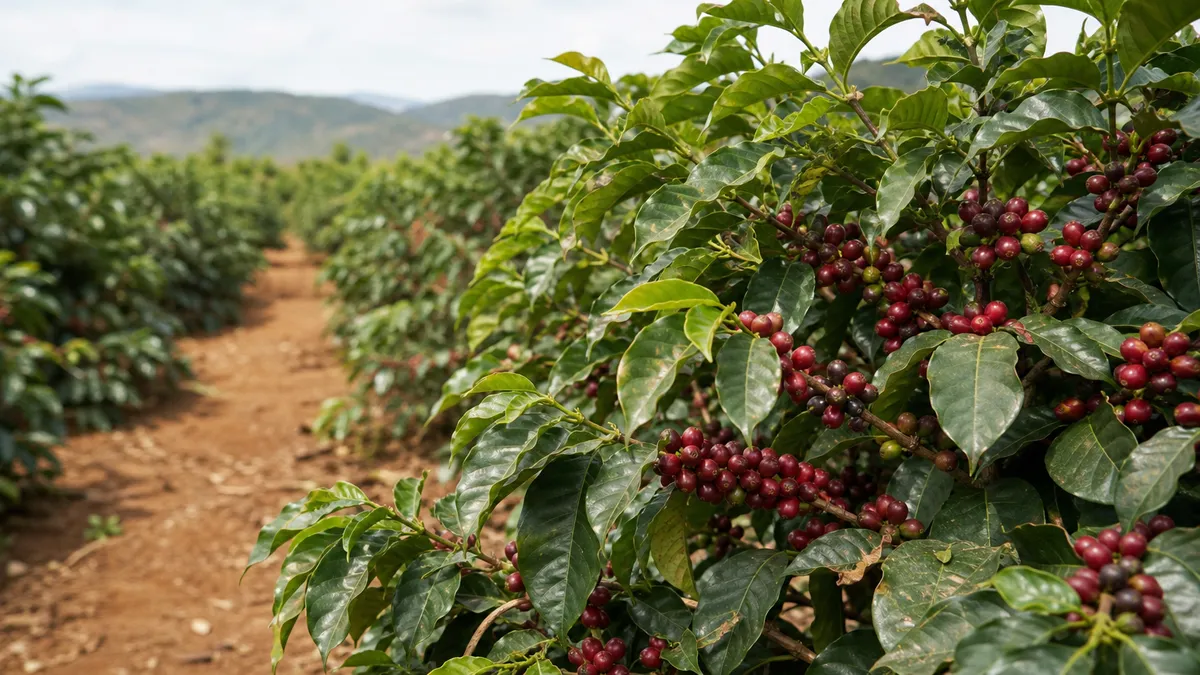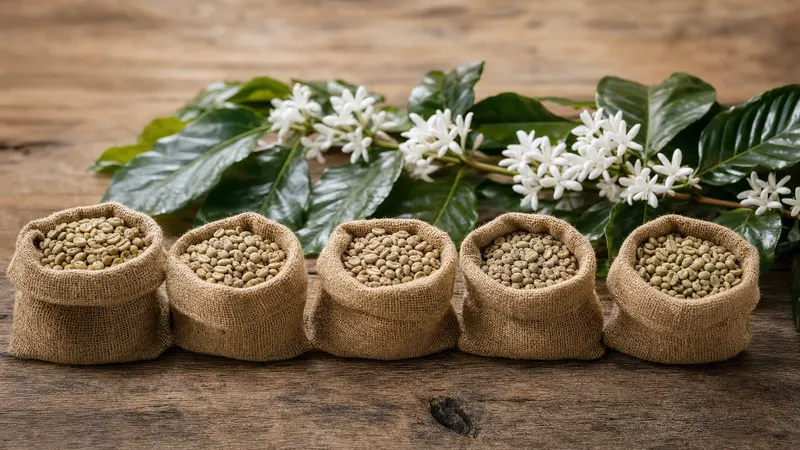
Coffee is grown mainly in the bean belt, the tropical band around the equator that crosses the Americas, Africa, Asia and the Pacific. Origin helps explain a coffee’s character, but the growing environment, plant genetics and processing matter more than a country name alone.
In short
- Follow the 11 regional guides below, then narrow your search to a country, growing district or producer.
- The bean belt is a useful geographical guide, not an absolute boundary: coastal California is one exception.
- Harvest calendars describe picking at origin, not when roasted coffee reaches a UK shelf.
- Compare coffees with similar processing and roasting before attributing every flavour difference to origin.
- These 11 regions are the site’s navigation system, not an official coffee-industry classification.
Explore the topics
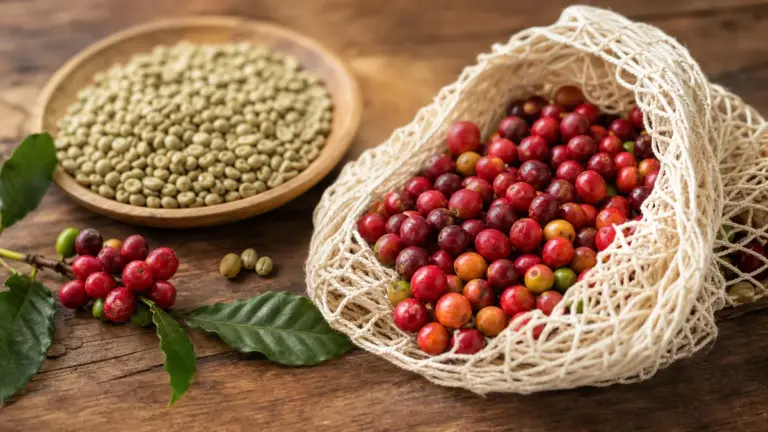
Guides in Coffee Growing Regions
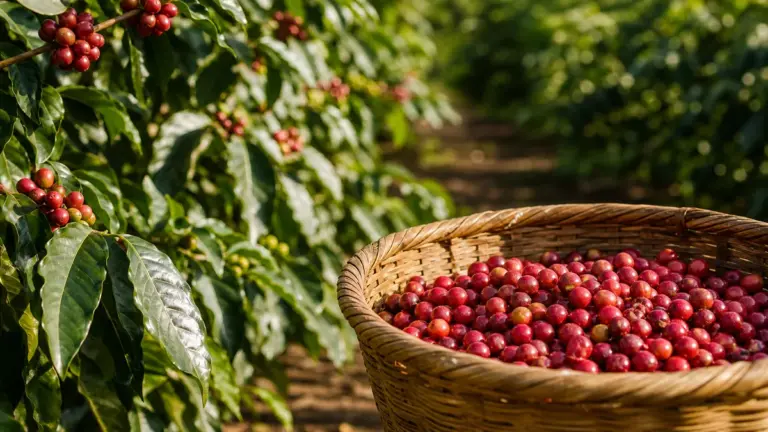 Coffee Harvest Seasons by CountryCompare coffee harvest months by country, understand main and fly crops, and learn how picking dates relate to UK arrivals, roast dates and freshness.Read the guide
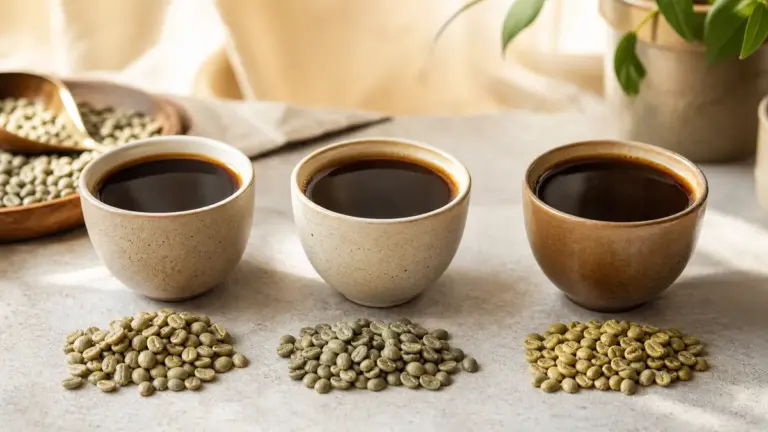 How Origin Affects FlavourLearn how variety, altitude, climate, soil and processing shape coffee flavour, what origin labels can predict, and how to compare coffees fairly.Read the guide
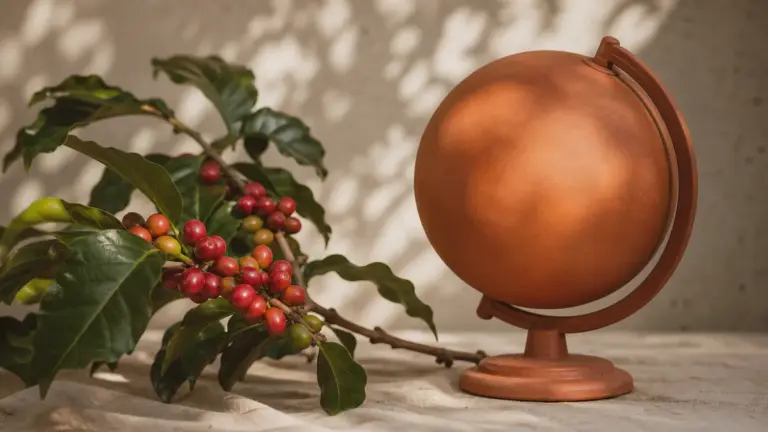 The Bean Belt ExplainedUnderstand the bean belt, why latitude and altitude matter, how arabica and robusta differ, and why climate change is reshaping suitable growing areas.Read the guide
 The World’s Coffee Growing Regions: The Complete GuideExplore the world's coffee growing regions, leading producers, growing conditions, flavour tendencies, harvest seasons and trade routes to UK roasters.Read the guide
Start here if you are new
- Read the bean belt to understand why coffee production clusters around the tropics.
- Follow the complete growing-regions guide for the wider geographical picture.
- Continue with origin and flavour to connect a place on the map with what you taste.
This hub is the route into individual destinations. The parent beans and origins guide puts geography alongside the other information you will encounter when choosing coffee.
The bean belt: where coffee grows
The bean belt lies between the Tropics of Cancer and Capricorn. However, latitude alone does not determine whether a farm can grow coffee successfully: local conditions matter, and suitable pockets exist beyond the tropics.
Arabica and robusta also occupy different growing environments. The Coffee Board of India, for example, distinguishes cooler, higher arabica areas from warmer, more humid robusta areas. Those are useful tendencies, not universal altitude rules to apply unchanged across the world.
Our regional groupings make the site easier to explore. Central America and the Caribbean have separate guides, although both belong to North America geographically. Hawaii sits within the North America navigation because it is part of the United States; Madagascar appears within Southern Africa for this site’s purposes.
Coffee growing regions at a glance
The destinations below are starting points, not exhaustive lists of producing countries. The final column suggests a question to take into each regional guide rather than assigning a fixed flavour to an entire area.
| Region | Destinations covered here | Useful question to explore |
|---|---|---|
| North America | Mexico, Hawaii, California | How far does the bean-belt model take us? |
| Caribbean | Jamaica, Puerto Rico, Dominican Republic, Cuba, Haiti | What does an island or district name actually tell you? |
| Central America | Guatemala, Costa Rica, Honduras, Nicaragua, Panama, El Salvador | How do neighbouring origins differ? |
| South America | Brazil, Colombia, Ecuador, Peru, Bolivia, Venezuela | What disappears when a whole country gets one flavour description? |
| East Africa | Ethiopia, Kenya, Tanzania, Burundi, Uganda, Rwanda, Malawi | How do genetics, environment and processing interact? |
| West and Central Africa | Liberia, Côte d’Ivoire, Ghana, DR Congo, Cameroon | Which origins sit beyond the familiar arabica shortlist? |
| Southern Africa | Angola, Zambia, Zimbabwe, Madagascar | What can less familiar origins add to your understanding? |
| Middle East | Yemen | How should you read a distinctive origin’s names and traditions? |
| South Asia | India, Sri Lanka, Nepal | Where does geography end and processing begin? |
| East and Southeast Asia | Indonesia, Vietnam, Laos, Philippines, Thailand, Myanmar, Timor-Leste, China | Why is a single continental flavour description inadequate? |
| Oceania | Papua New Guinea, Australia | How do Pacific origins fit into the wider picture? |
North America
Start with North America for the regional overview, especially if you are trying to reconcile coffee geography with political borders. Mexico, Hawaii and California make useful contrasting destinations rather than a single flavour family.
- Mexico is the next read for moving from a country name towards its individual growing areas.
- Hawaii provides an island-origin comparison, distinct from mainland US production.
- California illustrates an exception to the tropical-belt shorthand. University of California extension reporting documents coffee cultivation along the state’s coast.
Caribbean
Use the Caribbean guide when an island name is your starting point. Follow it with a country guide before treating that name as a complete description of the beans.
- Jamaica belongs in this regional comparison, with attention to the specific names and growing areas on a coffee label.
- Puerto Rico provides a separate route into the island’s coffee.
- the Dominican Republic helps you explore this origin on its own terms rather than under a general Caribbean heading.
- Cuba and Haiti is the paired next read for comparing two destinations without assuming that neighbouring islands produce interchangeable coffee.
Central America
Central America is a useful starting point for comparing neighbouring origins. Work towards individual growing districts and producers rather than stopping at the national border.
- Guatemala helps you take the next step from national origin to regional identity.
- Costa Rica is useful when you want to connect growing areas with the details on a coffee bag.
- Honduras broadens a Central American reading list beyond its most familiar names.
- Nicaragua gives you another country-level reference for a neighbouring-origin comparison.
- Panama is the next destination when you want to investigate the origin behind a particular lot.
- El Salvador completes this regional route and offers another point of comparison.
South America
Read South America for the overview before choosing a country. Brazil alone produces both arabica and robusta, a straightforward warning against giving an entire nation one flavour identity.
- Brazil is useful for examining how much a broad origin label can conceal.
- Colombia is a good next read when harvest timing and regional differences are part of your question.
- Ecuador extends the comparison beyond the continent’s most prominent names.
- Peru provides another destination for following a national label towards more specific provenance.
- Bolivia is worth including when building a wider South American reference.
- Venezuela completes the site’s country routes through this region.
East Africa
Begin with East Africa, then separate questions about growing place from questions about plant genetics and processing. A regional heading is a navigation aid, not a promise that every cup will be floral, fruity or sharply acidic.
- Ethiopia is especially useful for exploring the relationship between origin and arabica’s genetic diversity.
- Kenya gives you a country-specific route when a broad East African description is not enough.
- Tanzania adds another destination to a regional comparison.
- Burundi is a focused next read for investigating the provenance of a particular coffee.
- Uganda is useful when comparing arabica and robusta within one producing country.
- Rwanda offers a separate reference for a neighbouring-origin tasting.
- Malawi widens the reading path beyond the names you may encounter first.
West and Central Africa
West and Central Africa deserves its own place in a coffee reference, rather than appearing as a footnote to East Africa. Use the regional guide to orient yourself, then investigate each destination separately.
- Liberia is the next read when this country appears in your coffee research.
- Côte d’Ivoire and Ghana provides a paired route for comparing these neighbouring origins.
- the Democratic Republic of the Congo helps you move beyond an abbreviated country name towards a fuller origin reference.
- Cameroon adds another distinct destination to the regional picture.
Southern Africa
The Southern Africa guide brings together the site’s routes into Angola, Zambia, Zimbabwe and Madagascar. Treat this as an editorial grouping for exploration, not a claim that their coffees share a common character.
- Angola is a useful starting point for extending your African origin knowledge westwards.
- Zambia gives you a dedicated reference when researching a coffee from this country.
- Zimbabwe adds a neighbouring destination for comparison.
- Madagascar provides the island route within this group, keeping it distinct from mainland origins.
Middle East
Start with the Middle East for the site’s regional context. The linked country destination here is Yemen, the next read when you need to investigate Yemeni origin names, growing conditions and coffee traditions in more detail.
Keep the regional and country guides together when researching a bag. Neither a historical association nor a familiar trade name should replace information about the actual coffee.
South Asia
South Asia is a useful place to examine how growing location and post-harvest treatment can become intertwined in an origin’s identity.
- India is particularly useful for separating regional growing conditions from distinctive processing. Monsooned Malabar, for example, is deliberately exposed to moist monsoon air during processing, which changes the beans and their cup character.
- Sri Lanka and Nepal extends the reading path beyond India and provides a paired introduction to these destinations.
East and Southeast Asia
Use East and Southeast Asia as an orientation guide, not a flavour category. USDA production reporting distinguishes arabica and robusta within several countries in this group, including Indonesia and Vietnam.
- Indonesia is the next read for moving beyond a broad national label.
- Vietnam helps you examine the origin behind a familiar producing-country name.
- Laos adds another mainland destination to the comparison.
- the Philippines provides a separate island-country reference.
- Thailand and Myanmar offers a paired route through these neighbouring origins.
- Timor-Leste deserves its own country guide rather than being folded into Indonesia.
- Yunnan provides a more specific geographical starting point when a bag identifies this Chinese growing region.
Oceania
Oceania completes the site’s regional circuit. Use it to place the linked destinations within the wider Pacific picture before following a specific origin.
- Papua New Guinea is the next read for investigating coffee bearing this country’s name.
- Australia provides a distinct destination guide rather than treating all Pacific production as one category.
Harvest seasons: picking is not arrival
There is no single worldwide coffee harvest season. Even within one country, the picking calendar can differ by growing area or species.
Colombia illustrates the regional complication. USDA reporting describes a principal harvest peak from October to December and a secondary crop, the mitaca, from April to June, concentrated in the central coffee region. Some areas have harvesting distributed throughout the year.
India illustrates the species distinction: its traditional arabica harvest runs from November to January, while robusta is harvested from December to February. These are reference windows, not a prediction for every farm or season.
For a UK purchase, ask which harvest produced the lot and distinguish that from its roast date. Picking, processing and transport are separate stages; do not turn a harvest month into an assumed UK arrival date. The detailed harvest-seasons guide is the next reference when timing matters.
How to read origin without over-reading it
The most useful question is not “What does this country taste like?” but “What information explains this particular coffee?”
Work through the label in this order:
- Place: country, growing district and named producer or producer group.
- Plant: species and, where supplied, variety, meaning a recognised plant type within that species.
- Processing: how the harvested fruit and seeds were handled.
- Roasting and preparation: how the coffee was subsequently roasted and brewed.
What the evidence can tell us
Original field research in Brazil found that the relationship between sun exposure and coffee quality differed with altitude. That is evidence of interacting growing conditions, not support for a universal rule that higher always means better.
Genetics also matters. Cenicafé research assessed Ethiopian-origin arabica material grown at a Colombian experimental station and found substantial sensory variation. Its relevance here is precise: genetic material can contribute different sensory characteristics even when its collection origin is not the current growing location.
Processing provides another clear example. The Coffee Board of India describes monsooning as changing bean appearance and reducing acidity. A characteristic associated with an origin can therefore reflect a deliberate treatment, not simply its soil or latitude.
For a useful tasting comparison, choose coffees with similar processing and roast descriptions, prepare them consistently, and record what you notice before reading the tasting notes. Use words such as floral, citrus, nutty or papery as observations rather than country labels. The World Coffee Research sensory lexicon provides a shared vocabulary for describing such attributes.
FAQ
Does “single-origin” always mean one farm?
No: ask the seller what geographical unit the term describes. For your own comparison, establish whether the coffee comes from one farm, a producer group, a named district or a broader origin. Record that detail alongside the variety and processing information rather than treating the phrase alone as a complete account of provenance.
Should I explore origins alphabetically or by taste?
Use whichever route answers your question, but a controlled comparison is a useful way to learn. Choose a pair with similar processing and roast descriptions, then compare your observations. Alternatively, stay within one country and investigate increasingly specific origins. Both approaches are more informative than trying to memorise a flavour stereotype for every destination.
Do I need the harvest year when buying roasted coffee?
Ask for it when crop identity or seasonality matters to your choice, but do not confuse it with the roast date. The harvest identifies the agricultural crop; the roast date identifies a later preparation stage. If a label gives only an origin and roast date, ask the roaster for the lot’s harvest information rather than guessing from the calendar.
Where to go next
Read The World's Coffee Growing Regions: The Complete Guide for the wider geographical explanation, then How Origin Affects Flavour for the mechanisms behind the cup. Keep Coffee Harvest Seasons by Country beside your origin research, and return to Beans & Origins to place coffee growing regions within the broader subject.
Sources
-
International Coffee Organization, Report of the 49th meeting of the Private Sector Consultative Board, PSCB 165/20, 2020, including the bean-growing-belt illustration.
https://ico.org/documents/cy2019-20/pscb-165e-report.pdf -
University of California Agriculture and Natural Resources, Ben Faber, Learning Coffee, 2022. Used specifically for documented coastal California cultivation.
https://ucanr.edu/blog/topics-subtropics/article/learning-coffee -
USDA Foreign Agricultural Service, Coffee: World Markets and Trade, July 2026. Used for producing-country context and distinctions between arabica and robusta production.
https://apps.fas.usda.gov/psdonline/circulars/coffee.pdf -
USDA Foreign Agricultural Service, Coffee Annual: Colombia, report CO2026-0008, 2026. Used for regional harvest patterns.
https://apps.fas.usda.gov/newgainapi/api/Report/DownloadReportByFileName?fileName=Coffee+Annual_Bogota_Colombia_CO2026-0008.pdf -
USDA Foreign Agricultural Service, Coffee Semi-annual: India, report IN2023-0081, 2023. Used for traditional species-specific harvest windows, not current production estimates.
https://apps.fas.usda.gov/newgainapi/api/Report/DownloadReportByFileName?fileName=Coffee+Semi-annual_New+Delhi_India_IN2023-0081.pdf -
Coffee Board of India, Coffee Regions: India, undated live reference, including “Growing Conditions” and “Specialty Coffees”.
https://coffeeboard.gov.in/coffee-regions-india.html -
World Coffee Research, Coffee Varieties Catalog, undated live reference.
https://varieties.worldcoffeeresearch.org/ -
World Coffee Research, Sensory Lexicon, version 2.0, 2017.
https://worldcoffeeresearch.org/resources/sensory-lexicon -
Ferreira and colleagues, Association of altitude and solar radiation to understand coffee quality, Agronomy, 2022. Original field research, retrieved through the Incaper institutional repository.
https://biblioteca.incaper.es.gov.br/digital/handle/item/4213 -
Cenicafé, Arias-Suárez and colleagues, Sensory characterization of the Ethiopian germplasm of Coffea arabica L. conserved in the Colombian Coffee Collection, Frontiers in Sustainable Food Systems, 2025. Original research.
https://www.frontiersin.org/journals/sustainable-food-systems/articles/10.3389/fsufs.2025.1497350/full
This hub was researched using retrieved institutional references, agricultural reporting and original sensory and agronomy studies; its regional groupings and reading routes follow the site’s editorial structure.
Last checked: November 2026